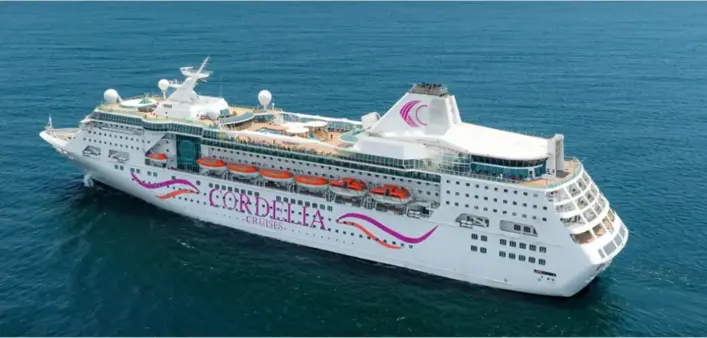
Waterways Leisure Tourism, the parent company of Cordelia Cruises which operates luxury domestic ocean cruises, will launch its ₹585 crore initial public offering (IPO) on Tuesday, June 23, 2026.
Incorporated in November 2020, the company operates cruise vessels across multiple domestic destinations like Mumbai, Goa, Kochi, Chennai, Lakshadweep, Visakhapatnam, and Puducherry. The company’s international routes comprise Sri Lanka, Thailand, Singapore, and Malaysia.
Waterways Leisure Tourism IPO will remain open for subscription till June 25. The IPO is a completely fresh issue of over 72 lakh shares
Here are key things to know about Waterways Leisure Tourism ahead of its IPO opening on June 23:
Waterways Leisure Tourism IPO details
Waterways Leisure Tourism IPO aims to raise ₹585 crore through its public issue. The issue is a complete fresh issue of over 72 lakh shares.
The company has fixed the price band of the issue at ₹769 to ₹808 per share. The lot size, or the minimum bid quantity to apply for the issue, is 18 shares. This equates to a minimum investment amount of ₹14,544 per lot at the upper end of the price band for retail investors.
Waterways Leisure Tourism has appointed Centrum Broking Ltd as the book-running lead managers of the IPO, while MUFG Intime India Pvt.Ltd is the registrar for the issue.
Waterways Leisure Tourism IPO: Important dates
Waterways Leisure Tourism IPO will remain open for bidding from June 23 to 25 June. After the bidding is closed, the allotment of shares is expected to be finalised on June 29.
Successful bidders can expect the shares to be credited to their demat accounts by June 30, with others receiving refunds on the same day. Waterways Leisure Tourism shares are scheduled to list on the BSE and NSE on July 1.
Waterways Leisure Tourism IPO objective
The money raised from the IPO will be used towards the following objectives:
-
Lease deposit & rental payments: The company will use ₹480.01 crore towards lease deposit and rental payments to the subsidiary Baycruise IFSC.
-
General corporate purposes: The company will use some amount of gross proceeds for general corporate purposes, which will not exceed 25% of gross proceeds.
Financial snapshot
| (₹ crore) | FY24 | FY25 | FY26 |
|---|---|---|---|
| Revenue | 444.1 | 590.6 | 579.7 |
| Total Assets | 399.2 | 247.3 | 341.7 |
| Net Profit | (122.7) | 168.1 | 52.1 |
| EBITDA | 111.1 | 215.4 | 117.4 |
About the company
Waterways Leisure Tourism is one of the prominent domestic ocean cruise operators in India. The company provides vacation cruises that emphasise Indian culture, hospitality, food, and entertainment. As of FY25, the firm has captured around 79% market share in value terms in India’s overnight ocean and coastal cruise segment.
The company’s major revenue comes from selling cruise tickets, which provided 91.22% of FY26 revenue, and additional sources of income came from passengers’ onboard spending, including speciality dining, excursions, Wi-Fi usage, spa, gambling, and entertainment costs. Pricing of the tickets was based on a dynamic pricing model.
The company established a robust sales strategy with direct access to customers through its website, mobile app, and call centre. Direct sales constituted 62.25% of all cabin sales during FY26, which helped the company minimise expenses related to travel agency fees and increase profitability. The company employs a group of 148 cruise holiday specialists for direct customer sales.
As of March 31, 2026, the company owned one cruise vessel known as MV Empress, which has hosted over 730,819 passengers and covered over 321,292 nautical miles from the date of its launch. The MV Empress accommodates a total of 2,005 guests and has a total of 796 rooms. This vessel is well equipped with various facilities for use by its clients. These include restaurants, bars, casinos, swimming pools, spas, and entertainment areas.
The firm adopts an asset-light and scalable business model through the outsourcing of essential operational functions like hospitality services, food and beverage management, housekeeping, technical management, crew management, logistics, procurement, and entertainment. Management can thus concentrate on acquiring customers, enhancing the customer experience and expanding the business. The company is also planning to grow its fleet capacity through the addition of two more cruise ships, namely Norwegian Sky and Norwegian Sun, with passenger carrying capacities of around 2,004 and 1,936, respectively. The company will use Norwegian Sky in FY27 and Norwegian Sun in FY28.
The overnight ocean and coastal cruises sector in India had a market size of about ₹830 crore in FY25 and is expected to rise to ₹1,820-2,250 crore by FY31, signifying a CAGR of 20-25%. The cruise penetration in India is very low at about 0.01% compared to that in developed countries, which signifies great potential for future growth.
Strengths and Opportunities
Unique position in an expanding, emerging market: Monopolistic dynamics of India’s one and only large-scale operator in domestic ocean cruises with expected market growth of 20 to 25% CAGR to reach ₹1,820-2,250 crore by FY31 due to highly complex regulations and capital intensity that act as entry barriers.
Curated India experience: Revenue per head showed a positive trend, going up from ₹10,524 in FY24 to ₹12,036 in FY26 on the strength of effective onboard monetisation and India-centric experience. The ticket price has also increased from ₹9,244 to ₹10,980 in the two years.
High share of direct cabin bookings: In excess of 62% of all cabins are booked via the website/app/call centre team of 148 operators, thus avoiding agent commission and ensuring better customer information through direct booking. Direct cabin numbers increased from 36,769 in FY24 to 47,895 in FY26 (+30% in two years).
Risks and Threats
Concentration of revenue: All the revenue generated is currently channelled via one ship named MV Empress, and any mechanical issues, accidents or even regulatory issues leading to the grounding of such a vessel can disrupt all activities without a second ship to absorb such shocks.
Concentration of cruise ticket revenue: The bulk of the revenue for the business is derived from cruise ticket purchases, amounting to 91.22%. Thus, the business will be extremely vulnerable to changes in economic conditions, pandemics or competitive threats from new entrants.
Hefty lease payments due to ship expansion: The business is fully committed to paying $16.1 million every year for the first two years following delivery of each vessel. This translates to annual lease payments of over $32 million after delivery of both vessels, considering the fact that the EBITDA earned by the business stood at only ₹117.48 crore in FY26.