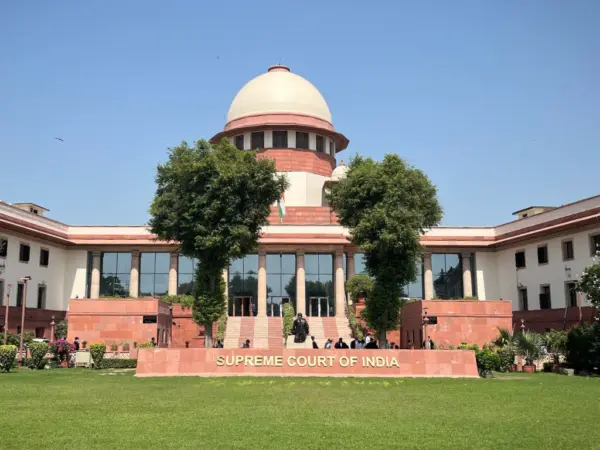
New Delhi: The Supreme Court on Thursday (June 18) refused to pass any interim order on a plea challenging the implementation of the three-language policy of the Central Board of Secondary Education (CBSE).
Tagging the petition filed by the NGO Friends of People for Active Democracy with similar petitions pending on the issue, a bench of Chief Justice of India (CJI) Surya Kant and Justice V. Mohana listed the matter for hearing on July 14 along with other pending petitions, reported Press Trust of India.
“We cannot pass a single-line order today. This matter was argued at length. There is no question of interim protection,” said the top court on Thursday.
During the hearing, the counsel representing the NGO made it clear that the petition didn’t challenge the three-language policy per se but its implementation.
In a lighter vein, CJI Kant also questioned the NGO’s name – Friends Of People For Active Democracy – and asked if such a nomenclature was meant to create fear in the mind of the court or the people.
In response, the counsel for the NGO answered in negative and said that it is the name of the trust which was set up in 2013″.
The counsel submitted that the CBSE was required to issue detailed guidelines by June 15.
The CBSE, in alignment with the National Education Policy (NEP) 2020, has a revised three-language framework to be implemented from the 2026-27 academic session. The policy mandates that students from class VI onwards study three languages, with at least two of them being Indian.
Earlier, Congress MP in Rajya Sabha Digvijaya Singh had urged the Union government not to implement the three-language policy for Class IX students of the CBSE in the ongoing session, saying that enforcing it without adequate teachers, textbooks or transition time would create “serious disruption”.
Singh, who heads the Parliamentary Standing Committee on Education, Women, Children, Youth and Sports, compared enforcement of the three-language policy with the chaos witnessed during the “hasty implementation of CBSE’s On-Screen Marking System (OSM)”.