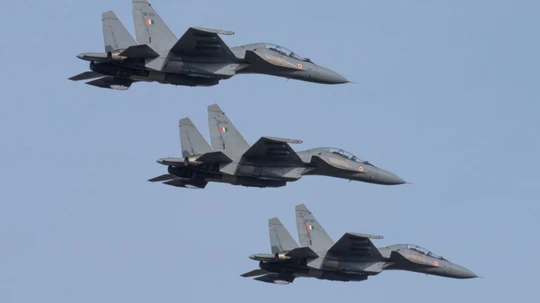
The Ministry of Defence has issued a Request for Proposal (RFP) to upgrade the Su-30MKI fighters fleet with a state-of-the-art anti-jamming, anti-spoofing multi-constellation GPS (Global Positioning System) antenna in a significant push toward self-reliance in defence electronics.
As per the RFP, an online bid from an indigenous firm/vendor is invited by the Directorate of Projects, SU-30 for and on behalf of the President of India for the supply of items listed in Part-II of this RFP from technically sound and financially capable Indigenous Original Equipment Manufacturers/ Suppliers. In case the bidder is not the OEM , the agreement certificate with OEM for sourcing the equipment/ spares shall be mandatory.”
The upgrade is aimed at enhancing the capability and reach of the existing Su-30MKI with a new multi-constellation Antenna. The IAF currently operates about 260 Su-30MKI fighter aircraft – the backbone of the Indian Air Force’s combat fleet. A significant portion of the fleet was assembled domestically by Hindustan Aeronautics Limited (HAL) under a licensed production agreement with Russia’s Sukhoi Design Bureau.
Jamming and spoofing are part of electronic warfare. Under jamming, the signal is stopped or overpowered from reaching the receiver, and spoofing is the process by which a wrong signal is fed to trick the receiver.
The GPS antenna upgrade is part of the wider “Super Sukhoi” modernisation programme, a multi-pronged overhaul of the IAF’s Su-30MKI fleet valued at approximately ₹65,000 crore that also includes a new indigenous AESA radar, electronic warfare suite, and self-protection jammer pods.
Significance of Upgrade
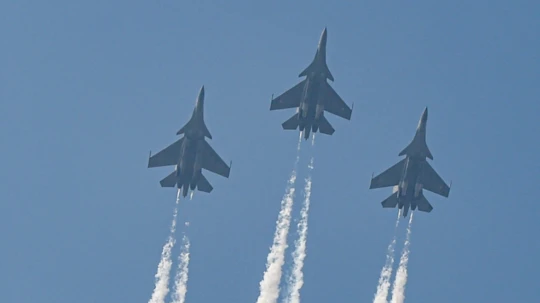
With the upgrade, the navigation resilience of the Su-30 MKI in contested electronic warfare environments will be significantly enhanced.
The antenna will be compatible to operate under multiple satellite navigation constellations simultaneously, including India’s own NaVIC system, GPS, GLONASS, BeiDou, Galileo, and the GAGAN satellite-based augmentation system.
NaVIC (Navigation with Indian Constellation), developed by ISRO, is India’s indigenous regional satellite navigation system. It provides precise position information services within India and up to 1,500 km outside its borders. Unlike foreign systems – particularly the American GPS, which could potentially be restricted or degraded during critical moments, NaVIC gives India complete sovereign control over its navigation services, guaranteeing uninterrupted access for defence applications.
GAGAN (GPS Aided GEO Augmented Navigation) is a complementary system. Jointly implemented by ISRO and the Airports Authority of India (AAI), it functions as a Satellite-Based Augmentation System for Indian airspace, providing the additional accuracy, availability, and integrity necessary for all phases of operation. It is interoperable with international augmentation systems, including the US WAAS and European EGNOS.
Thus, even if the enemy tries to jam or spoof the navigational signals, the pilots will get reliable positioning data. This will be possible as the new system will make it exceptionally difficult to jam.
The system, as per the RFP, is required to operate across the full flight envelope of the Su-30MKI, functioning at altitudes up to 21 kilometres, speeds up to Mach 1.5, and accelerations ranging from -2g to 9g.
As per the RFP, 300 antenna systems along with 50 field-level testers and 10 base-level testers are to be delivered. The entire project is to be completed within 24 months of contract signing.
The RFP bids must be submitted online by June 22, 2026, with the technical bid opening scheduled for the following day.
Among the other requirements of the contract are certification trials on two aircraft, full installation across the fleet, and structured training for IAF personnel at the 9 TETTRA School. The 9 TETTRA (Technical Training) School is an IAF establishment responsible for advanced technical and avionics training for air force personnel.
Push to Make in India
Only the Indian firms can participate in the procurement process of the MoD, thus aimed at reducing import dependency in defence. This aligns with the government’s broader Defence Acquisition Procedure framework, under which an increasing number of defence equipment categories are reserved exclusively for Indian manufacturers, a policy designed to grow the domestic defence industrial base and reduce the IAF’s historically heavy reliance on Russian-origin avionics and navigation systems.