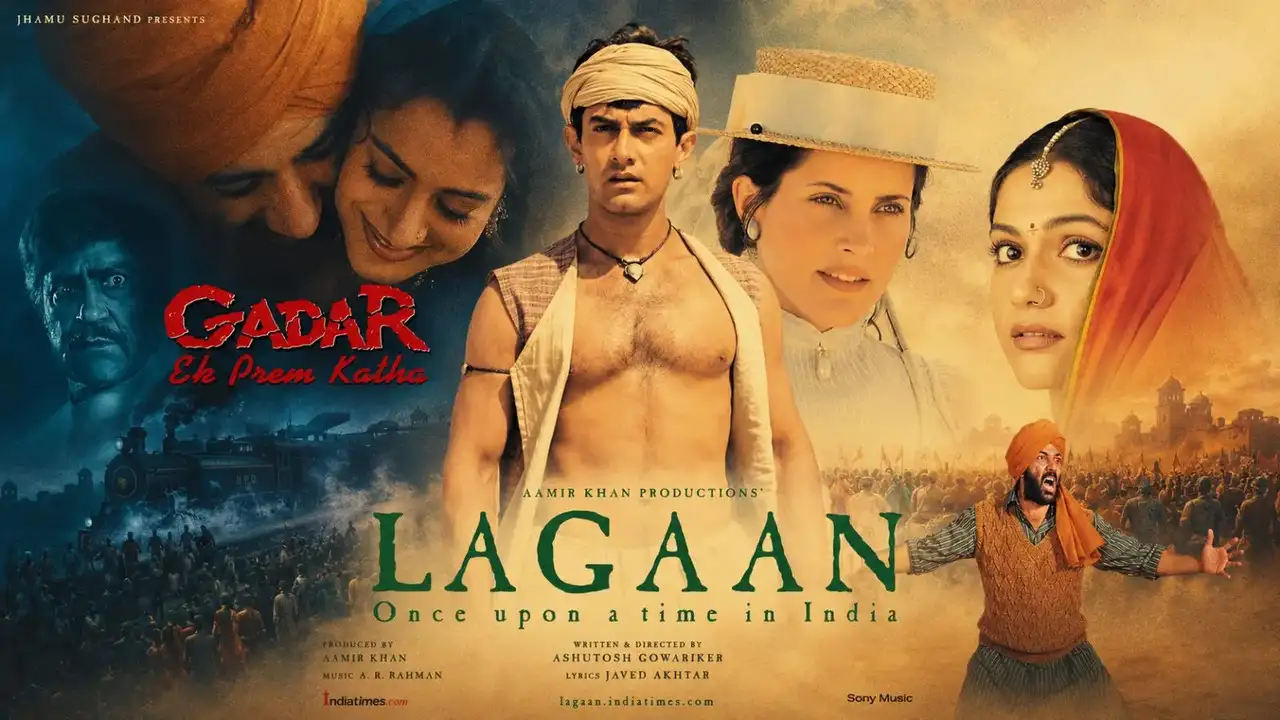
There are certain cinematic events that become immortal in film history. While for Hollywood, they maybe releases like the 1975 Jaws or the more recent Barbenheimer event, for Bollywood, June 15, 2001 remains one of the most significant release dates ever. On that day, two films arrived in theatres carrying vastly different ambitions, tones and narrative styles. While one was a sprawling period sports drama set in colonial India, the other was an emotionally charged action-romance rooted in the trauma of Partition. While conventionally usually when it is two tentpole films, one emerges victorious over the others, but contrary to the norm both films became historic blockbusters.
Now, 25 years later, the simultaneous release of and is still regarded as one of the most remarkable box-office clashes in Indian cinema history. The films reshaped Bollywood’s understanding of scale, storytelling and audience preferences.

Gadar Vs Lagaan: The Biggest Box Office Clash Of Its Era
The early 2000s were majorly a transitional period for Hindi cinema. The industry was still trying to find its footing following a difficult 1990s and very few films were managing to achieve universal success. Then on June 15, 2001, Ashutosh Gowariker’s Lagaan – produced by Amir Khan – released in theatres, narrating a classic underdog tale of a group of impoverished Indian villagers challenging British officers to a game of cricket to escape oppressive taxation (lagan). Also released was Anil Sharma’s Gadar: Ek Prem Katha, starring Sunny Deol and in lead roles. The film, set against the backdrop of Partition, told the story of a Sikh truck driver and a Muslim woman, whose love got tested by one of the darkest periods in Indian history. The two films could not have been any different from each other, but somehow, both managed to catch the pulse of the audience.
Why Was Aamir Khan’s Lagaan Considered A Huge Risk?
While today Aamir Khan’s sports drama Lagaan is regarded as a masterpiece, before release, many industry insiders considered it a risky proposition. The film had a run time exceeding three and a half hours, was a period drama, featured cricket as a central narrative device and lacked the conventional commercial formula that dominated Bollywood at the time. Adding to it, Aamir Khan himself reportedly invested heavily in the project, taking on the responsibility of producing it himself. And the gamble paid off spectacularly. Not only did the audience embrace the underdog story, emotional drama and thrilling cricket climax, critics too hailed it as one of the finest Hindi films ever made.

Gadar: A Cultural Phenomenon
While Lagaan earned widespread critical acclaim, Gadar became something even bigger – a mass cultural phenomenon. The film connected deeply with the grassroot audience in tier 2 and tier 3 cities across Northern India. Sunny Deol’s portrayal of Tara Singh resonated with moviegoers who responded to the film’s emotional patriotism and larger-than-life heroism. The songs, including Udja Kale Kawan and Main Nikla Gaddi Leke, became chartbusters. Gadar demonstrated the immense box-office power of single-screen audiences at a time when multiplex culture had not yet fully arrived.
Gadar Vs Lagaan: The Box Office Numbers
Lagaan reportedly earned around Rs 34-35 crore net in India during its original run. Adjusted for ticket inflation and modern admission rates, its performance would be significantly larger today. Gadar, meanwhile, emerged as the highest-grossing Hindi film of its time, earning approximately Rs 76 crore net domestically, more than double Lagaan’s collections. In terms of footfalls, it remains one of the most watched Hindi films ever made. Reports suggest that Gadar sold over 50 million tickets during its theatrical run.
Not Gadar Vs Lagaan
Conventional industry wisdom may suggest that major films releasing on the same day often eat into each other’s business, with so many makers delaying the projects when it seems to clash at the box office. However, June 15, 2001 proved otherwise. Both films catered to different audience segments, and they effectively expanded the overall theatrical market. Where the urban audience all went for screenings of Lagaan for its never-before-seen storytelling and critical acclaim, the masses embraced Gadar for its emotional intensity, patriotic themes and Sunny Deol’s star power.

On the other hand Sunny Deol and Gadar redefined the domestic mass entertainer, reinforcing the importance of emotional storytelling, larger-than-life heroes and strong cultural themes, with its impact still resonating in many contemporary action dramas. The film’s enduring popularity was evident when Gadar 2 released in 2023 and emerged as one of the biggest Hindi blockbusters of the decade.

Gadar, Lagaan And The Legacy Of June 15, 2001
Very rarely does a single day alter the trajectory of an entire film industry and June 15, 2001 did exactly that. Aamir Khan’s Lagaan proved that ambitious, unconventional storytelling could achieve both critical acclaim and commercial success and at the same time Sunny Deol’s Gadar proved that mass entertainment rooted in strong emotions could create unprecedented box-office records. And more than two decades later, the date remains a symbol of what Hindi cinema can achieve at its very best.