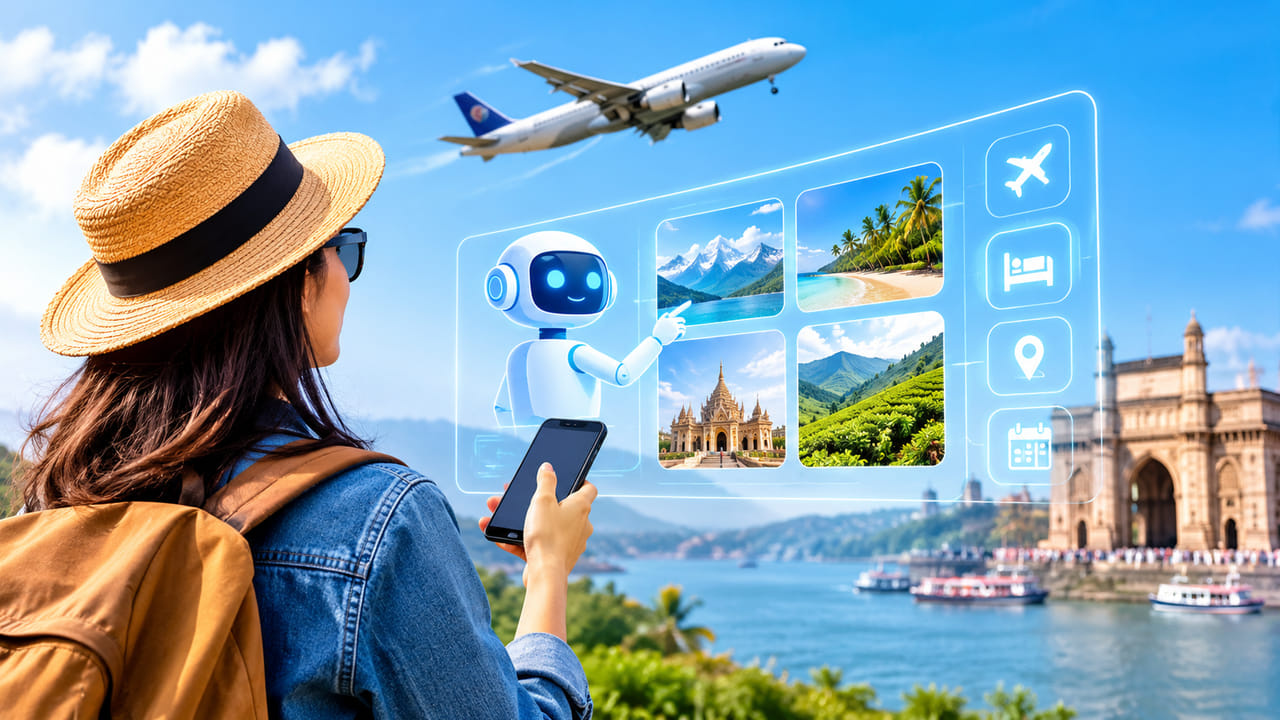
AI is transforming how Indians plan and experience travel, from personalised holiday recommendations and smarter bookings to disruption management. Here’s how technology is making journeys more seamless and connected.
Travel preferences have become immensely diverse. Some travelers favour wellness retreats and a few choose cultural experiences, whereas some like impromptu, adventurous or even offbeat trips. A family holiday in Kashmir, a spiritual journey to Varanasi, a wellness retreat in Kerala or an adventure in the Northeast reflects very different expectations. This requires the travel industry to go beyond conventional packages and understand the needs of the individual traveler. Artificial intelligence (AI) is emerging as an important enabler of this shift.
Recent Google Trends data shows that there has been a considerable increase in interest in the use of technology for travel planning due to the fact the search term “AI for travel” has surged by 600%. Furthermore, there is also a clear increase in the interest for wellness trips, solo travel and less popular travel destinations. While searching trends in Google do not guarantee bookings, they indicate that people’s interests are changing and that an increasing willingness to use digital tools to plan their trip.
In the past, digital advancement in the tourism sector focused largely on simplifying payments, price comparisons and hotel reservations. However, AI has the potential to make travel planning more intuitive and personalised. Travellers can communicate their requirements through conversational interfaces, reducing the need to browse multiple websites to find flights, hotels and experiences that match their budgets and interests. For example, a family may prioritise convenient transfers and suitable accommodation, while a solo traveller may seek destinations and experiences aligned with personal interests. The opportunity is to move from presenting multiple choices to understanding what matters most to each traveller. Nonetheless, the bigger picture encompasses more than planning and booking travels. A trip consists of several elements that complement one another and connect a range of services like air travel, airports, hotel accommodations, and ground transportation services. It becomes hard to manage the whole experience when they are operating in their own frameworks. The introduction of AI in combination with integrated technology platforms provides better coordination among various parties.
Imagine a passenger whose flight is delayed. Intelligent systems could analyse the situation, suggest alternative options and help coordinate onward travel arrangements. AI can also help airports manage passenger flows and allocate resources more efficiently, while hotels can anticipate customer preferences to deliver more personalized services. These examples demonstrate how AI can improve both operational efficiency and the overall travel experience.
Beyond individual journeys, AI also provides the industry with opportunities to understand demand and make better business decisions. Through booking behaviour analysis and other data-driven insights, travel companies can understand changing preferences and anticipate demand. Airlines can improve pricing and capacity planning, hotels can manage inventory more effectively, and travel service providers can offer more relevant recommendations. The shift is towards moving from reactive service delivery to anticipating traveller needs.
However, the successful adoption of AI depends on more than the underlying technology ecosystem. It requires a deep understanding of the business context, operational complexities and domain-specific requirements of the travel industry. Many companies continue to operate with legacy technologies, disconnected databases and systems that restrict data exchange. Without the right business context, even sophisticated AI solutions may deliver limited value. Combining domain knowledge with reliable data, interoperable platforms and integration with existing systems will therefore be essential to building relevant, scalable AI capabilities that deliver meaningful business outcomes.
Trust must remain equally important. Travel involves personal information, financial transactions and decisions that require accuracy. Companies must ensure that data is handled responsibly, recommendations are reliable and travellers retain control over important decisions. When disruptions occur or situations require empathy and judgement, human intervention remains essential. AI should augment travel professionals, enabling them to respond to customer needs more effectively, rather than replace the human element of service.
India’s growing digital adoption, diverse traveller base and increasing appetite for both domestic and international experiences provide significant opportunities for the industry. The next phase of travel will not be defined simply by faster bookings or greater use of AI technologies, but by how intelligently the industry connects services, anticipates needs and creates seamless, personalised journeys. Ultimately, the real value of AI in travel will not be measured by the number of technologies deployed, but by its ability to remove complexity while preserving the joy of discovery. Travellers may remember the destinations they visit, but what stays with them is how the journey made them feel.
-This article is authored by V K Mathews, Founder and Executive Chairman, IBS Group