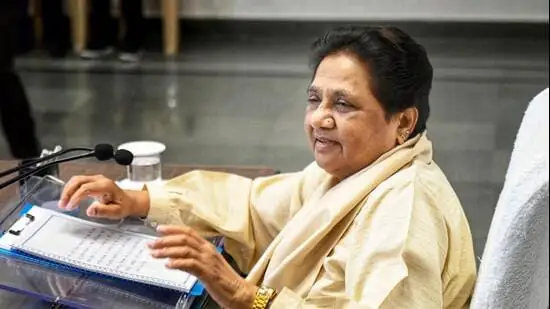
Bahujan Samaj Party (BSP) chief Mayawati on Saturday welcomed the Centre’s renewed push for 33% reservation for women in the Lok Sabha and state legislative assemblies but demanded a separate sub-quota for women belonging to Scheduled Castes (SC) and Scheduled Tribes (ST), saying it would ensure more meaningful and equitable representation.
Ahead of the special session of Parliament beginning November 30, the former Uttar Pradesh chief minister also questioned the political intentions behind the proposed 50% expansion of the Lok Sabha and state assemblies and the accompanying delimitation exercise. She alleged that governments in power often use electoral arrangements to advance their political interests rather than public welfare.
In a series of posts on X, Mayawati said the BSP consistently supported women’s reservation and demanded its early implementation. However, she argued that women from historically oppressed and marginalised communities needed a separate arrangement within the proposed quota.
“Had a separate reservation been provided to women from SC and ST communities, it would have been a historic step,” she said, urging the Centre to consider the demand sympathetically.
The Union Cabinet cleared a legislative package to operationalise women’s reservation through delimitation, proposing a 50% increase in the number of Lok Sabha and assembly seats in every state. The package includes the Constitution (132nd Amendment) Bill, 2026, the Delimitation (Second) Bill, 2026 and legislation relating to Union Territories.
The proposals seek to facilitate 33% reservation for women ahead of the 2029 Lok Sabha elections. The delimitation exercise is proposed to use the 2011 Census for redrawing constituency boundaries while retaining the existing inter-state representation ratio based on the 1971 Census until 2051.
Questioning the proposed exercise, Mayawati alleged that the party in power at the Centre could influence seat allocation and constituency boundaries to suit its electoral interests.
Her remarks assume political significance ahead of the 2027 Uttar Pradesh assembly elections, particularly as the proposed expansion of legislative seats and reservation arrangements could reshape political representation and candidate selection.
Mayawati also appealed to voters to rise above religious, caste and regional considerations while choosing their representatives. She urged them not to be swayed by political parties’ promises and announcements, but to elect candidates with integrity and commitment to public welfare.
Invoking BR Ambedkar’s legacy, she said the BSP remained committed to the Constitution’s principles of equality, dignity and social justice.
The proposed constitutional framework provides for women from SC and ST communities to be covered under the one-third reservation, with their reserved seats rotated within existing SC/ST constituencies. Mayawati, however, is seeking a more explicit separate arrangement for women from these communities.
The Centre’s proposals are yet to receive parliamentary approval, with the special session expected to discuss the constitutional amendments and the proposed delimitation framework.