Adefining moment in Christchurch’s history was the earthquake that devastated it in 2011 — 185 people died in the calamity. Lancaster Park, the metropolis’ main cricketing centre, was so badly disfigured that international matches had to be moved to the more ancient, but less utilised Hagley Oval; a venue which has notably desisted from erecting concrete structures, which were Lancaster Park’s undoing.
At the new venue, where India have played only once before, no soil tremors were felt on another gloriously sunny, though chilly Saturday — the second day of the second Test between India and New Zealand. At the start of play, both sides had an outside chance of qualifying for the World Test Championship (WTC) final at The Oval in London in June.
However, there were perceptible plate movements in the Indian camp as wickets tumbled and they were left reeling at 116/6, 240 runs adrift in the first innings, with six of their frontline batters back in the pavilion. Among them, Rishabh Pant, who was initially circumspect, then smashed Jacob Duffy for six to long-on, irresponsibly skied the same bowler.
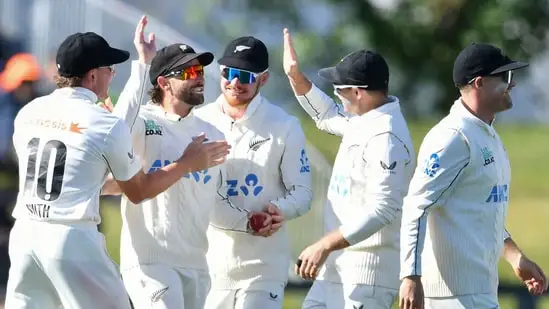
India captain Shubman Gill’s move to invite the opposition to bat on a grassy pitch backfired for the second time in the series. New Zealand battled their way through the adversity of a wicket assisting pace, helped by un-penetrative Indian bowling and shoddy catching.
The spearhead of the Indian bowling, the redoubtable Jasprit Bumrah, uncommonly finished empty-handed. Only twice before has he ended wicketless in a completed innings – in the WTC final against New Zealand in Southampton and versus England at Lord’s, both in 2021, or more than five years ago when he was still chiselling his skill.
In this instance, he was characteristically parsimonious, with an economy rate of 1.88. But he flagged in velocity, more often than not generating speeds below 135 kph, and failed to conjure the unplayable balls he often produces.
The New Zealand innings continued to revolve around batter-wicketkeeper Tom Blundell. Batting allrounder Glenn Phillips, who resumed with him, pushed at a delivery outside off-stump to be caught behind. India were, therefore, into the Kiwi tail after only one run had been added to the overnight score. But the lower order not just resisted, but did so quite stroke-fully, boosting the team total to 356. Blundell, however, perished 11 short of three figures, capably caught by Akash Deep at deep fine leg off Gurnoor Brar.
Akash Deep did not receive the same support when Devdutt Padikkal dropped Matt Henry twice at gully — the first time when the batter was on nought — and Brar spilled a sitter at deep mid-on — Kyle Jamieson the beneficiary. Nonetheless, the Bengal pacer returned figures of 5/99 – another five-fer after his match-winning 6/99 in Birmingham last year – and was unequivocally the most impressive of the Indian bowlers. Sairaj Bahutule, the Indian bowling coach, described the wicket as ‘ideal for Test match cricket’.
Into his 13th Test as skipper, Gill is still not demonstrating innovation. His stewardship reflects a preconceived outlook, waiting for batters to make mistakes, rather than being proactive. He is also prone to retreat into petrified defence.
At one point, he had no slips for Brar, who, incidentally – Kapil Dev would be horrified to know – bowled 11 no balls. With qualifying for the WTC final on the line, should the Indian tour selectors have experimented?
Mohammed Siraj has 144 wickets in 48 tests, averaging 29.63 (Kapil Dev completed his career with an average of 29.64), with game-changing displays in Brisbane, Lord’s, Cape Town, Birmingham, and most recently, at The Oval. Prasidh Krishna possesses 35 scalps in 10 tests, capped by match figures of 8/188 at The Oval last year in conditions not dissimilar to New Zealand’s. It was a no-brainer as to who should and should not have featured in the Indian bowling line-up in this vital fixture.
That the Indian bowlers didn’t exploit the pitch that efficiently became evident when New Zealand operated with the ball. The Kiwi bowlers pitched it up more. Opener Yashasvi Jaiswal was fed five deliveries outside off-stump by Matt Henry, which he left alone, following which he was surprised by an incoming ball, which straightened to knock back his stumps.
Padikkal looked fluid – even pulled Kyle Jamieson for a six over long leg – but made the mistake of driving on the up at a ball that was leaving him. He was caught at the wicket. Gill, too, appeared to be in fine form, driving the ball handsomely, but was squared up by an awkward Jamieson delivery.
It was precariously 59/3 with KL Rahul left standing on a burning deck. He showed due patience, consuming 80 balls for his 25. But he failed to keep down a drive to a half-volley to be caught at point. After the hammering heaped on him in the previous Test, Duffy had made amends with two valuable victims.
Seating at Hagley Oval for the general public is on grassy banks, accommodating about 12,000. There is not even a proper media box, with journalists condemned to a temporary tent, exposed to cold winds. But as pop music, sometimes with a bhangra beat, embellished the entertainment in between overs, the hosts, not the tourists, derived inspiration from it.