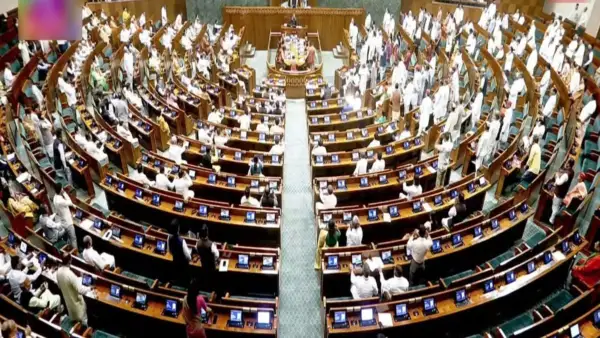
Delimitation Bill: Ahead of the special parliamentary session, the central government has moved to withdraw the Delimitation Bill, 2026, introduced in the Lok Sabha in April and replace it with the Delimitation (Second) Bill, 2026. The revised legislation proposes a uniform 50 per cent increase in Lok Sabha seats, alongside a 50 per cent rise in state legislative assembly seats, to roll out the 33 per cent reservation for women in Parliament and state and Union Territory assemblies.
The reasons for withdrawing the earlier legislation were outlined in a statement signed by Minister of State for Law and Justice (Independent Charge) Arjun Ram Meghwal on November 27.
Delimitation (Second) Bill, 2026
Titled the Delimitation (Second) Bill, 2026, the replacement draft overhauls key parts of the original proposal. The changes centre on how the Delimitation Commission is constituted, which Census figures are used, how seats reserved for women are allotted, and how legislative seat counts expand.
The earlier Delimitation Bill was introduced in the Lok Sabha on April 16, 2026, alongside the Constitution (One Hundred and Thirty-first Amendment) Bill, 2026, and the Union Territories Laws (Amendment) Bill, 2026. Together, those bills were brought in to set up a Delimitation Commission to readjust seat allocations in the Lok Sabha and state and Union Territory assemblies and redraw constituency boundaries.
However, the Constitution Amendment Bill failed to secure the special majority required under Article 368 when brought up on April 17. As a result, the connected bills were not taken up further, leaving the original Delimitation Bill pending in the Lok Sabha.
50% Uniform Seat Increase, 2011 Census
Under the proposed framework, every state and Union Territory sees a uniform 50 per cent increase in its Lok Sabha seat count and state assembly strength over existing numbers during the first delimitation exercise. The draft also raises the maximum Lok Sabha strength to 850 (up to 815 from states and 35 from Union Territories) and caps state assemblies at 650 seats, while keeping the relative share of seats among states intact.
To allow delimitation to proceed without waiting for fresh Census figures to be published, the draft defines the basis as the latest published Census data when the law comes into force, meaning the 2011 Census applies if newer figures are not out yet.
The Centre is also required to constitute the Delimitation Commission as soon as possible after the legislation takes effect, rather than “from time to time” as proposed earlier.
Women’s Quota And Seat Rotation Rules
The revised bill links delimitation directly to implementing 33 per cent reservation for women in the Lok Sabha and state and Union Territory legislative assemblies. Seats reserved for women will be allotted through rotation, with the authority and manner of rotation decided by Parliament and the Delimitation Commission.
According to news agency PTI, the women’s reservation runs for 15 years from when the 2023 amendment takes effect, subject to extension by Parliament, while seat readjustments are frozen until 2051.
Because the revised draft substantially alters the April bill, the Centre has moved to withdraw the earlier version under clause (b) of Rule 110 of the Lok Sabha’s Rules of Procedure and Conduct of Business.