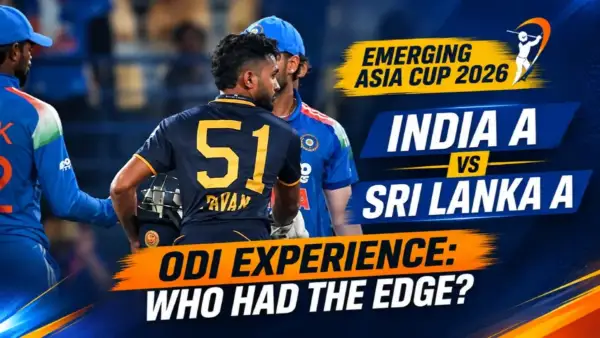
India A’s eight-wicket defeat to Sri Lanka A in the semi-final of the Emerging Asia Cup 2026 raised questions about the team’s performance despite its impressive collection of IPL and India international names.
The semi-final defeat followed a challenging group-stage outing against Pakistan A, whose strong bowling attack restricted the Tilak Varma-led side and handed them a 48-run defeat. India A were bowled out for 265 while chasing Pakistan A’s 313, struggling to respond when put under pressure.
The boys in blue bounced back against the UAE, producing a record-breaking performance led by Vaibhav Sooryavanshi. But the semi-final against Sri Lanka A exposed a different challenge. Despite posting 317, India A were thumped by eight wickets, with Sri Lanka A chasing down the target in just 41.3 overs.
The two defeats against stronger opposition raised questions about whether India A’s T20 star power was translating into the demands of 50-over cricket.
A comparison of the two teams through format-specific experience offers a more balanced perspective. India A had greater T20 star power and IPL visibility. Sri Lanka A, meanwhile, brought a more seasoned core of players with senior international and domestic 50-over experience, alongside familiarity with franchise competitions such as the Lanka Premier League.
India A had the bigger T20 profile
India A’s line-up featured several familiar names from international cricket and the Indian Premier League. Abhishek Sharma, Tilak Varma and Rinku Singh have established themselves in T20 cricket, while the presence of several IPL regulars gave the side considerable visibility and attacking potential. Even teen batting sensation Vaibhav Sooryavanshi has been making waves with his explosive performances.
The team’s reputation was built largely on this format-specific strength. Abhishek and Vaibhav’s explosive batting, Tilak’s versatility and Rinku’s finishing ability made India A look formidable on paper.
But T20 experience does not automatically translate into the same level of familiarity with 50-over cricket. The longer format requires batters to manage different phases of an innings, assess when to consolidate and when to accelerate, and build partnerships that can survive beyond a few overs.
India A’s star power was real. The question was whether that experience was equally deep in the format being played.
India A vs Sri Lanka A: Experience Comparison
The playing XI comparison highlights the difference in the two teams’ international experience and format-specific strengths.
| Experience Category | India A | Sri Lanka A |
|---|---|---|
| Players with senior international experience | 5 | 7 |
| Players with ODI experience | 3 | 4 |
| Players with Test experience | 1 | 2 |
| T20I experience | Stronger profile, led by Abhishek Sharma, Tilak Varma and Rinku Singh | Comparatively limited |
| IPL experience | Several established IPL players and regulars | More limited IPL exposure |
| Franchise T20 experience | Strong IPL exposure | Experience in the Lanka Premier League (LPL) and other franchise T20 competitions |
| Domestic 50-over experience | Relatively young, T20-oriented core | More seasoned domestic List A core |
| Format-specific strength | T20 cricket and IPL experience | 50-over cricket, domestic List A experience and LPL familiarity |
| Bowling and fielding | Sloppy fielding and inconsistent bowling; failed to create sustained pressure | More composed execution during the chase; capitalised on India A’s mistakes |
The comparison showed Sri Lanka A with a broader spread of senior international experience. Seven players in their XI had represented Sri Lanka at senior level, compared with five in India A’s line-up. Sri Lanka A also had more players with ODI and Test experience.
Their core included established domestic 50-over performers such as Lasith Croospulle, Nishan Madushka, Janith Liyanage and Nipun Dhananjaya.
India A, by contrast, had a younger and more top-heavy List A profile. While the side included experienced domestic players such as Shahbaz Ahmed and Tanush Kotian, several of its most prominent names were better known for their T20 exploits.
India A had the advantage of greater IPL exposure, with several players accustomed to the demands and visibility of India’s premier franchise competition. Sri Lanka A, however, were not short of franchise T20 experience. Many of their players have featured in the Lanka Premier League, their homegrown franchise competition, and have developed experience in high-pressure T20 environments.
The distinction, therefore, was not simply IPL experience versus inexperience. It was a contrast between India A’s stronger IPL profile and Sri Lanka A’s familiarity with the LPL, alongside a more seasoned core in domestic 50-over cricket.
The chase showed Sri Lanka A’s understanding of the format
India A posted 317 for eight in their 50 overs, a total that appeared competitive. Abhishek Sharma scored 78 off 63 balls, Tilak Varma made 53, and Shahbaz Ahmed finished unbeaten on 54 off 48 deliveries.
Sri Lanka A’s response was emphatic. Lasith Croospulle scored 116 off 107 balls, while Sineth Jayawardena made 105 off 70. Their opening partnership of 174 put the chase firmly on course, and Sri Lanka A reached 318 for two in just 41.3 overs, winning by eight wickets with 51 balls remaining.
The innings was not simply an example of aggressive batting. Jayawardena attacked at a high tempo, while Croospulle provided a more measured presence at the other end. Together, they kept the required rate under control and prevented India A from building sustained pressure. At drinks break in Doha, Sri Lankans were 130 without a loss, laying a solid foundation for the big run chase.
After Jayawardena’s dismissal, Croospulle continued with Nishan Madushka, who remained unbeaten on 58. Sri Lanka A completed the chase without losing control of the game.
That combination of calculated aggression, partnership-building and awareness of the target is central to successful 50-over cricket.
Sloppy bowling and fielding cost India A
India A’s defeat was not just about the difference in format-specific experience. Their sloppy fielding and inconsistent bowling made it difficult to create the pressure required to defend 317.
Missed chances and expensive spells allowed Sri Lanka A’s openers to settle, build a massive partnership and dictate the chase. Harshit Rana conceded 61 runs in seven overs, while Arshad Khan gave away 46 in four overs. India A were unable to break the opening partnership before it had taken the game away from them.
Once Croospulle and Jayawardena found their rhythm, India A had few answers. The bowlers struggled to control the scoring rate, and the fielding lapses gave the Sri Lankan batters further opportunities to maintain their momentum.
Sri Lanka A, by contrast, were composed and clinical. They capitalised on India A’s mistakes and executed their chase with the kind of control that is often required in 50-over cricket.
Experience was a factor – not the only explanation
It would be simplistic to attribute the defeat entirely to an experience gap. India A had enough batting quality to post a strong total, and their T20 credentials were not in question.
The group-stage defeat to Pakistan A had already shown how a disciplined bowling attack could expose the side when it failed to adapt. Against Sri Lanka A, the challenge was different: India A had runs on the board, but their bowling and fielding could not defend them.
Sri Lanka A were better on the day because they executed their plans with greater consistency. Their more seasoned 50-over core may have helped them manage the chase, but the result was ultimately secured through skill, decision-making and performance under pressure.