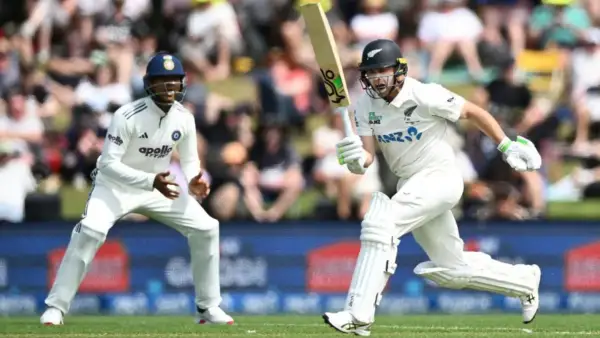
India had a day of two halves in the second Test against New Zealand at Hagley Oval, Christchurch. The visitors fought back impressively in the afternoon session to reduce the hosts to 110/4, but failed to sustain the pressure as New Zealand recovered to 246/5 at stumps on Day 1.
While Akash Deep and the Indian bowlers showed what they could achieve with discipline, missed chances and an inability to finish off the middle-order recovery left India with plenty to think about heading into the second day.
What Worked in India’s Favour
Akash Deep’s spell turned the game around. India’s strongest phase came in the second session, when Akash Deep struck twice to remove Tom Latham and Rachin Ravindra. Anshul Kamboj also dismissed Henry Nicholls as New Zealand lost three wickets in quick succession.
The hosts went from 110/1 to 110/4, and India suddenly had the upper hand. Akash was particularly effective in making the batters play and exploiting the movement available on the surface.
His two wickets were a reminder of the impact India can make when the bowlers maintain pressure from both ends.
Bowling in partnerships brought rewards
India’s afternoon effort was not built around one individual spell alone. The bowlers kept probing, attacked the stumps and made scoring difficult.
New Zealand managed only 54 runs in 24 overs during the session, with the pressure eventually leading to wickets. Gurnoor Brar had already provided the breakthrough before lunch by dismissing Devon Conway, ending the opening partnership.
The middle session showed that India had the discipline and bowling resources to put New Zealand under serious pressure.
New Zealand’s scoring rate remained under control
Despite the late recovery, India did not allow the hosts to score freely for most of the day. New Zealand finished on 246/5 after 85 overs, with the scoring rate remaining below three runs per over.
India also managed to take five wickets on the opening day, leaving themselves in a position to make further inroads when play resumes.
What Didn’t Work in India’s Favour
India failed to make the most of the new ball. India elected to bowl on a green Hagley Oval surface, but the early advantage did not translate into wickets.
The Indian pacers struggled with their lines and lengths, allowing Tom Latham and Devon Conway to settle. The openers left well, rotated the strike and punished loose deliveries, building a 77-run partnership..
With conditions offering movement early on, India would have expected a more threatening start.
KL Rahul’s dropped catch proved costly
Latham survived a significant opportunity when KL Rahul dropped a catch with the New Zealand captain on 29.
Latham went on to score 59, giving the hosts a solid foundation. The missed chance was particularly frustrating because India were searching for a breakthrough and had already seen Latham survive an early scare.
In a Test match where chances can be limited, the reprieve allowed New Zealand to build momentum.
India couldn’t finish the job after reducing New Zealand to 110/4. This was arguably India’s biggest disappointment of the day.
After the quick wickets in the afternoon, India had New Zealand in trouble. But Daryl Mitchell and Tom Blundell responded with a resilient 74-run partnership for the fifth wicket.
Mitchell scored 31 before Washington Sundar removed him with a delivery that spun and bounced. India had another opportunity to push New Zealand towards a collapse, but Blundell found support from Glenn Phillips.
The hosts managed to rebuild twice in the innings, and India were unable to prevent the second recovery.
Blundell and Phillips made India pay
Blundell was dropped on 49 and went on to complete a half-century in his 50th Test. He remained unbeaten on 53 at stumps.
Phillips, meanwhile, looked composed and kept the innings moving with proactive running between the wickets. He finished unbeaten on 36, with the pair adding an unbroken 62-run stand for the sixth wicket.
Their partnership ensured New Zealand finished the day with momentum, despite being reduced to 110/4 earlier.
Bumrah went wicketless
Jasprit Bumrah bowled probing spells but finished the day without a wicket. His discipline helped keep the scoring in check, but India will be hoping their premier fast bowler can make an early impact on the second morning.
With Blundell and Phillips set, India cannot afford another prolonged partnership if they want to keep New Zealand’s first-innings total within reach.
India’s Day 1 Assessment
India’s performance was encouraging in patches, particularly during the afternoon session. The bowlers showed that they could exploit the conditions and put New Zealand under pressure.
However, the visitors missed opportunities at crucial moments. The dropped catches, early lack of discipline and inability to break the Blundell-Phillips partnership prevented India from turning a promising position into a dominant one.
At 246/5, New Zealand are not out of reach, but India will need to strike early on Day 2. The first session could determine whether the visitors regain control or allow the hosts to build a substantial first-innings lead.