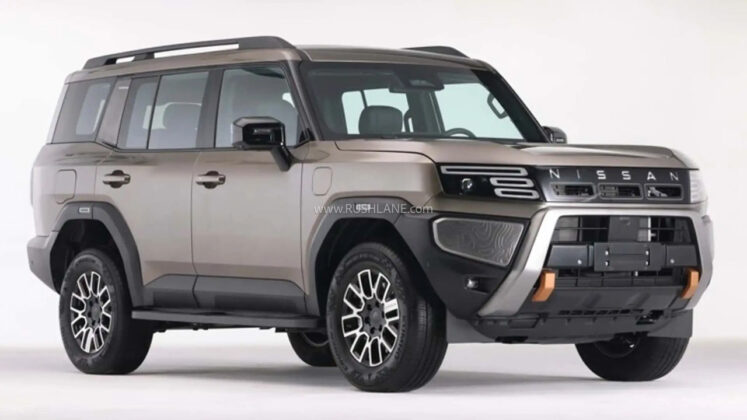
While the Terrano concept was unveiled as a PHEV, new details reveal that conventional petrol and diesel engine options will also be available
Nissan had showcased the Terrano concept earlier this year in April at the Beijing Auto Show. The ladder-frame SUV will be manufactured in China by Zhengzhou Nissan joint venture. In addition to China, will also be available in markets like Latin America, ASEAN and the Middle East. Launch in India is also possible, as part of Nissan’s broader India revival strategy. In the latest development, new details about the Terrano SUV have emerged from regulatory filings in China.
Nissan Terrano – Dimensions, features
As per information published on China’s Ministry of Industry and Information Technology (MIIT) website, Nissan Terrano is 5,098 mm long and has a wheelbase of 2,850 mm. This makes the Terrano larger than the Fortuner, which is 4,795 mm long and has a wheelbase of 2,745 mm. The larger dimensions will unlock a more commanding presence and also ensure roomier interiors.

At this length, Terrano is also longer than Toyota Land Cruiser 250 by around 110 mm. However, Terrano is around 227 mm shorter than Nissan’s global flagship SUV Patrol/Armada. Nissan Terrano uses a ladder-frame architecture, based on the Nissan Frontier Pro pickup sold in China. The SUV has strong off-road capabilities with a 36-degree approach angle and a 31-degree departure angle.
For all variants of Nissan Terrano, the towing capacity is rated at 2,500 kg. The SUV has various options for users such as a tow hitch, side steps, a sunroof, distinctive bumper and wheel designs and a rear spoiler. Interior features are yet to be revealed, although some of the equipment could be borrowed from the Frontier Pro. Possibilities include a 10-inch digital instrument cluster and a 14.6-inch touchscreen infotainment system.
” alt=”” aria-hidden=”true” />
Nissan Terrano powertrains
Along with the PHEV, Nissan Terrano will also have pure petrol and diesel engine options. The petrol version will get power from a 2.0-litre turbocharged engine, generating 258 PS. Diesel variants will be powered by a 2.3-litre four-cylinder turbocharged engine, generating 190 PS. Both petrol and diesel models have a top speed of 170 km/h.
Plug-in hybrid Terrano combines a 207 PS 2.0-litre turbocharged engine with a single electric motor. The latter generates 78 PS. Combined peak output is 272 PS. Terrano PHEV uses a lithium iron phosphate (LFP) battery, although the battery capacity has not been revealed. Top speed of Terrano PHEV is rated at 180 km/h, which is slightly higher than the petrol and diesel variants.

Exterior highlights
Images published by MIIT reveal a boxy silhouette with most of the features largely the same as seen with the concept. However, some of the fancy stuff shown with the concept has been removed from the production version. Nissan Terrano has distinctive lighting elements, NISSAN lettering, an upright fascia and rugged bumper design.
Side profile has squared wheel arches, a flat roofline and beltline, rectangular ORVMs, body coloured conventional door handles, side steps, large alloy wheels, roof rails and door moulding. At the rear, the SUV has vertically stacked tail lamps, a spare wheel and a chunky bumper. The PHEV version gets a black-finished tailgate, as compared to the body-coloured format used with the combustion models. Terrano PHEV also has a more prominent support bracket for the rear spare wheel.

Terrano India launch
While Terrano’s India launch is not officially announced, it is reported that the company is actively working on that project. India could get the PHEV version, considering the tightening CAFE emission norms in India. A ladder-frame PHEV will also ensure a differentiated alternative to the diesel-powered . Nissan Terrano could be introduced in India in 2027 or 2028.