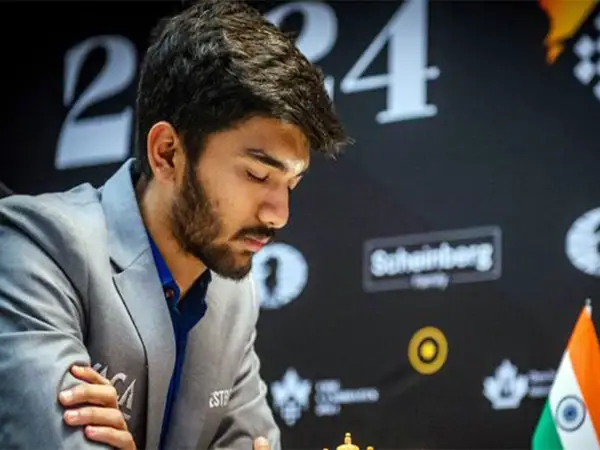
Game 3 of the World Chess Championship 2026 between defending champion D Gukesh and challenger Javokhir Sindarov ended in a draw on November 27, with Gukesh applying pressure in another Berlin Defence encounter.
Gukesh surprised observers with his opening preparation, opting for the seldom-used 5…Be7 Rio de Janeiro variation instead of the more popular 5…Nd6 line. After 6. Qe2 Nd6 7. Bxc6 bxc6, he responded to dxe5 with 8…Nf5, steering the game into the rarely seen Cordel variation rather than continuing the Rio route with Nb7.
The Cordel variation saw significant use in the 1980s and 1990s, with notable recent games including the 2013 encounter between Dominguez Perez and Vasyl Ivanchuk, and the 2019 match between Hovhannisyan and Haik Martirosyan. Former World Champion Boris Spassky was also known for employing this line, with both his 1988 games featuring it ending in draws.
Following the game, Gukesh acknowledged his awareness of Spassky’s 1988 use of the same opening. When asked about his preparation, the Indian grandmaster responded humourously, “Yeah, I can reveal that Spassky is not one of my seconds. (laughs) But yeah, I was aware of the game,” according to Chessbase India.
Gukesh explained his attempts to create winning chances after playing 21…Kd7, exploring rook manoeuvres and possible exchange sacrifices such as …Rb8, …Rb5, and sacrifices on c5. However, none of these ideas came to fruition. He highlighted Sindarov’s 29. f4 as a key moment that made the game especially interesting. “I think I played 21…Kd7, hoping for something. But I knew it shouldn’t really be anything more than just fine for Black. I was trying to make some ideas, like …Rb8, …Rb5 and some exchange sacrifice on c5, but I never really managed to make it happen. Obviously, here I was hoping for …e6; I was just looking at different kinds of exchange sacrifices, but none of it really worked. I think the game got super interesting once he played 29. f4,” he said.
Sindarov praised Gukesh for his strong opening preparation, admitting that his own team had not analysed the 5…Be7 line in depth. Although he initially believed he had a favourable position, he recognised the endgame was completely balanced. He also admitted edging close to a mistake under time pressure but was pleased with his defensive efforts to secure the draw. “Today my opponent was really well prepared. We checked this move 5…Be7, but not that deep. I was surprised. I thought I got a very good position, but my opponent was really well prepared. I was just trying to find some chances because I was playing as White. In the endgame, I started to understand that the position was completely equal, and in the time trouble I was really very close to missing something. But I’m happy that I defended very well,” Sindarov said.
The game concluded in a draw after 60 moves, following the exchange of the remaining rooks and an opposite-coloured bishop endgame. The match score remains level at 1.5-1.5 after three games. Gukesh will have the advantage of the white pieces in Game 4, scheduled for Saturday, as the players prepare for a rest day.