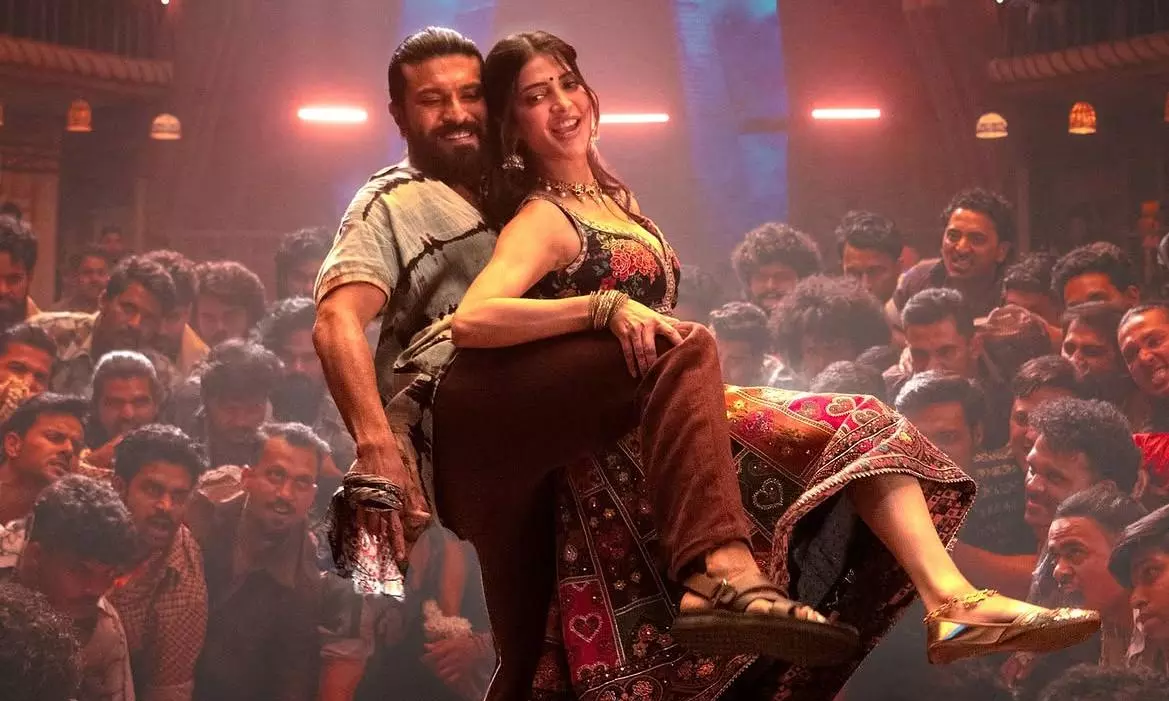
The debate sparked by Shruti Haasan defending her dance number Hellallallo in Peddi, amid the backlash over Janhvi Kapoor’s character, highlights the tension between individual agency and industry pressure.
Choosing to wear a revealing outfit or perform a sensual dance for the camera is a professional decision made within a controlled workplace. It does not mean an actress forfeits her right to privacy, either on or off camera! As Shruti Haasan pointed out, an actress may choose her costume, but intrusive camera angles are in the hands of the director. Audiences often judge the performer for the way a scene is framed, even when the visual gaze is determined in the editing room.
Visibility comes at a price
Visibility drives market value. In mainstream commercial cinema, high-glamour roles often serve as important marketing tools. They keep actresses trending on social media! There is also the question of shelf life. Many actresses feel compelled to accept glamorous parts simply to remain visible in big-budget projects.
Conversely, accepting too many such assignments can trap her in a glamour-only bracket, making it harder to find performance-driven scripts later!
Privilege of saying no
Established stars and actors with an industry lineage have the financial cushion to walk away from projects. Newcomers rarely enjoy that luxury.
As actress Nithya Menen noted in the same discourse, saying no is always possible, but it comes with a direct trade-off. Even when an actress agrees to a role on paper, pushing back against last-minute costume changes on a multi-crore film set can invite considerable professional friction!
Priyanka Chopra Jonas recalled an incident from the early years of her career, around 2002, when a film director told her he needed to see her underwear during a scene. She described it as a dehumanising moment. After shooting for two days, she realised she could not face the director every day and decided to walk out of the film. Her father, Ashok Chopra, supported her decision and advised her to repay the production house, from her own pocket, for the two days of filming.
Women as ‘bits of anatomy’
Veteran actress Mita Vashisht, known for her fearless choices, including nude scenes early in her career, believes that the freedom to say no to vulgarity is ultimately an individual decision. But she also points to a larger, deeply entrenched problem in the way women are presented on screen. “If filmmakers present a heroine as bits of anatomy and this is a phrase I used back in the 1990s to describe the way Hindi film heroines were shot, particularly in 90s, then nothing has really changed. The camera would focus on the bosom, waist, hips. Often, when you are on a set, especially when you are playing opposite a huge superstar, it is not always possible to know what is really going on. Filmmakers decide how they want to show something. It is unfair to blame any heroine for the way this industry functions!
The patriarchy has always been very clear and it continues to exist. Even in some Hema Malini films, although she never showed bare skin, she wore skin-coloured stockings. If you look at Hindi films of 90s, the treatment was equally ridiculous.”