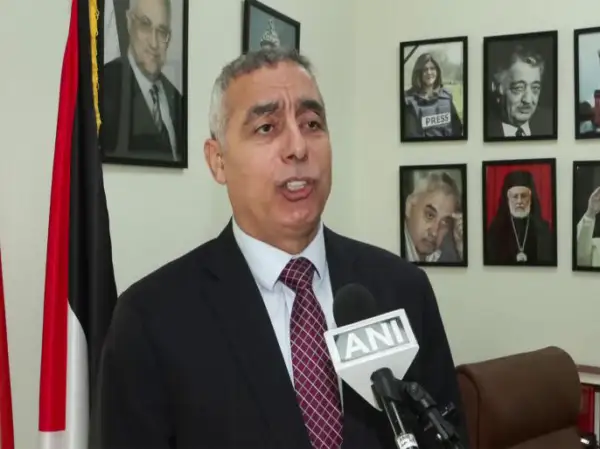
New Delhi [India], 25 November: The Palestinian Ambassador to India, Abdullah M Abu Shawesh, has stated that India’s robust diplomatic and strategic relationship with Israel could be instrumental in advancing the Palestinian cause and achieving a two-state solution.
Concurrently, he characterised Israel’s military campaign in Gaza as a ‘textbook genocide’.
Responding to remarks made by Congress leader and Lok Sabha Leader of Opposition, Rahul Gandhi, regarding India’s ties with Israel and the situation in Gaza, Abu Shawesh clarified that Palestine has never interfered with India’s sovereign decision to maintain diplomatic relations with Tel Aviv.
Speaking to ANI, the Ambassador reiterated Palestine’s consistent stance that India’s engagement with Israel offers a valuable opportunity to facilitate the peace process and address issues affecting the Palestinian people. ‘Our opinion as a Palestinian, we did not interfere when it came to India-Israel relations or any country with Israel. We did not interfere in this issue,’ Abu Shawesh affirmed.
He recalled that when India established diplomatic relations with Israel over three decades ago, the then Congress government had consulted Palestinian leader Yasser Arafat before making the decision. ‘It’s so important to know that when India started its diplomatic relations three-plus decades ago under the Congress, when the Congress was ruling India, they consulted us. They consulted Yasser Arafat,’ he explained.
The Ambassador emphasised that Palestine’s position has remained unwavering over the years, consistently encouraging India to utilise its relationship with Israel to further the two-state solution and the broader peace process. ‘Our opinion used to be, still is, and will continue to be that India is a great country. India having good relations with Israel, we will and we can utilise it and we will do our ultimate best to capitalise on this relation between India and Israel for our benefit. And when it came to our benefit, I mean the two-state solution, peace process and other issues,’ he elaborated.
Abu Shawesh underscored that maintaining relations with Israel is India’s sovereign choice, irrespective of whether this position is articulated by the government, political leaders, commentators, or journalists. He affirmed that Palestine respects India’s right to determine the nature and extent of its bilateral relations without external interference.
The Ambassador’s comments followed Rahul Gandhi’s remarks on 19 November during an interaction at the University of Chicago with political science professor Robert Pape on ‘The Iran War and India’s Role in the World’. Gandhi had advocated for India to maintain strong strategic relations with Israel, including defence cooperation, while ensuring that such ties do not hinder New Delhi from expressing its position on developments in Gaza.
‘We have good relations with Israel, and we buy weapons from them. But we are a much bigger country, with a population of 1.5 billion, and our foreign policy should be based on what is good for us, not on what is good for others,’ Gandhi had stated. He had also condemned the 7 October attacks and Israel’s military actions in Gaza, maintaining that one act of violence could not justify another.
Responding to Gandhi’s remarks on 7 October, Abu Shawesh acknowledged the right of political leaders and governments to condemn the attacks. However, he contended that the Palestinian conflict should not be viewed solely through the lens of the 7 October 2023 events, without considering its historical context.
‘But again, just to tackle the issue as if the history started on October 7, this is unfair and unjust for the Palestinian people,’ he asserted. The Ambassador also objected to describing the ongoing Israeli military campaign in Gaza merely as violence or military action, alleging that it constitutes genocide against Palestinians.
‘Then to condemn October 7th and to say it’s a terror attack, and to talk about up to date 1,147 days of genocidal war and to call it violence, this is again, I think, an unfair situation for the Palestinian people and for their reality,’ Abu Shawesh stated. He described the situation in Gaza as a ‘textbook genocide’, claiming that this characterisation is also supported by international organisations and Israeli human rights groups.
‘It’s not action. It’s a textbook genocide. This is not our word; this is the United Nations, this is Amnesty, this is the Israeli watchdog, Israeli human rights organisations that are tackling it, call it a genocidal war,’ he emphasised. Abu Shawesh further argued that while condemning the 7 October attacks is legitimate, the same standards should be applied when discussing Israel’s military operations in Gaza and the situation in the West Bank.
‘You used to call it a Hamas attack, a terror attack; this is your right absolutely, and no one should question your right. But when it came to the Palestinian issue, you cannot say that action or violence. It’s a textbook genocide,’ he concluded. He also raised concerns over the situation in the West Bank, alleging that Palestinians face repeated attacks by extremist Israeli settlers.
The Ambassador referred to recent remarks by Gadi Eisenkot, whom he described as a likely future Israeli Prime Minister, saying Eisenkot himself had characterised attacks by extremist Jewish groups against Palestinians as Jewish terrorism. ‘And again, this is not my word; this is what Gadi Eisenkot, the upcoming Israeli Prime Minister most probably, he called it loud and clear less than one week ago: an Israeli Jewish terror attack,’ Abu Shawesh stated. He argued that focusing exclusively on the 7 October attacks while overlooking violence against Palestinians in Gaza and the West Bank would provide an incomplete picture of the conflict. ‘I think it cannot give the full picture of what happened in Palestine,’ he added.