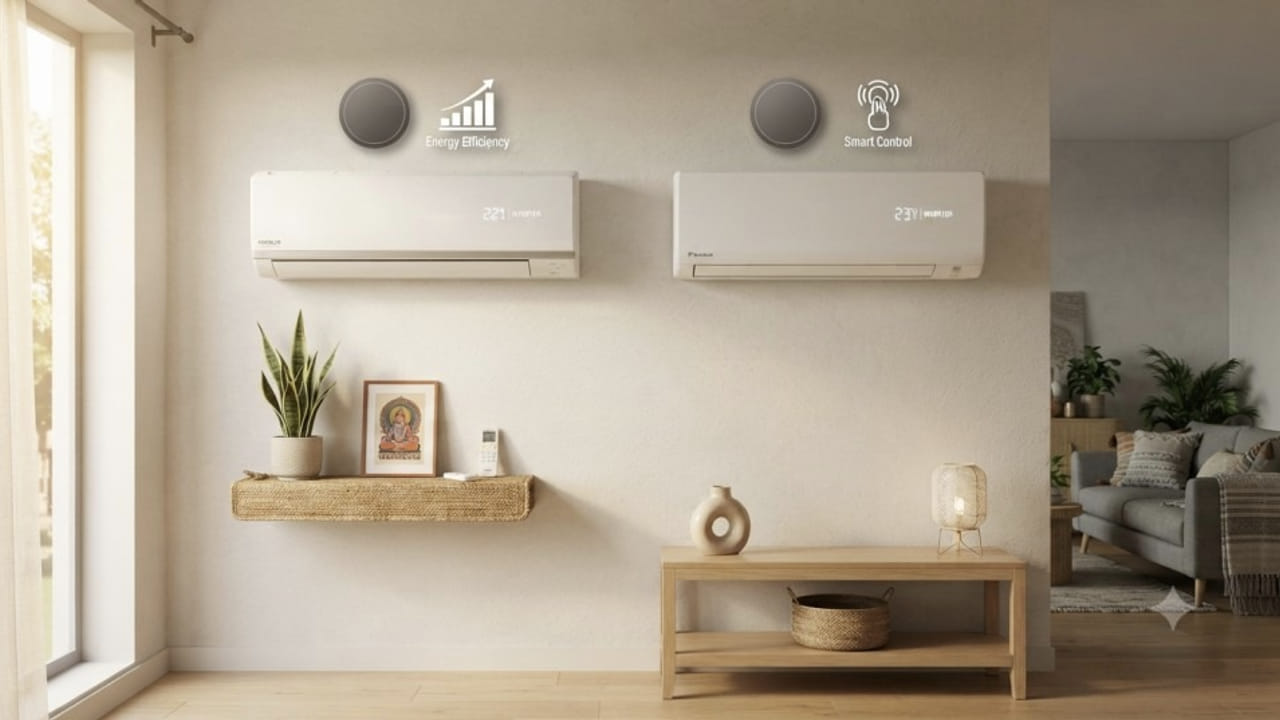
Compare Hitachi and Daikin 1.5-ton inverter ACs by price, cooling performance, energy efficiency, and warranty. Explore popular models and bring home your preferred AC on Easy EMIs with Bajaj Finance.
Planning to upgrade your AC but unsure whether to choose Hitachi or Daikin? Both brands offer 1.5-ton inverter ACs designed to handle India’s hot summers, but their features, energy efficiency, and prices can make the decision difficult. Hitachi offers models with Octa Sensor technology, convertible cooling, and smart controls, while Daikin has options with 3D airflow, Dew Clean technology, and high ISEER ratings. You can also explore 3 Star, 4 Star, and 5 Star models across different budgets. Whether you need an AC for a bedroom that stays warm at night or a living room that receives direct afternoon sunlight, comparing the two brands can help you find the right balance of cooling performance, electricity consumption, and price. This guide breaks down the differences to help you decide which brand offers better value for your home.
Once you have compared the Hitachi 1.5-ton AC price range with Daikin’s offerings and found a model that offers the right balance of cooling performance, energy efficiency, and price, the next step is making the purchase fit your budget. With Bajaj Finance Easy EMIs, you can bring home your preferred model without paying the entire cost upfront. Explore over 1 million eligible products from 550+ brands at 1,50,000+ partner stores across 4,000+ cities, including Reliance Digital, Croma, and Vijay Sales. The Bajaj Finance Insta EMI Card offers a limit of up to Rs. 6,00,000, while the Bajaj Finance Easy EMI Loan provides financing of up to Rs. 12,00,000. With repayment tenures of 3 to 60 months, you can spread the purchase cost across convenient monthly instalments and enjoy a cooler, more comfortable home.
What are the key differences between Hitachi and Daikin inverter ACs?
Both Hitachi and Daikin offer inverter ACs with technologies designed to improve cooling comfort and convenience. However, their features differ across models, so understanding what each technology does can help you choose the right AC for your home. Here are the key differences worth comparing:
- Cooling technology: Hitachi offers Octa Sensor technology on select models to monitor operating conditions and adjust cooling. Daikin offers Power Chill operation on select models for faster cooling when temperatures are high.
- Airflow distribution: Hitachi offers multi-directional airflow on select models, while Daikin’s 3D airflow combines vertical and horizontal movement to distribute cool air around the room.
- Energy efficiency: Both brands offer 5 Star inverter ACs. Compare the ISEER rating and annual electricity consumption of individual models to understand their potential running costs.
- Cleaning and maintenance: Daikin’s Dew Clean technology helps clean the indoor heat exchanger on compatible models. Hitachi also offers self-cleaning functions on select models.
- Smart controls: Both brands offer models with Wi-Fi or app-based operation, allowing you to control compatible ACs remotely.
- Warranty coverage: Both brands offer compressor warranties on select models, but product, compressor, and PCB coverage can differ. Check the exact warranty terms before buying.
What should you consider before choosing?
- Compare similar star ratings: A lower-priced 3 Star AC and a higher-priced 5 Star AC are not directly comparable on electricity consumption.
- Check the annual kWh: Two 5 Star models may have different annual electricity consumption figures, so compare their BEE labels for the same rating period.
- Look beyond the selling price: Installation charges, additional copper piping, stabiliser requirements, and warranty coverage can affect the final cost.
- Choose useful features: Wi-Fi controls, advanced airflow, and self-cleaning functions can add convenience, but you may not need every feature.
Which is better for your home: Hitachi or Daikin?
Neither brand is automatically better for every household. Hitachi is worth considering for its sensor-based cooling and convertible modes, while Daikin offers models with advanced airflow, heat-exchanger cleaning, and high energy-efficiency ratings. Your room conditions and daily usage should guide the decision. Here is how to choose based on your needs:
- For a bedroom with changing cooling needs: Consider Hitachi AC models with Octa Sensor and convertible cooling, especially if the room is occupied by different numbers of people throughout the day.
- For a living room needing wider airflow: Explore Daikin models with 3D airflow, which can help distribute cool air across different parts of the room.
- For long hours of daily use: Compare 5 Star models from both brands. Check the annual electricity consumption and ISEER value rather than assuming one brand will always use less power.
- For convenient maintenance: Compare Daikin’s Dew Clean technology with the self-cleaning features available on select Hitachi models.
- For smart-home convenience: Both brands offer models with remote operation. Check whether the exact AC supports Wi-Fi, app control, scheduling, or voice commands.
- For long-term ownership: Compare the complete warranty, service availability, installation costs, and replacement-part support for the exact models.
Buying tip: If two ACs have similar cooling capacity and annual electricity consumption, the model with the better final price, warranty coverage, and installation package may offer greater value.
How can you compare the running costs of Hitachi and Daikin ACs?
An AC’s purchase price is only one part of its total cost. If you use it for several hours every day during summer, electricity consumption can make a noticeable difference over time.
Use these points to compare running costs:
- Check annual electricity consumption: The BEE label displays estimated annual energy consumption under standard test conditions.
- Compare ISEER ratings: A higher ISEER generally indicates better seasonal energy efficiency under comparable testing conditions.
- Consider daily usage: An AC running for 8 hours a day will generally consume more electricity than the same model running for 3 hours, although actual consumption depends on operating conditions.
- Account for room conditions: Direct sunlight, poor insulation, frequent door opening, and high outdoor temperatures can increase cooling demand.
- Review maintenance needs: Regular filter cleaning and servicing help maintain cooling performance.
Example: If one AC has a rated annual consumption of 700 kWh and another uses 800 kWh under the same BEE test conditions, the difference is 100 kWh annually. At an illustrative electricity rate of Rs. 8 per unit, that represents Rs. 800 in estimated annual electricity costs.
Actual savings will depend on your electricity tariff, usage, room conditions, and operating settings.
How do Hitachi and Daikin 1.5-ton AC prices compare?
Hitachi and Daikin offer inverter split ACs across different price points, so the better deal depends on the exact model rather than the brand name alone. A 3 Star model may cost less upfront, while a 5 Star model can be worth considering for households with longer daily cooling requirements.
| Model | Listed price | BEE rating | Key feature |
|---|---|---|---|
| Hitachi IZEN 3500STXL RAS.D318PCD3ST1 | Rs. 39,490 | 3 Star | Convertible cooling, Octa Sensor |
| Hitachi Yoshi 5600WTXL RAS.X518PCDISM | Rs. 48,490 | 5 Star | Octa Sensor, smart controls |
| Daikin ATKM50XV Premium Series | Rs. 50,490 | 5 Star | 3D airflow, Dew Clean, 5.7 ISEER |
| Daikin ATKM50XV16MKA | Rs. 52,490 | 5 Star | PM2.5 filter, inverter cooling |
| Daikin JTKJ53XV16MAA | Rs. 59,790 | 5 Star | Voice and app control, PM1.0 filter |
| Daikin JTKJ60XV16MAA | Rs. 76,090 | 5 Star | Voice and app control, PM1.0 filter |
Disclaimer: Each model’s features, availability, and pricing are subject to change and may vary. For the most accurate and up-to-date information, please visit the official website.
Limited time offers on air conditioners
With EMIs starting as low as Rs. 833 per month, upgrading to the latest air conditioner has never been more affordable this season.
Terms and conditions apply. Check with your store for details.
What are my financing options to buy an AC on EMI?
Bajaj Finance offers two financing options for AC purchases. You can choose based on the AC’s price, your available limit, and your preferred repayment tenure.
| Financing option | Loan limit | Tenure | Best for |
|---|---|---|---|
| Insta EMI Card | Up to Rs. 3 lakh | 3 to 60 months | Buying across categories over time |
| Easy EMI Loan | Up to Rs. 5 lakh, basic KYC | 3 to 60 months | A single higher-value purchase |
How to buy a Hitachi or Daikin AC at the nearest Bajaj Finance partner store?
Buying a Hitachi or Daikin AC with Bajaj Finance’s in-store financing options is simple and convenient. The process usually takes just 10–15 minutes at the store. Follow these steps:
- Browse Hitachi and Daikin ACs on Bajaj Mall: Compare models based on capacity, inverter technology, energy efficiency ratings, cooling performance, smart features, air purification functions, and price before visiting a store.
- Find a partner store: Visit a nearby Reliance Digital, Croma, Vijay Sales, or any Bajaj Finance partner store.
- Check the AC in person: Ask the store executive to demonstrate the cooling modes, energy-saving features, air filtration technologies, smart connectivity options, and suitability of different Hitachi and Daikin AC models for your room size.
- Choose your EMI option: Enquire about the Insta EMI Card or Easy EMI Loan and check available repayment tenures and zero down payment offers on select Hitachi and Daikin ACs.
- Complete your purchase: Once financing is approved, you can take your AC home or schedule delivery.
Explore the latest range of Hitachi and Daikin ACs on Bajaj Mall and visit your nearest Bajaj Finance partner store to bring home an air conditioner that matches your cooling requirements, room size, and budget with flexible EMI options.