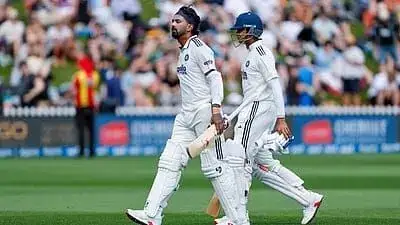
India’s Test batting has found an encouraging combination at the top of the order in KL Rahul and Yashasvi Jaiswal. Their contrasting approaches have helped India negotiate difficult conditions against quality fast-bowling attacks, while their growing understanding has produced some crucial opening partnerships in overseas cricket.
At a time when getting through the first session can determine the direction of a Test match, the pair are offering India something more valuable than quick runs: stability, adaptability and the ability to absorb pressure.
Their 130-run opening partnership against New Zealand in the first Test at Wellington on November 20, 2026, was another example of how effectively the two batters can complement each other. India were responding to New Zealand’s first-innings total of 368 and needed a strong start to prevent the hosts from gaining further control. Jaiswal scored an attacking 85 off 89 deliveries, while Rahul remained unbeaten on 52 from 116 balls as India reached 159/1 at the end of the second day’s play. The partnership also ended India’s 32-year wait for a century opening stand in a Test match in New Zealand.
KL Rahul’s experience and Jaiswal’s aggression create the perfect balance
The biggest strength of India’s opening combination lies in the difference between the two players’ batting styles. Jaiswal is an attacking left-handed batter who looks to score whenever the bowlers offer him an opportunity. His ability to play confident drives, cuts and attacking strokes puts pressure on opposition bowlers and prevents them from maintaining control for extended periods. However, his recent performances have also demonstrated his willingness to adapt his natural attacking instincts when conditions demand patience.
Rahul brings a different approach to the partnership. The experienced right-hander relies on sound technique, careful shot selection and the ability to leave deliveries outside the off stump. He understands the importance of surviving the initial spell of fast bowling, particularly in countries where swing, seam movement and bounce can make batting difficult. His composure allows Jaiswal to play more freely at the other end, creating a combination in which both players can contribute without changing their natural game.
This balance was particularly evident in Wellington. New Zealand’s Matt Henry and Kyle Jamieson initially made life difficult for the Indian openers, keeping them quiet with disciplined lines and movement off the surface. Rahul and Jaiswal resisted the temptation to play attacking shots too early, negotiating four consecutive maiden overs before gradually increasing the scoring rate. Once they settled, Jaiswal began finding boundaries while Rahul continued building his innings through controlled batting.
From Perth to Wellington: Partnerships that have strengthened India’s overseas batting
The success of Rahul and Jaiswal is not limited to their performance against New Zealand. Their 201-run opening partnership against Australia in the first Test at Perth in November 2024 remains one of the most important milestones in their partnership. Playing against a formidable Australian pace attack at the Optus Stadium, the two batters showed remarkable composure and provided India with the foundation for a memorable victory.
Jaiswal scored 161 runs in that innings, while Rahul contributed 77. Their partnership helped India establish control after the early challenges of batting in Australian conditions and laid the groundwork for a 295-run victory. The performance was particularly significant because it came against an experienced bowling attack on a surface known for its pace and bounce. It also established that their combination could deliver against high-quality opposition away from home.
The Wellington performance further strengthened that reputation. The 130-run stand against New Zealand showed that the Perth partnership was not an isolated achievement. Although the conditions and opposition were different, the two batters once again demonstrated their ability to adjust their methods, negotiate the new ball and build a substantial partnership.
Why opening partnerships are crucial in overseas Test matches
Opening the batting in overseas Test cricket remains one of the most demanding responsibilities in the game. Fast bowlers often receive assistance from the new ball, with movement in the air and off the pitch making the first 15 to 20 overs particularly challenging. Early wickets can expose the middle order before it has had sufficient time to settle, allowing the opposition to dictate the pace of the match.
Rahul and Jaiswal provide India with two different ways of dealing with this challenge. Rahul’s experience helps him manage difficult spells, while Jaiswal’s attacking ability can force bowlers to reconsider their lengths and field placements. Their left-right combination also requires opposition teams to adjust their bowling angles and strategies. This gives India an additional advantage when the partnership begins to develop.
A strong opening stand also has a wider impact on the team’s batting performance. It allows the middle order to enter the innings with fewer immediate concerns, creates opportunities for longer partnerships and gives India greater flexibility when planning an innings. In overseas conditions, where batting collapses can quickly change the outcome of a match, this stability becomes especially important.
Can Rahul and Jaiswal become India’s long-term Test opening combination?
India have frequently had to reassess their opening combinations across different Test series, making consistency at the top of the order an important part of their long-term plans. Rahul and Jaiswal offer an encouraging solution, combining the experience of an established international batter with the attacking potential of one of the country’s leading young Test players.
However, their partnership will ultimately be judged by how consistently they perform across different countries and against varied bowling attacks. Conditions in England, Australia, South Africa and New Zealand present different challenges, and the ability to adapt will remain essential. Both players will also need to maintain their fitness and form to establish themselves as a regular combination over multiple seasons.
Their performances in Perth and Wellington have already provided strong evidence of their potential. Rahul’s patience and technical discipline, combined with Jaiswal’s attacking approach, give India a valuable balance at the top of the order. If they continue to build on this understanding, the pair could become an important part of India’s Test ambitions and provide the team with the dependable starts needed to compete consistently in overseas conditions.