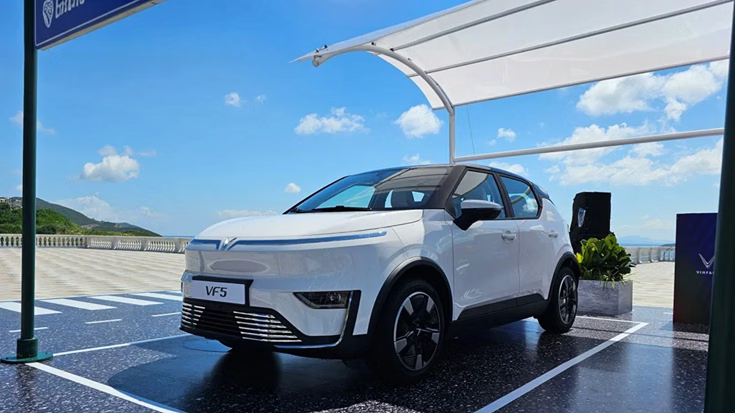
Vietnamese electric vehicle manufacturer VinFast plans to introduce more Vietnam-developed electric cars adapted for Indian conditions in 2027, including the compact VF5 SUV, as it looks to expand its presence in India’s mass-market electric vehicle segment.
The company’s immediate product strategy will focus on modifying existing models from its global portfolio to meet Indian customer requirements, while the development of vehicles specifically for India remains a longer-term possibility, Tapan Ghosh, CEO of VinFast Asia, said during a media interaction.
“Next year we’ll be launching a couple of products,” Ghosh said, adding that these would be “Vietnam products which will be fine-tuned for India.”
The comments come after VinFast said in September 2026 that it intended to design, develop and manufacture vehicles specifically for India, with higher levels of localisation.
The announcement followed a news report that the company had suspended work on the local manufacturing programmes for certain global models because of cost concerns. VinFast had disputed the report and maintained that its existing CKD assembly operations would continue.
Separately, on September 10, a separate news report said that VinFast was evaluating two India-specific electric vehicles, internally codenamed VF X and VF Y, including a smaller, more affordable model.
Ghosh’s latest comments suggest that the company’s immediate launch plans remain centred on existing Vietnamese products, even as it continues to evaluate India-specific development. He said the company had not finalised a roadmap for developing vehicles in India for global markets.
VF5 to Expand Mass-Market Presence
The VF5, positioned below the VF6 in VinFast’s global portfolio, is expected to be the company’s next step towards smaller and more affordable electric vehicles in India.
“We will be coming in with VF5 next year,” Ghosh said, adding that wider EV adoption would require products across different segments of the mass market.
The company has not finalised the launch month or pricing for the VF5 in India.
In Vietnam, VinFast introduced an updated VF5 on November 12, priced at VND 460 million (approximately ₹16.5 lakh) for the fleet-oriented Green variant and VND 540 million (approximately ₹19.4 lakh) for the Premium variant.
The rupee figures are direct currency conversions and do not indicate the model’s eventual India pricing. VinFast is also evaluating other vehicles from its global portfolio, including the smaller VF3, but has not committed to an India launch timeline for the latter.
VinFast currently sells the VF6 and VF7 electric SUVs, the seven-seat VF MPV7 and the Limo Green, which targets commercial fleet operators. Ghosh said the broader portfolio had helped increase monthly registrations to approximately 2,500-3,000 units from around 300 vehicles during the company’s initial months in India.
According to an analysis of retail sales data from VAHAN, VinFast registered 15,867 electric passenger vehicles in India between January 1 and November 9, 2026, accounting for approximately 5% of the market and placing it fourth among electric passenger vehicle manufacturers.
Engineering Changes for Indian Conditions
While VinFast is relying on its existing vehicle platforms, Ghosh said the company has made several engineering changes to suit Indian operating conditions. These include suspension tuning for the VF6 and VF7 to suit local roads, changes to air-conditioning systems to handle higher temperatures, and modifications to battery management and thermal management systems.
The company is following a similar approach for its upcoming electric two-wheelers, which will have India-specific changes to their size, specifications and other components.
However, VinFast does not have immediate plans to establish a dedicated research and development centre in India. Ghosh said the company’s existing R&D operations are based in Vietnam, although it could consider investing in engineering capabilities in India as the business grows.
He acknowledged India’s engineering talent and supplier capabilities but said the company would expand its operations gradually rather than commit to too many investments simultaneously.
Manufacturing Expansion Linked to Demand
VinFast’s passenger vehicle plant in Thoothukudi, Tamil Nadu, has an installed annual capacity of 50,000 units, which can be expanded to 150,000 units.
Ghosh said the facility is operating at approximately 70% capacity utilisation, prompting the company to consider a phased expansion as more products are introduced. “It’s not that from 50,000 directly we will go to 150,000; probably 50,000 we will go to 75,000 or 100,000,” he said.
The company could consider increasing capacity over the coming months, particularly with the planned launch of the VF5. However, Ghosh clarified that no final decision had been taken.
VinFast is also working to increase localisation from its current level of approximately 15%. Ghosh said higher domestic sourcing would depend on production volumes and the development of local suppliers.
The company had earlier outlined an ambition to raise localisation towards 40%, including through discussions with domestic battery manufacturers. However, Ghosh did not provide a revised localisation target or timeline during the latest interaction.
Domestic Market Takes Priority Over Exports
Despite VinFast’s earlier plans to develop its Tamil Nadu facility into an export hub, Ghosh said the company’s immediate priority is to strengthen domestic sales and increase local sourcing. “Right now we are not focussing on exports,” he said, adding that overseas shipments could be considered as domestic volumes and localisation improves.
When VinFast inaugurated its Thoothukudi plant in August 2025, the company had outlined ambitions to supply vehicles to South Asia, the Middle East and Africa. It had also indicated that initial export orders had been secured from overseas markets.
Ghosh said exports remained part of the company’s longer-term plans, with right-hand-drive markets likely to be considered first, followed by left-hand-drive destinations. No export timeline or volume target has been announced.
The company is also keeping its luxury vehicle range outside its immediate India expansion plans. VinFast introduced the Lac Hong 800S and 900S ultra-luxury electric models in March 2026, expanding its global portfolio beyond mainstream passenger vehicles.
However, Ghosh said VinFast was not considering a near-term India launch of the Lac Hong brand, as it targets a different market segment. For now, the automaker intends to concentrate on expanding its mass-market EV portfolio, increasing domestic production and developing its supplier network, with further investments tied to customer demand and commercial viability.