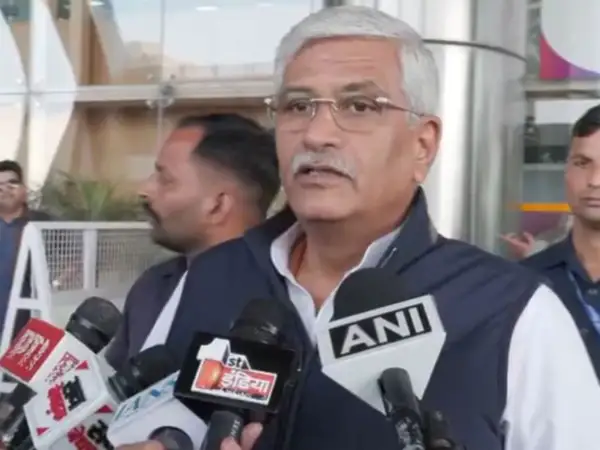
Union Minister Gajendra Singh Shekhawat on Sunday said the entire world is acknowledging India’s economic momentum, responding to US President Donald Trump’s praise of the country’s Gross Domestic Product (GDP) growth.
Speaking to reporters in Jaipur, Shekhawat pointed to recent growth projections by major global institutions, noting that the World Bank, the International Monetary Fund (IMF), and the Organisation for Economic Co-operation and Development (OECD) have all forecast India’s economic growth above seven per cent.
“The whole world is acknowledging this. The World Bank has just announced that India’s GDP growth will remain above 7.1 per cent. The IMF has announced that India’s GDP growth will be 7.2 per cent. The OECD has announced that India’s GDP growth will remain above 7 per cent,” the Union Minister said.
Highlighting India’s economic resilience amid global headwinds, Shekhawat asserted that the country is set to exceed current growth estimates by the end of the year despite geopolitical instability, supply chain disruptions, and an energy security crisis.
“Our own estimates are that despite all the challenges, despite this being the most turbulent period in geopolitics, despite supply chain disruptions, and despite a major energy security crisis, our economy is currently at a certain level, and by the end of this year, we will be far ahead of these estimates,” he stated.
Taking a swipe at critics, Shekhawat added, “Now, there are some people who do not want to see the underlying intent; they do not want to see it.”
Meanwhile, citing India’s 7 per cent GDP growth rate and low interest rates by the central bank (RBI), US President Donald Trump on Friday (local time) criticised the American central bank for keeping borrowing costs high, arguing that the US economy could achieve growth of 15 to 20 per cent if interest rates were lowered.
Speaking to reporters at the White House, Trump accused the US Federal Reserve of being “very political” and alleged that it raised interest rates whenever America announced strong economic figures, instead of lowering them to support further economic growth.
“Interest rates are too high because we have a very political Fed. I’m not blaming the chairman, but the fact that we have a very political Fed. Whenever we announce good numbers, they raise the interest rates. They do that for a reason. It should be the opposite,” Trump said.
He argued that strong economic performance should allow the US to lower interest rates, as better financial figures indicated improved creditworthiness. However, he alleged that the Federal Reserve was following the opposite approach, thereby restricting the country’s economic potential.
“We do just the opposite. We do it to destroy the country. When we have these great numbers, you shouldn’t keep raising the rates. You should lower rates because we’re a better credit. We would have a GDP of 15 or 20 per cent, not 4 per cent. We’d pay off the debt very rapidly. That’s the way it should work. But we do it in reverse,” he said.
Drawing a comparison with India, Trump pointed to the country’s low interest rates and 7 per cent GDP growth, suggesting that the US could achieve significantly higher growth if it followed a similar approach.
“If you look at India, they have low interest rates, and they have a 7 per cent GDP. We’d have a 14%, 15%, maybe even a 20% GDP. It’s really a sad thing when you do so great and then they (Fed) raise the interest rate. The fact is, we’ve blown through it,” the US President said.
Trump’s remarks came amid his continued criticism of the Federal Reserve’s monetary policy. This comes as US inflation continues to remain well above the Federal Reserve’s 2 per cent target. According to the data cited in his speech, the annual personal consumption expenditures (PCE) inflation rate stood at 3.6 per cent in September, while core PCE inflation, which excludes food and energy prices, was 3.1 per cent.