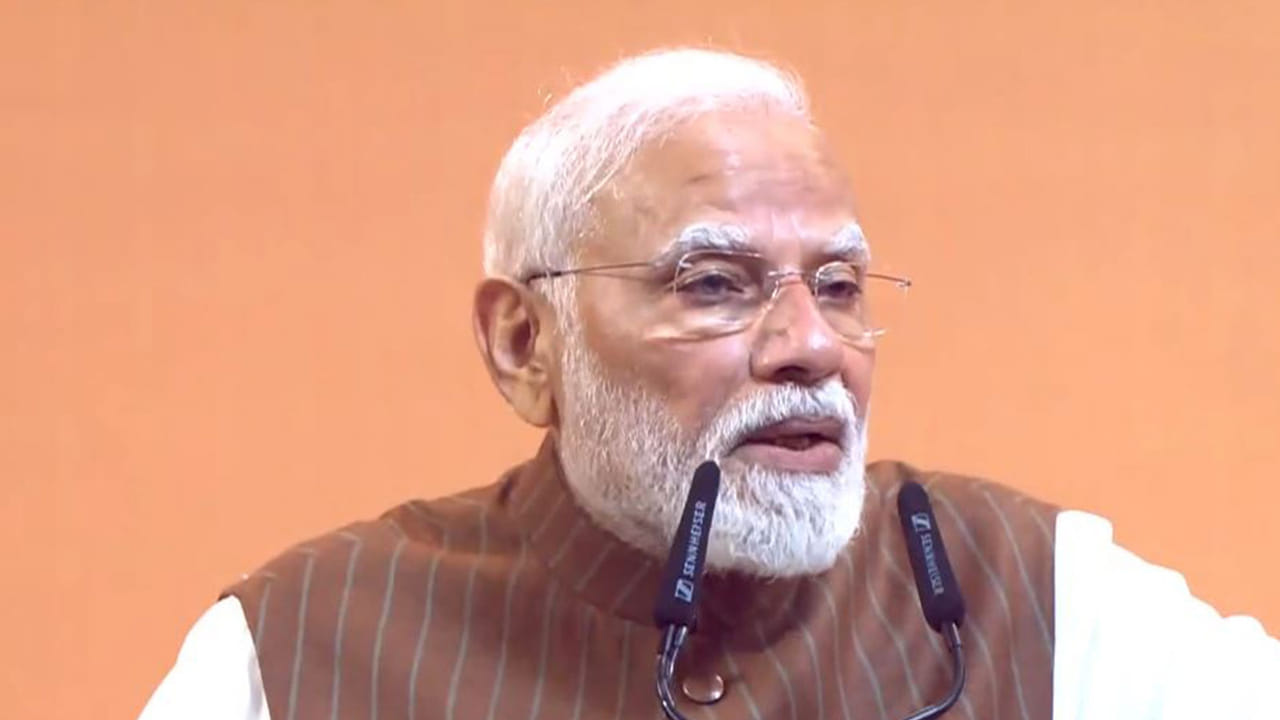
PM Narendra Modi addressed the IIT Kharagpur Platinum Jubilee, calling on Indians to discard limiting beliefs. He highlighted achievements in semiconductor manufacturing and poverty reduction as evidence of the nation overcoming obstacles.
PM Modi Urges India to Shed Limiting Beliefs at IIT Kharagpur Event
Prime Minister Narendra Modi on Saturday called on Indians to shed “limiting beliefs” and push past self-imposed boundaries, asserting that India’s strides in semiconductor manufacturing, poverty reduction, and scientific innovation demonstrate its ability to overcome long-standing challenges. Addressing the Platinum Jubilee celebrations of the Indian Institute of Technology (IIT) Kharagpur on November 21, 2026, PM Modi said the country had moved away from a mindset that accepted limitations.
Describing his personal approach to obstacles, he remarked, “Mere swabhaav mein hi bana hain ki main chunauti ko chunauti diye bina reh nahi sakta hoon” (It is in my very nature that I cannot live without challenging a challenge).
Recalling questions raised at the launch of the Semiconductor Mission over whether India was too late to enter a sector dominated by decades-old global players, PM Modi said he refused to let past delays hold the country back. He stated that within four years, multiple semiconductor facilities had been established across the country, India had begun exporting chips, and IIT Kharagpur alumni were helping lead and execute these projects.
“When I launched the Semiconductor Mission, many questions were raised. People asked, ‘What is the need for this mission now? Other countries are already manufacturing them, and semiconductors have been produced for the last 50 years. What will we achieve by manufacturing them now?’ That is the kind of thing that was being said—a reflection of a limited mindset. But friends, I was determined. I asked, ‘So what if it was delayed in the past? Should India just sit idly by forever?’ We took the initiative. I personally worked with officials to develop a plan, and today, look at the result: within just four years, numerous semiconductor facilities have been established across the country. India has now begun exporting chips,” PM Modi said.
Linking technological ambition to mindset shifts, PM Modi cautioned against placing boundaries on personal talent, dreams, or national potential, saying a stagnant mindset prevents true progress while nations unlock their potential by breaking through mental limits.
“Often, people impose boundaries on their own thinking—they set limits for themselves—and these are what we call ‘limiting beliefs.’ What are limiting beliefs? They mean placing limits on your dreams, on your talents, and even on the potential of your own nation,” he said.
“Those who live with a stagnant, lifeless mindset cannot truly live life at all. We have come to accept the boundaries of our own thinking as the boundaries of our world. A nation, too, recognises its true potential only when it breaks through the limits of its own thinking. In the last few years, India has demonstrated exactly that,” he added.
Citing past slogans on poverty eradication that he said were left unaddressed in files, PM Modi recalled early ridicule in Parliament when he announced a drive to build toilets for the poor from the Red Fort, stressing their importance for dignity and safety, particularly for women and mothers.
Pointing to a World Bank report, he stated that roughly 50 crore people had been lifted out of poverty over a 12-to-13-year period.
“Until 20 years ago, poverty was considered a permanent problem in our country. Five decades ago, slogans about eradicating poverty were being raised from the ramparts of the Red Fort. Yet, whenever it came to taking action at the policy level, the entire system would simply bury the matter in files,” he said. “When we first came to power, I announced from the Red Fort that I would build toilets for the poor. In Parliament, people mocked this, asking, ‘What kind of Prime Minister is this? He’s talking about building toilets.’ Such people failed to grasp how essential a toilet is, how critical it is for the poor, and especially for poor women and mothers,” he aded.
Citing a recent World Bank report, PM Modi said that 50 crore people in India had been lifted out of poverty over a period of 12 to 13 years. “The World Bank has stated that in just 12 to 13 years, 50 crore people in India have been lifted out of poverty. This is no small change; it is the outcome of a mindset that advocates for breaking the limits,” he said.
Tracing IIT Kharagpur’s origins to India’s early post-independence years before its first general election, the Prime Minister credited its graduates with contributing to industrial infrastructure, space and atomic energy programmes, and the growth of India’s IT sector and global corporate leadership.
“As the country’s scientific capabilities expanded, graduates of the institution contributed to the development of India’s space and atomic energy programmes,” he said. He added that during the subsequent growth of the information technology sector, IIT Kharagpur graduates strengthened India’s software industry and went on to lead some of the world’s largest companies. “In every era, this institution has taken the lead in fulfilling its responsibility toward nation-building,” he said.
Describing the journey from the aspiration for self-rule to the resolve for self-reliance as central to India’s development, PM Modi said the country was now working towards shaping its future through the goal of a developed India. “This land, which once held an aspiration for self-rule, now reflects a resolve for self-reliance. Where there was once a dream of freedom, there is now an opportunity to shape the future. This journey—from aspiration to self-reliance—is the true driving force behind the creation of a developed India,” he said.
India’s scientific trajectory includes ISRO’s Chandrayaan-3 mission in 2023, which made India the first country to achieve a soft landing near the Moon’s south pole, alongside broader expansions in space, atomic energy, and digital infrastructure. India’s science, technology and innovation landscape has undergone an unprecedented transformation over the last twelve years, marked by a nearly twenty-fold expansion of the bioeconomy, a historic Moon landing near the lunar south pole, rapid growth of the space startup ecosystem, revolutionary improvements in weather forecasting and the emergence of indigenous technologies across strategic sectors.