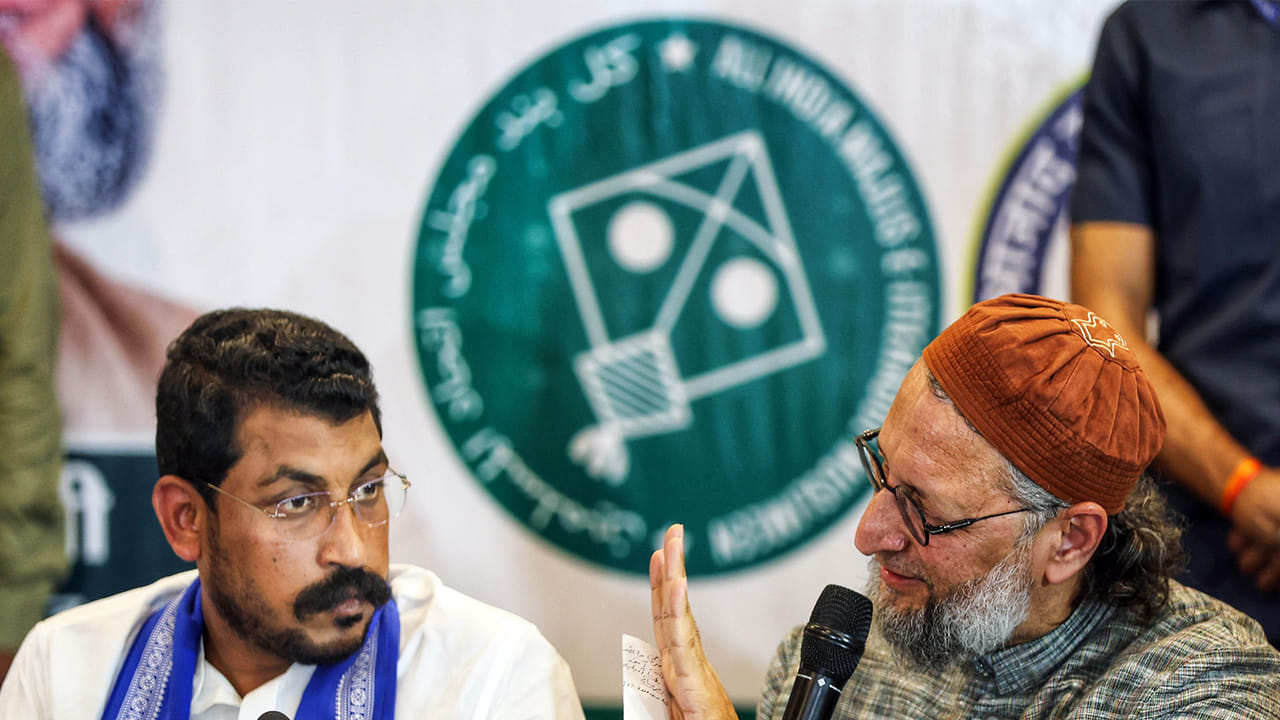
Asaduddin Owaisi and Chandrashekhar Azad are fortifying their Samajik Parivartan Morcha to create a Dalit-Muslim coalition in Uttar Pradesh, aiming to contest the 2027 elections and challenge established political parties in the state.
Saharanpur (Uttar Pradesh) [India], November 21 (ANI): The political partnership between AIMIM chief Asaduddin Owaisi and Azad Samaj Party-Kanshiram president Chandrashekhar Azad is beginning to acquire a sharper electoral character, with the AIMIM chief’s visit to Saharanpur on Saturday marking an important step in the alliance’s efforts to establish a grassroots presence ahead of the 2027 Uttar Pradesh Assembly elections. Owaisi is scheduled to meet Azad at his residence in Chhutmalpur, where the two leaders are expected to hold political discussions over lunch. The visit also includes a proposed interaction with the district administration over a mosque-related issue, followed by a visit to a madrasa. Leaders and supporters of the Azad Samaj Party are expected to welcome Owaisi in Chhutmalpur. Coming barely days after the announcement of the Samajik Parivartan Morcha, the visit is significant not merely as a meeting between two political leaders but as an attempt to demonstrate that their alliance intends to build a common political presence in western Uttar Pradesh. The region has considerable electoral importance, particularly because of its Dalit and Muslim populations and its historical association with the Bahujan movement. The Saharanpur engagement follows the alliance’s first major public mobilisation in Meerut on November 14, where Owaisi delivered an aggressive political message, declaring that the Morcha’s immediate objective would be to prevent the BJP from returning to power in Uttar Pradesh in 2027. Taking the challenge beyond the state, he also spoke of confronting the BJP at the national level in the 2029 general elections. Addressing supporters at Nauchandi Grounds, Owaisi urged voters to support candidates of the newly formed alliance and invited the Samajwadi Party and Congress to join its political platform. His speech was marked by criticism of established opposition parties, particularly over their claims of representing Muslim interests and other marginalised communities. He also raised issues concerning unemployment, inflation, farmers and constitutional rights. The political message was clear: the new alliance does not intend to restrict its challenge to the BJP alone. It also wants to question the established opposition’s claim to represent the social groups whose support has traditionally shaped electoral outcomes in Uttar Pradesh. The Samajik Parivartan Morcha was formally announced in Lucknow on November 12 by Owaisi and Azad. The two parties have declared their intention to contest all 403 Assembly constituencies together, with Azad projected as the alliance’s chief ministerial face. They have also indicated that the platform remains open to other political parties willing to join their effort. The decision to project Azad as the chief ministerial candidate is central to the alliance’s political positioning. It places a prominent Dalit leader at the forefront of a partnership with a major Muslim political figure, giving the Morcha an opportunity to present itself as a broader coalition centred on social justice and political representation. For Owaisi, the partnership provides an opportunity to expand AIMIM’s political footprint in Uttar Pradesh, where the party has yet to emerge as a major electoral force. For Azad, it offers a platform to extend his political influence beyond his existing strongholds and establish himself as a statewide leader with ambitions of occupying the highest political office in the state. However, the real test of this partnership will be its ability to convert the proposed Dalit-Muslim combination into an effective electoral coalition. Both communities have considerable demographic significance in Uttar Pradesh, but their voting preferences are shaped by diverse regional, social and political considerations. Numerical strength alone cannot guarantee electoral consolidation. The alliance’s emergence also puts the Samajwadi Party’s PDA strategy under a new kind of political pressure. Akhilesh Yadav has sought to consolidate backward classes, Dalits and minorities under a common political umbrella. The Owaisi-Azad partnership is now attempting to create an alternative platform that places greater emphasis on independent political representation and leadership from within marginalised communities. This could lead to competition between the two formations for sections of the same electorate. Whether the new alliance can attract voters who have traditionally supported the Samajwadi Party, or instead contribute to a division of opposition votes, will be one of the defining questions of the 2027 contest. The political implications also extend to the Bahujan Samaj Party. Mayawati’s political legacy remains closely associated with the consolidation of Dalit voters and the wider Bahujan movement. Azad’s growing political ambitions, coupled with his invocation of the legacy of Kanshi Ram, could intensify competition for the political space historically occupied by the BSP. The extent of any shift in the BSP’s traditional support base, however, remains uncertain. The BJP, meanwhile, will be closely watching the emerging opposition equations. A successful consolidation of Dalit and Muslim voters could alter electoral calculations in several constituencies. But if the Samajik Parivartan Morcha contests separately from the Samajwadi Party and Congress, fragmentation of opposition votes could also work to the BJP’s advantage. The next major test for the alliance will come on November 26, when it is scheduled to hold a major public gathering in Lucknow on Constitution Day. The proposed rally is expected to be an important opportunity for Owaisi and Azad to demonstrate their combined political strength and present a common programme for the state. The date is particularly significant because the Samajwadi Party is also scheduled to unveil its election manifesto on the same day. This creates an interesting political backdrop, with competing opposition formations seeking to establish their credentials on social justice, constitutional values, political representation and the future of Uttar Pradesh. The November 26 gathering could also provide greater clarity on seat-sharing arrangements between the two parties. Discussions are reportedly underway, with constituency-level considerations and local social equations expected to influence the distribution of seats. Whether additional political organisations will join the Morcha is another question likely to attract attention. Beyond electoral calculations, the alliance will need to offer a credible programme on unemployment, education, farmers’ distress, inflation, reservation and constitutional safeguards. These are issues that can determine whether the Morcha develops into a broader political movement or remains primarily an electoral arrangement between two prominent leaders. Its organisational challenge is equally formidable. An ambition to contest all 403 seats requires a functioning network across districts, constituencies and polling booths. The alliance will need credible candidates, effective coordination between its constituent parties and a campaign structure capable of competing with established political organisations. For Azad, the challenge is to demonstrate that his leadership has statewide appeal. For Owaisi, it is to establish that AIMIM can contribute to a wider political coalition and translate its support into electoral victories beyond its existing areas of influence. The Saharanpur visit, the Meerut mobilisation and the forthcoming Lucknow rally represent three important stages in the alliance’s early political journey. Together, they suggest an attempt to move from political announcement to public mobilisation and, eventually, electoral organisation. Whether this effort can alter Uttar Pradesh’s established political arithmetic remains an open question. The alliance has succeeded in attracting attention, but attention alone does not create an electoral alternative. The real challenge before Owaisi and Azad is to transform the politics of social representation into a credible politics of governance and electoral power. The Saharanpur engagement is an important step in that direction, while the November 26 rally will offer a more visible test of how far their political partnership has travelled since its formation. (ANI)