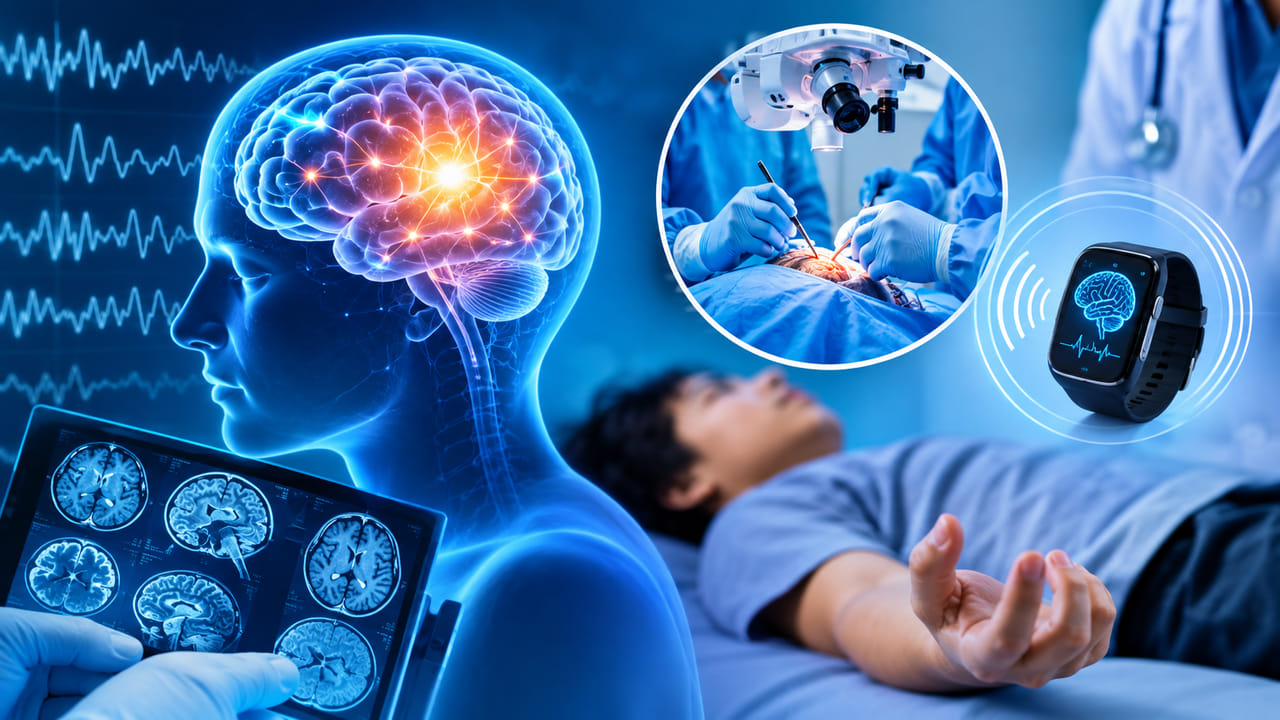
Epilepsy affects millions in India, but treatment gaps remain wide. Discover how AI-powered diagnosis, wearable seizure monitors, telemedicine and advanced brain surgery are transforming epilepsy care and offering new hope to patients.
A Large Burden, A Wider Gap
Epilepsy is one of the most common serious brain disorders, affecting more than 50 million people worldwide. India alone is home to an estimated 10–12 million people with epilepsy, about one in every hundred, with prevalence in rural areas nearly double that in cities.
Around 70% of patients can become seizure-free with the right medicine, often costing only a few hundred rupees a month. Yet the treatment gap, the share of people who receive no adequate treatment, ranges from about 22% among urban middle-class families to as high as 90% in rural communities. Stigma, myths about possession, delayed diagnosis, limited EEG and MRI facilities, and fewer than 3,000 neurologists for a population of 1.4 billion all contribute. Untreated seizures bring injuries, lost schooling and jobs, social isolation and a higher risk of premature death.
Where Artificial Intelligence Fits in
Artificial intelligence is no longer a distant promise in neurology. Its uses in epilepsy can be grouped into four broad areas.
1. Diagnosis. Automated EEG analysis can flag epileptiform discharges and classify seizures within minutes, easing the shortage of trained EEG readers. AI tools for MRI can highlight subtle lesions, such as focal cortical dysplasia or hippocampal sclerosis, that the human eye may miss. Video analysis of seizure semiology is emerging as a further aid.
2. Access and continuous monitoring. Tele-epilepsy and remote clinics bring specialist opinion to district hospitals and homes. Tele-EEG lets a recording done in a small town be reported by an expert hundreds of kilometres away. In intensive care units, continuous ICU-EEG with automated seizure detection can pick up non-convulsive seizures and status epilepticus in comatose patients, where every minute matters.
3. Seizure detection and prediction. Wearable devices, such as wristbands that sense movement, heart rate and skin conductance, can detect convulsive seizures and alert caregivers, particularly at night. Machine-learning models are now attempting to forecast periods of high seizure risk, giving patients a measure of control over an unpredictable illness.
4. Prognostication and treatment decisions. Predictive models built from clinical, EEG and imaging data can estimate the risk of drug resistance early, guide medicine selection and predict who is likely to benefit from surgery. Patient-facing chatbots can support education and adherence.
AI will not replace the neurologist, but it can multiply the reach of every specialist in a country where specialists are scarce.
Epilepsy Surgery: the Forte of Advanced Care
Nearly one in three patients continues to have seizures despite trying two appropriate medicines. For these patients with drug-resistant epilepsy, surgery is often the best, and sometimes the only, chance of cure. Carefully selected patients with temporal lobe epilepsy achieve seizure freedom in 60–70% of cases.
The field has advanced rapidly. Presurgical evaluation now combines prolonged video-EEG, 3-Tesla epilepsy-protocol MRI, PET and SPECT, and source localisation through high-density EEG and MEG. Stereo-EEG, in which fine electrodes are placed deep in the brain through tiny openings, maps the seizure network with great precision, increasingly with robotic assistance. Less invasive treatments such as laser interstitial thermal therapy and radiofrequency thermocoagulation can destroy the seizure focus without open surgery. For patients who are not candidates for resection, neuromodulation (vagus nerve stimulation, deep brain stimulation and responsive neurostimulation) offers meaningful seizure reduction.
The Way Forward
India needs both ends of this spectrum: AI-enabled screening and remote care to close the treatment gap at the grassroots, and comprehensive epilepsy surgery centres for those who need advanced care. Bridging the two, with early identification of drug resistance and timely referral, will define the next phase of neurological care in India. For many patients, the message is simple: epilepsy is treatable, and even difficult epilepsy can often be cured.
-This article is authored by Dr. Sachin Sureshbabu, HOD & Senior Consultant, Centre for Neurosciences, Meitra Hospital, Kozhikode