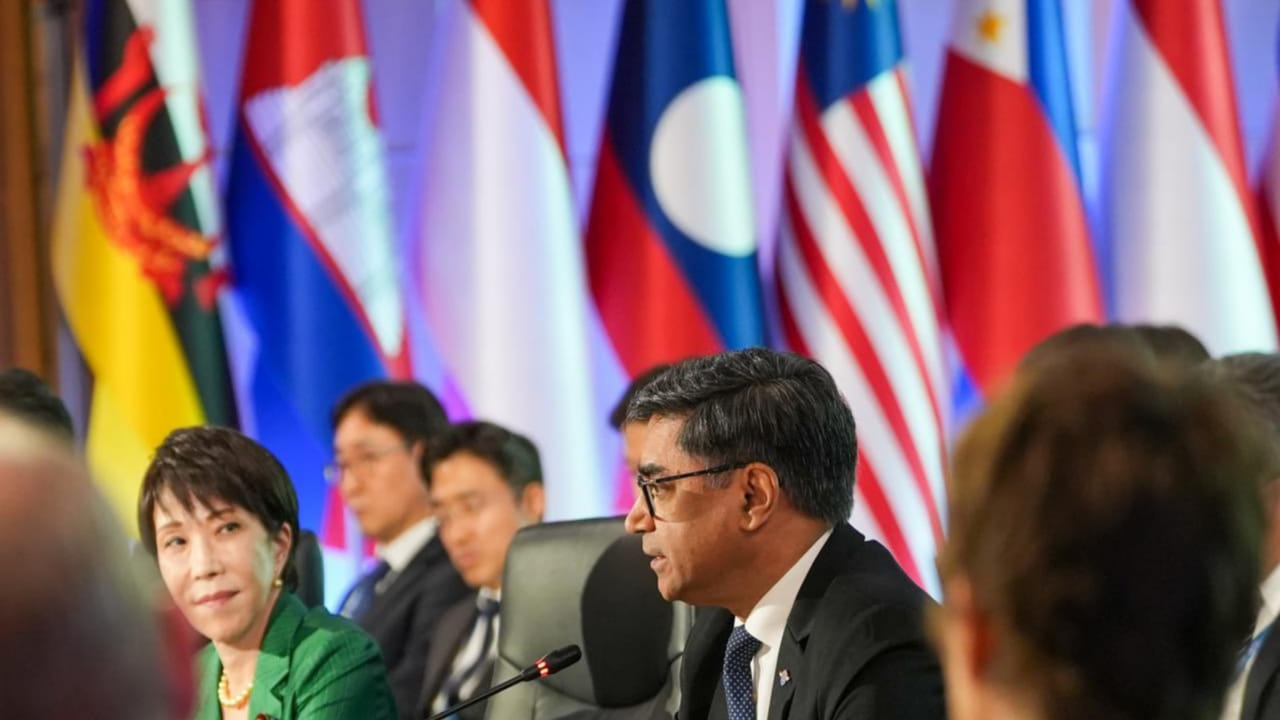
Foreign Secretary Vikram Misri represented India at the 4th AZEC Leaders’ Meeting in Manila, reaffirming commitments to energy security, supply chain resilience, and collaborative research through Japan’s new BRIDGE Asia initiative.
Manila [Philippines], November 17 (ANI): Foreign Secretary Vikram Misri represented India at the 4th Asia Zero Emission Community (AZEC) Leaders’ Meeting in Manila on Tuesday, where India welcomed Japan’s BRIDGE Asia initiative on joint research in emerging technologies and reaffirmed its commitment to strengthening regional supply chains and energy security. The Ministry of External Affairs (MEA), in a post on X, said Misri attended the meeting convened by Japan and the Philippines, highlighting India’s commitment to working with like-minded partners to build a secure and resilient energy future for Asia.
“Foreign Secretary Vikram Misri represented Bharat at the 4th AZEC Leaders’ Meeting, convened by Japan and Philippines, in Manila on 17 November. India remains committed to working with like-minded partners on energy resilience and economic security to build a secure and resilient energy future for Asia,” the ministry said. In a separate post, the MEA said India welcomed Japan’s BRIDGE Asia initiative, which focuses on joint research in new technologies. “At the 4th AZEC Leaders’ Meeting, India welcomed Japan’s BRIDGE Asia initiative on joint research in new technologies. India will keep working with like-minded partners for strong supply chains and a secure energy future for Asia,” it added.
According to Japan’s Kyodo News, Japanese Prime Minister Sanae Takaichi and Southeast Asian leaders on Tuesday pledged to strengthen economic cooperation and protect regional economies against external shocks, including disruptions to critical supply chains. At the Japan-ASEAN summit in Manila, leaders agreed to expand cooperation in energy, maritime security and advanced technologies while diversifying supply chains and promoting investments in these sectors. Takaichi welcomed the adoption of a joint statement on economic resilience, highlighting the need to strengthen supply chains, including those involving critical minerals, in response to arbitrary export restrictions.
Earlier, addressing the AZEC summit, Takaichi proposed establishing an Asia Oil Security Task Force to coordinate emergency releases of oil reserves and facilitate collective energy security measures. She also proposed using idle oil storage facilities in Japan to support a regional stockpiling initiative led by the Philippines, while calling for stronger cooperation between Gulf oil producers and Asian energy consumers. The Japanese Prime Minister further outlined plans for a common market in advanced technologies, encouraging joint research and investment in areas such as biofuels, small modular reactors and next-generation solar technology. The discussions come amid concerns over energy supply disruptions following the conflict involving Iran and disruptions to shipping through the Strait of Hormuz, prompting Asian economies to explore alternative energy supplies and strengthen regional resilience. Meanwhile, Philippine President Ferdinand R. Marcos Jr., addressing the 29th ASEAN Plus Three (APT) Summit on Tuesday, called on regional leaders to translate cooperation into tangible protections for food and energy supplies. He cautioned that geopolitical crises and supply-chain disruptions could affect households across East and Southeast Asia through rising food and energy prices. The ASEAN Plus Three mechanism brings together the 11 ASEAN member states with China, Japan and South Korea.