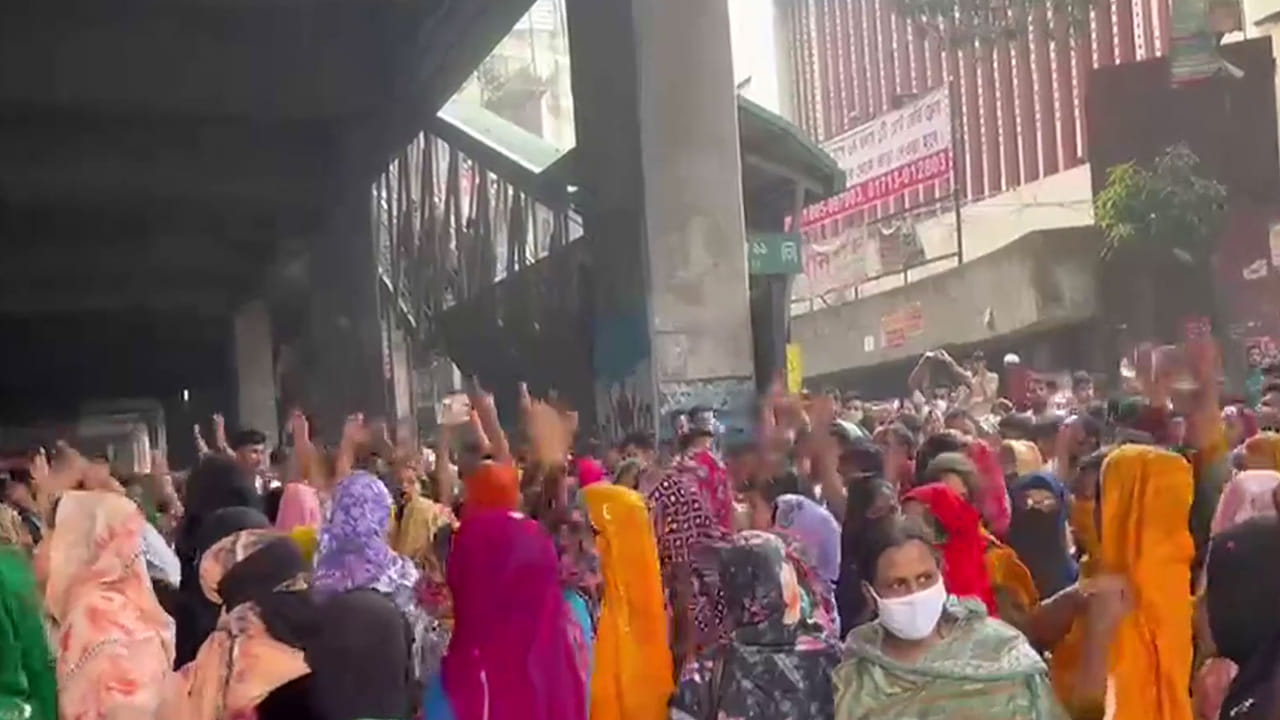
Garment workers in Bangladesh are striking for higher wages, causing factory closures in industrial hubs. Simultaneously, authorities have deployed security in Gopalganj following heightened political tensions linked to Sheikh Hasina.
Garment workers in Bangladesh staged protests in Mirpur, Dhaka, demanding an increase in the minimum monthly wage to 30,000 taka, as labour unrest continued across the country’s textile industry, with several factories remaining shut and sporadic incidents of violence reported. The protesting workers attempted to block roads as part of their demonstration but were stopped by police, who intervened to prevent disruption to traffic and maintain law and order.
Textile workers across Bangladesh have been striking to demand higher wages, with protests leading to the closure of factories in several industrial areas, DW reported. Workers have repeatedly raised concerns over wages and working conditions. According to Dhaka Tribune, a group of workers gathered at Padmar Mor in Savar’s Hemayetpur around 3 pm on Monday, briefly drawing attention to the area. Police subsequently asked them to disperse peacefully, following which they left the road without further incident.
Meanwhile, around 40 factories remained closed in the Savar and Ashulia industrial areas on Monday, according to industrial police. Of these, 27 factories were shut under Section 13(1) of the Bangladesh Labour Act, while nine were declared closed indefinitely. The remaining factories observed general holidays. Mohammad Mominul Islam Bhuiyan, superintendent of police (SP) of Ashulia Industrial Police-1, said workers at one factory refused to resume work after the lunch break and remained seated inside the premises, following which the management declared a holiday. Workers at two other factories also stopped working and staged sit-ins inside their respective premises. However, workers at other factories across the industrial areas continued their work peacefully, he added.
Separately, security arrangements have been strengthened in Gopalganj district, the hometown of ousted former Prime Minister Sheikh Hasina, with the Border Guard Bangladesh (BGB) deploying 10 platoons to maintain law and order. In a statement on Monday, BGB said armoured personnel carriers had also been deployed to handle potential disturbances, while body-worn cameras and drones were being used to monitor security operations. The deployment follows renewed political activity in Gopalganj after reports of Hasina’s planned return to Bangladesh in December, with pro-Awami League supporters staging demonstrations. Hasina was sentenced to death by Bangladesh’s International Crimes Tribunal-1 on November 17, 2025, in a case concerning crimes against humanity during the July 2024 uprising.