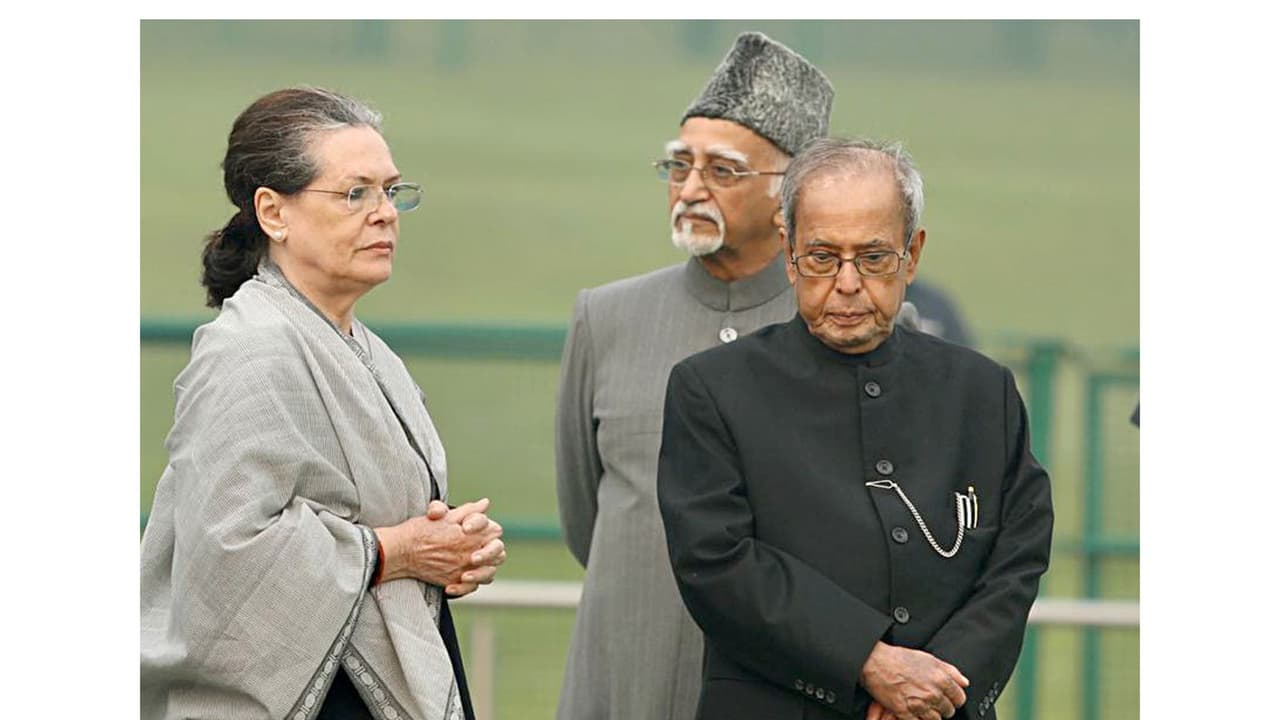
Sharmistha Mukherjee defends her father Pranab Mukherjee’s ambition to become PM after Sonia Gandhi’s memoir reveals his desire for the top post. She asserts his merit-based career and denies any resentment towards Gandhi.
Sharmistha Mukherjee Defends Her Father’s Aspirations
Former President Pranab Mukherjee’s daughter Sharmistha Mukherjee on Tuesday defended her father’s ambition to become Prime Minister after Congress Parliamentary Party (CPP) chairperson Sonia Gandhi described him as someone who never gave up his aspiration for the top post, in her memoir, ‘Belonging: A Journey of Love’ released on Tuesday.
Reacting to Sonia Gandhi’s account of her interaction with Pranab Mukherjee in 2010, Sharmistha questioned why his ambition should come as a surprise, saying that it was backed by decades of experience in politics and governance, hard work and intellectual ability. “What’s there to get ‘shocked’ about? Is it a crime to be ambitious, especially when that ‘ambition’ was supported by decades of experience in politics & governance, hard work & a brilliant mind? Once, when asked by me whether he wanted to become PM, he very candidly answered that ‘any politician worth his salt has this ambition’,” Sharmistha said in a social media post.
Merit vs Dynastic Entitlement
She said her father came from a humble background and achieved everything in life through merit and hard work, without being offered positions on a platter because of dynastic entitlement.
“My father came from a very humble background. Whatever he achieved in his life was through sheer merit & hard work. There was no one to serve him positions, including PM-ship, on a platter due to dynastic entitlements. If a well-deserving person harbours ambition to become Prime Minister, what’s wrong with that, unless Sonia ji was ‘shocked’ by the fact that anyone outside the Gandhi-Nehru family could even dare to nurture such an ambition & furthermore dared to ‘hint’ it to her?” she said.
Pranab Mukherjee’s Relationships Within the Congress
Responding to Sonia Gandhi’s observation that she felt Pranab Mukherjee “never held it against me”, Sharmistha said her father did not harbour resentment towards her or anyone else over the issue.
“In this same context, I read that she said she felt ‘he never held it against me’. From what I read in his diaries & whatever conversation he had with me, I would like to reassure her that he DID NOT hold it against her or anyone else. He was a pragmatic person with deep understanding. He understood her reasons & insecurities that all human beings are prone to,” she added.
Insights from Sonia Gandhi’s Memoir
In her memoir, which hits the stands on Tuesday, Sonia Gandhi recalled a conversation with Pranab Mukherjee in 2010, when he had suggested that perhaps “it was time for a change at the top”. “He (Pranab) had developed serious differences with the Finance Minister P Chidambaram, and on one occasion, in 2010, I think after expressing his frustration, he shocked me with the suggestion that perhaps it was time for a change at the top, which I understood as a hint of his long-held desire to become prime minister,” she wrote in her memoir.
“I gently changed the subject, and though he may have been disappointed, he never made me feel he held it against me,” she said.
Describing the former President as a leader celebrated for his “encyclopaedic mind”, Gandhi wrote that he was well-versed in the Congress Party’s history and equally scholarly on world history, international affairs and philosophical questions. However, she also noted that he could sometimes be short-tempered, to the point of becoming “almost purple in the face”.
Gandhi further points out that the Congress had nominated Mukherjee as the UPA’s Presidential candidate in 2012, and he went on to be elected to the country’s highest constitutional office. “Our party did nominate him in 2012 as the UPA candidate for president, the highest office in our republic, and he was elected. I often called on him, mostly just to converse with the erudite and knowledgeable politician that he always remained,” she wrote.
Gandhi wrote that Mukherjee had also left the Congress in 1984 and formed his own party after Rajiv Gandhi was chosen as Prime Minister, as he felt he had been sidestepped. He returned to the Congress in 1989, but, according to her, never abandoned his aspiration to become Prime Minister. “Over the years he held virtually all the important portfolios in previous Congress governments, but deep down he felt his seniority and experience made him a natural candidate for the prime ministership,” she wrote.
Reflections on Congress Colleagues
Gandhi also recalled several other senior Congress leaders who supported and advised her during her early days in the party. She described former Madhya Pradesh Chief Minister Arjun Singh as perhaps the wisest and most experienced among them, saying he would listen to everyone’s views during meetings before summing up the issue in a single sentence that addressed the core matter.
She remembered Priya Ranjan Dasmunsi, popularly known as “Priyo”, as a firebrand Congressman from West Bengal, a supportive colleague in Parliament and the party whip. Describing him as astute and close to ground realities, Gandhi said he instinctively understood which line was applicable to an issue and would pass on chits containing facts and figures whenever she had to respond. She also recalled how he would walk over to the Opposition when frayed nerves or egos needed to be calmed.
Gandhi said Madhavrao Scindia, her deputy leader of the Opposition, would readily come to her rescue whenever he sensed her nervousness or uncertainty in Parliament. She said both Scindia and Dasmunsi passed away at an early age, with Scindia dying in a plane accident and Dasmunsi after a prolonged illness. “They had become valued colleagues and counsellors, and I was greatly saddened by their premature deaths,” she wrote.
She also remembered Oscar Fernandes, one of the Congress general secretaries, as another trustworthy colleague whose loss continued to grieve her. Gandhi said he held important positions in the party, remained available to members at the party office and was attentive to their requests, adding that he was much loved by party workers across the country.
Recalling former Kerala Chief Minister A.K. Antony, Gandhi described him as a wise counsellor, a down-to-earth and spartan Gandhian who remained mindful of the party’s interests in all discussions. She also mentioned his simple dressing style, saying his only concession to the Delhi winter was a frayed greyish jersey or a white shawl over his traditional cotton mundu and shirt.
Among other colleagues, Gandhi recalled Mohsina Kidwai as an able Congresswoman and a source of extensive knowledge on Uttar Pradesh politics. She said she shared a close rapport with former Delhi Chief Minister Sheila Dikshit, with whom she shared interests in handlooms, music and the arts and discussed sensitive issues, including the state of the Congress party.
Gandhi recalled that in 1998, when a new Delhi Congress president was to be chosen, she felt Dikshit would be suited for the position. She said the decision proved correct as Dikshit went on to become a popular Chief Minister for three consecutive terms. Describing Dikshit as petite but resolute, Gandhi said she was warm and affectionate but governed her party MLAs with an iron hand. She also recalled occasional disagreements with her over the selection of candidates but described her as a Congress loyalist to the core.
Gandhi further recalled Ambika Soni’s long association with the Congress, including her tenure as Youth Congress president and her earlier association with Sanjay Gandhi. She said Soni had been dismissed from the party in 1978 after incurring Indira Gandhi’s displeasure but returned in 1986. Gandhi said Soni’s experience and knowledge were particularly helpful during her initial days in the organisation. She also recalled that Soni, Scindia and Ahmed Patel were part of a group she consulted on party-related matters.
Meanwhile, the release of Congress Parliamentary Party (CPP) chairperson Sonia Gandhi’s memoir, ‘Belonging: A Journey of Love’, triggered a political war of words on Tuesday, with Congress leaders accusing the Bharatiya Janata Party (BJP) of raising historical controversies for political gains, while the ruling party alleged that the book sought to “whitewash” the wrongs committed by the Nehru-Gandhi family and the Congress.
Published by HarperCollins in India, ‘Belonging: A Journey of Love’ went on sale on Tuesday. The memoir traces Sonia Gandhi’s journey from her childhood in post-war Italy and her romance with Rajiv Gandhi at Cambridge to her life in India and the personal losses that shaped her bond with the country, including the assassinations of Indira Gandhi and Rajiv Gandhi. (ANI)
(Except for the headline, this story has not been edited by Asianetnews Editorial staff and is published from a syndicated feed.)