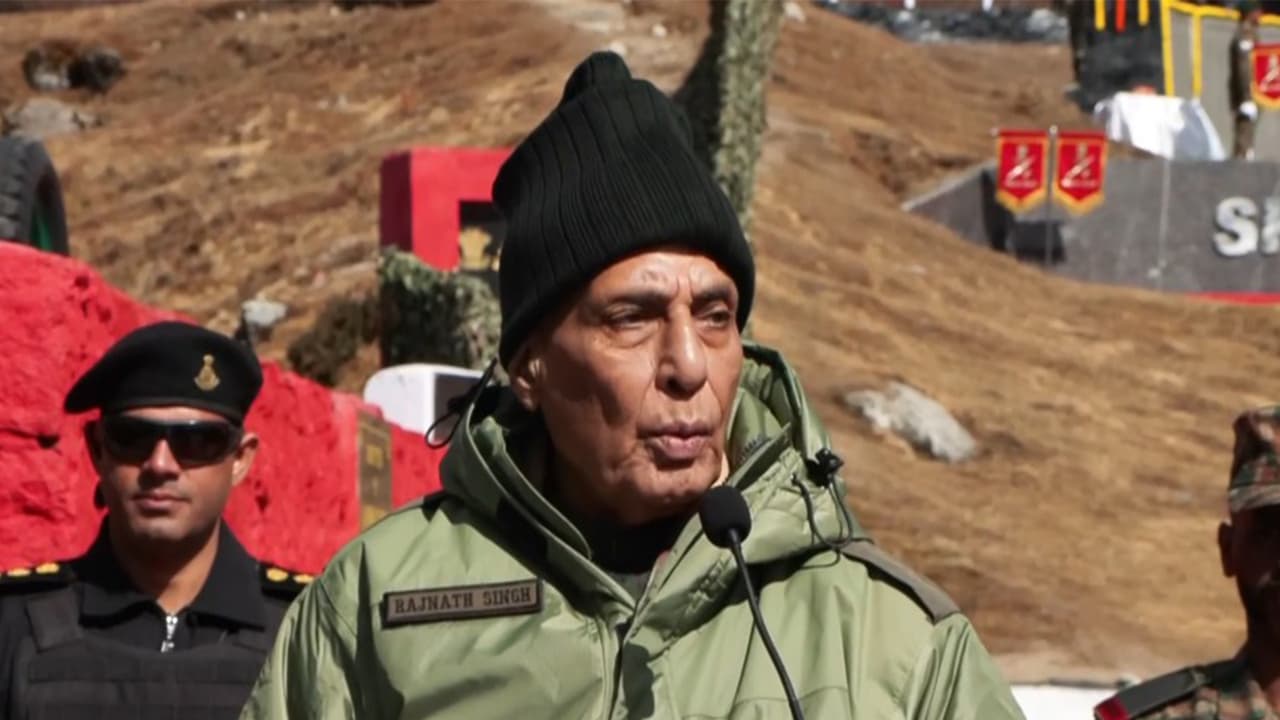
Defence Minister Rajnath Singh celebrated Diwali with soldiers at the Sherathang War Memorial in Sikkim. He lauded their dedication and sacrifices, noting that their constant vigilance allows the entire nation to celebrate festivals peacefully.
Celebrating Diwali at the Border
Defence Minister Rajnath Singh on Sunday celebrated Diwali with Indian Army personnel at the Sherathang War Memorial near Nathula Pass in Sikkim, hailing their discipline, dedication and sacrifices and saying that their presence along the country’s borders allows citizens to celebrate festivals and sleep peacefully.
Addressing Army personnel on the auspicious occasion of Diwali, Singh extended festive greetings to the soldiers and their families and paid tribute to the martyrs commemorated at the war memorial, who laid down their lives in the service of the nation. “First of all, I would like to congratulate all of you and your family members on Diwali. I would also like to congratulate the martyrs of Sherathang War Memorial who have sacrificed their lives for us,” he said.
Highlighting the sacrifices made by soldiers to protect the country, the Defence Minister said that the ability of people to light Diwali lamps in their homes was made possible by the sacrifices of brave soldiers. “Friends, the Diwali lamps that we are able to light in our homes today, it is because of the sacrifice of our brave soldiers. They have sacrificed their lives to protect the country and the community. I would also like to congratulate their families on Diwali,” he said.
Recalling his interaction with the troops at the high-altitude location, Singh said the warmth, energy and enthusiasm of the personnel were difficult to express in words. “It is very difficult for us to express the warmth and energy that I have received from you in words. I am proud of your faces, your enthusiasm and your passion. For me, Diwali is the biggest celebration,” he said.
Comparing the soldiers to lamps illuminating the country, Singh said their contribution extended far beyond the region where they were deployed, reaching every household across the nation. “I am standing here in Sherathang and I feel that all of you are like a single lamp. Your light is not limited to just Sherathang War Memorial. Your light is reaching every house in the country,” he said.
Discipline as the Ultimate Strength
Emphasising the importance of discipline alongside technological advancement, the Defence Minister said that discipline remained one of the greatest strengths of the armed forces. “But friends, I would like to make it clear that no matter how advanced the technology is, if there is no discipline and discipline in the youth, then technology becomes useless in itself. Your discipline is your greatest strength,” he said.
He also highlighted how the conduct, uniform, language and restraint of Army personnel shape the perception of the armed forces among local communities. “And wherever you are, your behaviour, your uniform, your language and your restraint also create a special image of the Army in the minds of the local people,” Singh said.
Referring to the affection the Army receives from residents of Sherathang and surrounding areas, he said it was the responsibility of soldiers to maintain the trust and goodwill of the local population. “In Sherathang and the surrounding areas, you have a great love for the Army. The common people have a great love for the Army. It is your responsibility to maintain that love,” he said.
Role of Soldiers in National Security
Drawing a parallel between the light of a Diwali lamp and the role of soldiers in safeguarding the country, Singh said that Army personnel silently perform their duties while ensuring national security. “Friends, the way a Diwali lamp fights in the dark without making any noise, I believe that your life is also like that. You do not make noise, but you trust the security of the whole country with your presence. Even when the country celebrates the festival, you keep an eye on the borders,” he said.
“And because of you, the citizens of the country can sleep peacefully. Because of you, the Diwali lamps look even brighter,” he added.
Preserving Bravery Through War Memorials
Speaking about the historical and national significance of war memorials, Singh said that such monuments preserve the bravery and sacrifices of soldiers for future generations and strengthen the collective spirit of the nation. “Friends, monuments like Sherathang have a very important place in the history of any civilisation and culture. This war memorial has forever marked the bravery of our youth in history. Now, no matter how many generations have passed, as long as this place remains, it will make the people of this area aware of the bravery and strength of our youth. And it will also keep giving them strength,” he said.
Recalling the diverse backgrounds of soldiers who made the supreme sacrifice at the memorial, Singh said that they belonged to different states, regions and communities but were united by their commitment to protect the country. “Friends, some of the young people who were martyred here were from Nagaland, some from Uttar Pradesh, some from Tamil Nadu, some from Rajasthan, and some from Assam. It means that almost all the soldiers of India were included in that list,” he said.
He said that despite belonging to different parts of the country, the soldiers had sacrificed their lives for the protection of its people. “It occurred to me that despite being from different parts of India, these soldiers gave their lives for the protection of the people of this country. Friends, it doesn’t matter which region, language, and community they were from. The only difference is that they were serving Mother India,” Singh said.
Reflecting on the source of inspiration behind their sacrifices, the Defence Minister said that India’s cultural ethos and sense of collective belonging motivated people to consider fellow citizens as members of their own family. “After all, where did these soldiers get such great inspiration from? Then I felt that this is the soul of India, this is the culture of India, and every person born here considers all Indians to be a part of his family. And for their protection, he does not back down in any way, even by sacrificing his life,” he said.
Singh further said that war memorials played an important role in shaping the collective spirit and consciousness of the country by preserving memories of historic events and the people associated with them. “Friends, I believe that such monuments shape our collective spirit and our collective consciousness. Monuments remind us of an incident, or at least remind us of the people involved in that incident. At the same time, monuments also play an important role in awakening our national spirit, that is, the sense of national pride,” he said.
Quoting a popular saying to underline the importance of memorials, he said, “There is a famous saying that monuments are for the living, not the dead. Monuments are made for those who have passed away, but they are made for those who are still alive. Monuments are made so that they continue to inspire the living.”
Referring to the National War Memorial in New Delhi, Singh said that around 26,000 names of martyrs had been inscribed there in gold letters, preserving their sacrifices for generations to come. “Take the example of the National War Memorial in Delhi. Many of you must have been there, and under the leadership of our Prime Minister, we commemorated those martyrs of our country who sacrificed their lives for their safety. In that memorial, about 26,000 names of the martyrs have been inscribed in gold letters forever,” he said.
He said that visiting the memorial and finding the names of their loved ones inscribed there evoked a deep sense of pride among the families of martyrs, their relatives and people from their villages and localities. “And now, whenever a family of a martyr, their relatives, the people of their village, the people of their area go to the National War Memorial and find the name of that soldier inscribed on a stone, they naturally develop many feelings within them,” Singh said.
“They are proud of the soldiers of their country. They are inspired to love their country more than their own life,” he added.
The Defence Minister said that such memorials also inspired ordinary citizens to develop a stronger sense of national pride and commitment towards the country. “India will also become a medium of inspiration in this way. Whenever a citizen comes to see the National War Memorial, he will naturally have a flood of emotions and a determination to do something for his country,” he said.
Expressing confidence in the role of the National War Memorial in inspiring future generations, Singh said, “I am confident that the National War Memorial will continue to inspire our youth and future generations.”
The Defence Minister expressed confidence that the Army personnel would continue to safeguard the country’s borders with the same dedication and enthusiasm. “All of you will continue to protect the national borders with the same enthusiasm,” he said.
(Except for the headline, this story has not been edited by Asianetnews Editorial staff and is published from a syndicated feed.)