Wellington: Success in sports, oftentimes, is judged by statistics. In cricket, for batters it’s centuries and half-centuries, and for bowlers it’s five-wicket hauls; in football or hockey it’s the number of goals scored for strikers and goals saved for goalkeepers, while in tennis and golf it’s the number of slams or titles won.
Numbers, however, may not reveal the true picture always. At times, a great catch or even a fine piece of fielding can alter the course of a game in cricket, in football it could be a goal line clearance from a striker in injury time or even a defence-splitting pass from a defender that propels a team to victory. It may not seem massive or celebratory in the overall scheme of things, but its impact on the team’s success on the day would be huge.
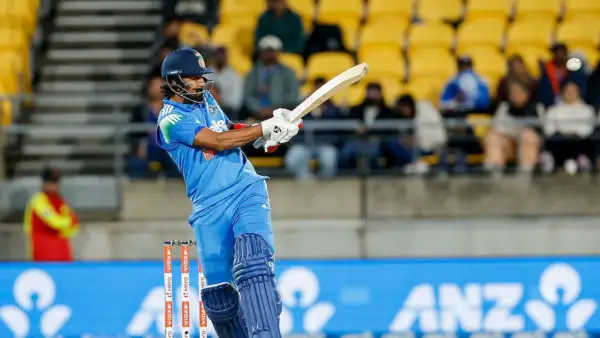
KL Rahul’s unbeaten 26 off 38 balls in the second ODI between India and New Zealand at the Hnry Stadium here in a rain-curtailed affair is one such example. In a match played on one of the spiciest pitches, especially in limited-overs cricket, in recent years where legends like Virat Kohli and Rohit Sharma struggled to get going and even top-scorer Daryl Mitchell (55) of New Zealand had to take his fair share of risks to reach that milestone, Rahul, easily, looked the most comfortable batter on the day.
From the moment the 34-year-old Rahul strode to the crease in the final ball of the 13th over till walking away when rain lashed the arena during India’s tense chase after 26 overs, Rahul was a picture of comfort on a hostile surface that had the rest of the batting pack scrambling their heads to find a way to counter it.
When Rahul joined forces with Shreyas Iyer at the fall of the fourth wicket, India were still 88 runs away from crossing the line. The New Zealand pacer quartet of Kyle Jamieson, Jacob Duffy, Nathan Smith and Matthew Fisher were making life as difficult as possible for the Indian batters, and Rahul and Iyer were the last recognised batting pair.
Rahul has been assigned the role of a finisher in one-dayers where more often than not he’s required to come and start playing the big shots from the get-go but Saturday required him to embrace the opener’s role that he plays in Test cricket. It’s the position the Karnataka batter cherishes and he was happy to adorn it.
Rahul was cautious to begin with. Having watched from behind the stumps as the designated wicketkeeper the mayhem the ball was causing on a pitch with plenty of pace, bounce and movement, the technically sound Rahul displayed all the skillsets needed to negotiate the constant dangers it posed. Some of the balls were spitting fire from good length and moved much more that what batters usually encounter in white-ball cricket.
Rahul was never flustered. He was quick to read the line and lengths, played the ones he had to and left those that had venom on it. Rahul, however, wasn’t extremely defensive too because he was aware on such pitches all it takes is one decent delivery. A ball can swing back in sharply or rise high etc. But he picked the right balls to play the attacking shots unlike many others who threw their bats to release the pressure and ended up walking back to the dressing room.
He hit two fours and an equal number of sixes and all of them came off short balls, something which he loves. The two hooked sixes, one off Smith and another off Duffy were a thing of beauty. Unlike other batters who were mostly playing poker on a lottery of a pitch, Rahul opted for chess and stood tall.
Forced to recalibrate himself as middle-order wicketkeeper batter to fit into the one-day team, Rahul has gone about his work diligently without loud noise or drawing attention like some others. It’s innings like these that show the immense value he brings to the Indian team.