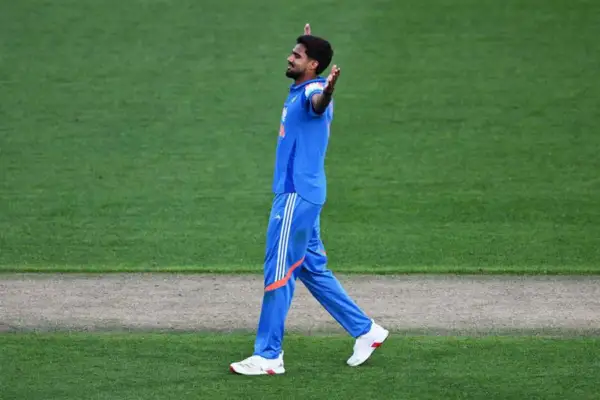
Gurnoor Brar does not want his bouncer sailing harmlessly over a batter’s head. Shoulder height is where he wants it: high enough to hurry the pull, low enough to make playing it tempting.
“I just try to bowl that hard length, the lengths where batters try to pull. I don’t want to bowl it very high; I just keep bowling at shoulder level,” he said.
In Wellington on Saturday, that distinction mattered. Brar took four for 30 as India dismissed New Zealand for 134, then survived a difficult chase to win the rain-affected second ODI by four runs under the Duckworth-Lewis-Stern method. He collected the Player of the Match award as India moved 2-0 ahead in the five-match series.
The figures rewarded a combination India’s selectors had backed before he had much international experience: a 6ft 5in frame, pace above 140kph and the ability to make a good-length ball climb.
“I really enjoyed it. Bowling here in New Zealand, the bounce and the pace really helped me, so I enjoyed it,” Brar said.
“Obviously, in India the pitches are quite flat, so we have to bowl that hard length. But here, there’s that extra bounce. So I was just bowling to my strengths, and it worked.”
The attributes that caught the selectors’ eye
When Brar earned his first India call-up for the Afghanistan series earlier this year, his selection was not simply a reward for topping a wicket-taking chart.
He had taken 52 wickets in 18 first-class matches at that point, and those were encouraging returns. However, his height and pace offered something beyond the numbers.
Ajit Agarkar, then chairman of selectors, said the panel had watched his progress over the preceding season and a half.
“He is a tall guy who can bowl at pace,” Agarkar said, according to The Times of India.
The attraction is understandable. A higher release point can make a familiar length behave differently. A batter preparing to drive may find the ball arriving higher than expected; one looking to pull still has to judge its pace and bounce.
Height alone does not deliver that discomfort. The bowler must repeatedly land the ball in the area that makes those decisions difficult.
Brar’s captain believes that consistency is the next step.
“In the last match, Gurnoor bowled really well too. As he gets more experience, he’ll get more consistent. He already has the pace and bounce. Most of the seamers have all the qualities. International cricket is about performing under pressure,” Shubman Gill said.
Learning where to land it
Brar’s account of his development is less about discovering another yard of pace than about learning how to use the pace he already has.
“Matches in Guwahati and Lord’s were demotivating, but it was important to learn from that. I had open nets with Virat and Rohit bhai, and they gave a lot of input.
“I also played in the Ranji Trophy, and those overs helped,” he said after the game.
The lesson was repetition. A threatening delivery becomes more useful when a batter knows another could follow, without the bowler having to search for something spectacular.
Brar has not abandoned aggression in that pursuit.
“If you’re a fast bowler bowling at an average of 140 or 142, you have to be aggressive as well. But you have to know your limits too. I just enjoy it and keep bowling,” he explained.
A double-wicket maiden, then a difficult finish
His double-wicket maiden in Wellington removed Tom Latham and Glenn Phillips, both caught attempting pulls. Brar later returned to dismiss Mitchell Santner and Nathan Smith, completing his four-wicket haul.
New Zealand captain Santner acknowledged how effectively India had used the conditions.
“It was a tricky wicket. There’s no hiding it. I think they bowled really well, especially at the top, challenged us, and obviously, wickets at the start are never ideal,” he said.
“Even if there was a potential way of scraping to 160 or 180, we could have gone from there.”
Brar’s work did not make the result straightforward. India were 113 for seven when rain ended the chase, four runs ahead of the DLS par score.
“As long as we get the win. It wasn’t easy batting. Getting them out at 134, I thought it’ll be an easy target, but it wasn’t. Happy we got there in the end,” Gill said.
“The pitch was challenging but we lost two extra wickets than we’d have liked in the end.”
Bishop’s case for patience
Former West Indies fast bowler Ian Bishop saw the performance as a reason to give Brar time.
“Days like these that remind us how bowlers come into their own in white ball cricket when there is a bit of help in the pitch; and why it’s important to give fast bowlers like Gurnoor Brar as long a rope as possible to find out if they can be the player you’re looking for,” Bishop wrote on X.
Brar, Anshul Kamboj and Auqib Nabi have given India encouraging options in New Zealand. That need not immediately become an argument about who makes way for a more established bowler.
For Brar, the more useful challenge is the one Gill identified: reproducing the threat often enough, across different surfaces and under pressure.
In Wellington, the bounce was available. Brar found the length to use it.