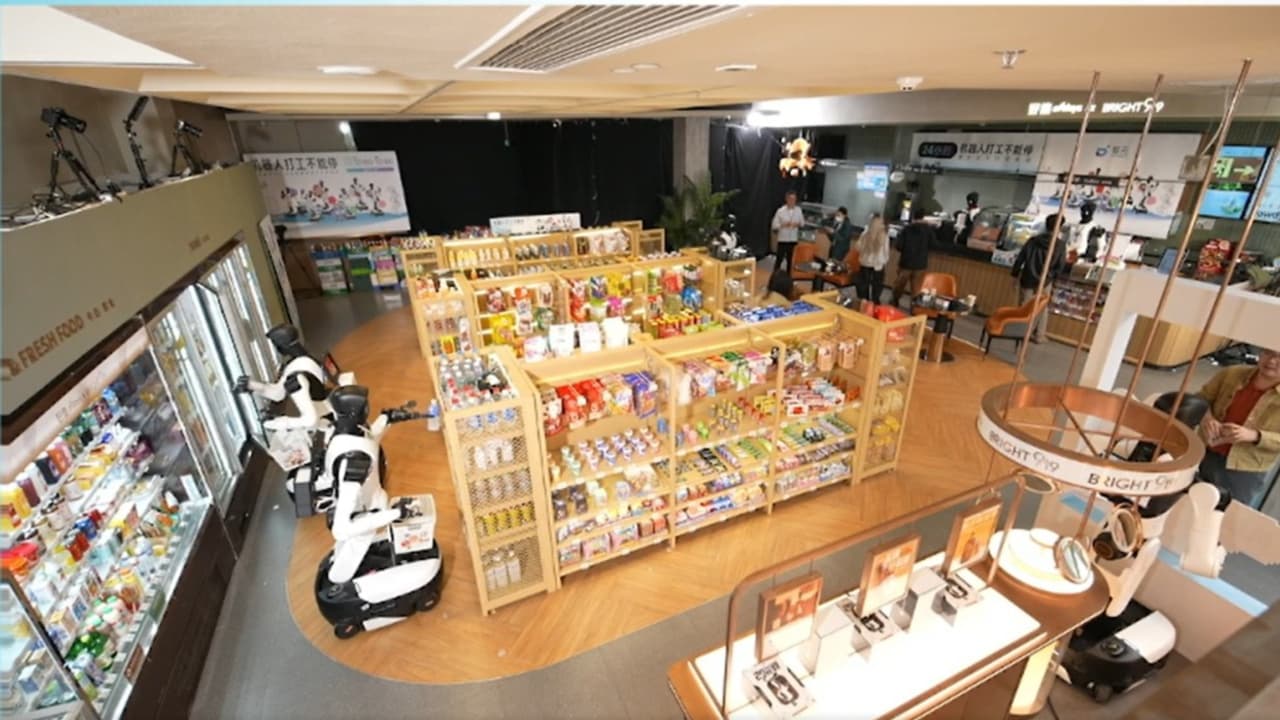
A new experiment in China has revealed that humanoid machines are not necessarily equipped to handle even routine jobs without human intervention.
As fears grow over artificial intelligence and robots potentially replacing humans in the workplace, a new experiment in China has revealed that humanoid machines are not necessarily equipped to handle even routine jobs without human intervention.
Chinese robotics manufacturer Agibot recently put six humanoid robots through a 24-hour work challenge at a convenience store in Shanghai’s Xuhui district. The livestreamed experiment tested whether the machines could withstand the demands of everyday retail operations across different shifts, from busy daytime hours to overnight duties.
Titled “Robots Never Clock Out”, the challenge was designed to assess how efficiently humanoid robots could perform regular store responsibilities under real-world working conditions.
Over the course of 24 hours, the six robots collectively completed 1,730 tasks. These included 683 customer greetings, 369 item retrievals and deliveries, and 147 coffee preparations. Their workload also featured 126 hot-food orders, 277 shelf inspections and restocking tasks, along with 128 table-cleaning assignments.
Scroll to load tweet…
The experiment covered four distinct periods of the day: the lunchtime rush, evening crowds, overnight operations and the morning breakfast rush. By exposing the machines to varying workloads and customer demands, the company aimed to evaluate their performance beyond a brief, controlled demonstration.
While four robots managed to deliver adequate performances, the two machines assigned to cleaning and shelf organisation struggled to complete their responsibilities.
According to a report by ITHome, the cleaning robot ran into trouble after encountering a full trash can along its designated route. Instead of picking it up, the machine strayed from its assigned path, wandered outside the store and failed to return to its original position.
The second robot, tasked with inspecting shelves and replenishing products, reportedly ‘lacked initiative’ and struggled to match the store’s pace of operations. Its inability to proactively identify and replenish products exposed another limitation in deploying humanoid robots for everyday retail work.
Human touch still matters
Despite impressive advances in humanoid robotics, the experiment underlined how machines continue to depend on human assistance to perform certain physical tasks. While AI systems may be capable of processing information and making decisions, translating those abilities into reliable control over physical hardware remains a significant challenge.
A similar concern emerged last month when US startup Dimensional advertised a rather unusual job opportunity, seeking human handlers to walk its robot dogs through the streets of San Francisco.
Dimensional founder Stash Pomichter said the company was hiring dog walkers to help improve the machines’ ability to navigate urban environments independently. He explained that the experiment had exposed the difficulties AI agents faced when attempting to control physical hardware without human assistance.
“What we determined from our dog-walking experiment was that agents are still very bad at controlling hardware,” Pomichter stated.
The company has reportedly purchased 100 robot dogs and 50 humanoid robots from manufacturers across China, Germany and the US. The $2,000 robot dogs spotted navigating San Francisco’s streets were purchased from Chinese robotics firm Unitree.