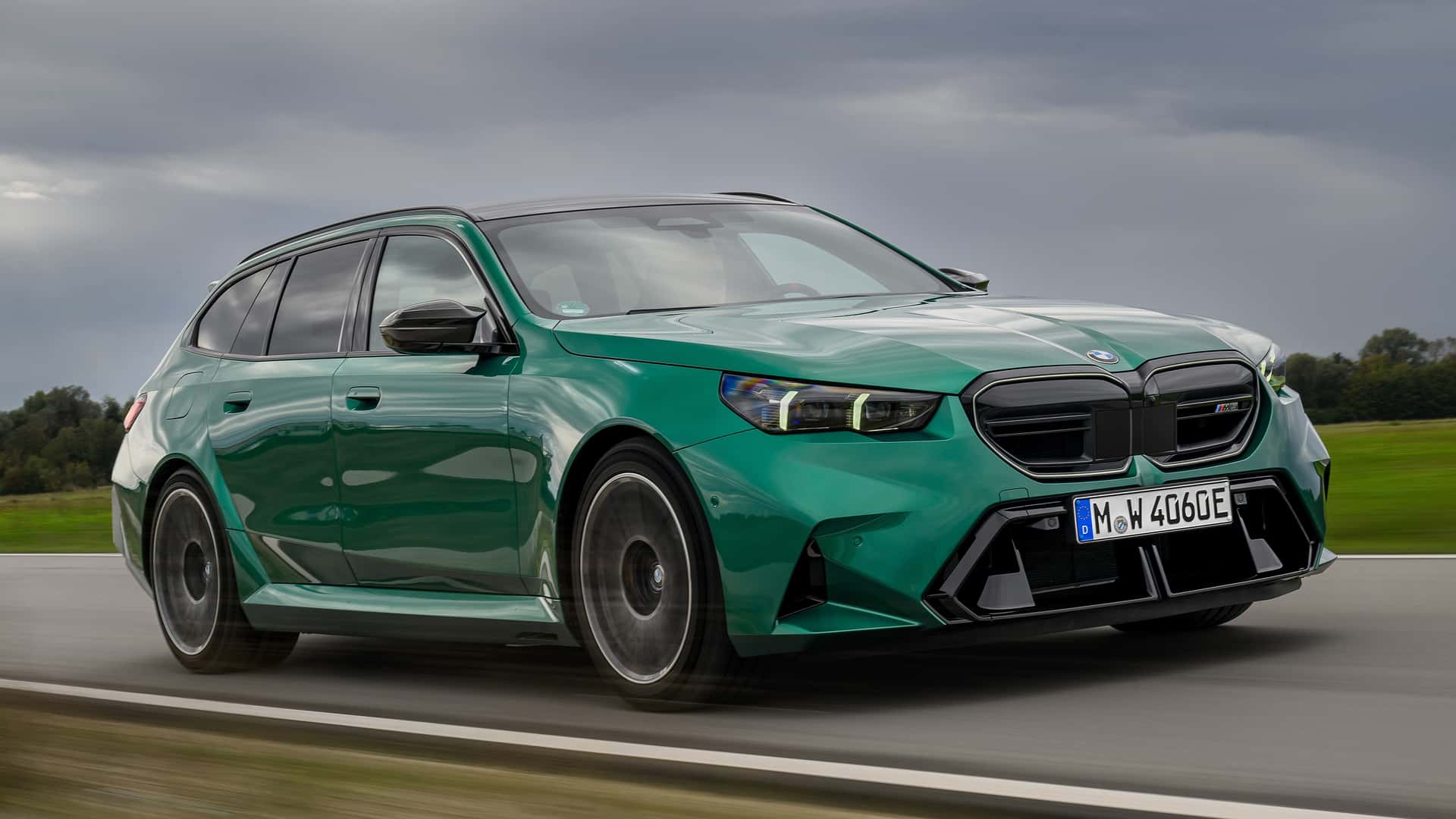
BMW’s decision to bring the M5 Touring wagon to the United States appears to be paying off far better than many expected. Long considered a niche body style in a market dominated by SUVs and crossovers, the high-performance wagon has emerged as a surprising success story for the German automaker, prompting discussions about whether more Touring models could make their way to American showrooms.
For decades, BMW enthusiasts in the U.S. watched from afar as European buyers enjoyed a wider range of Touring models. While wagons have traditionally struggled to gain mainstream popularity in North America, the arrival of the latest M5 Touring has challenged long-held assumptions about consumer demand.
M5 Touring Matching Sedan Sales
According to BMW North America, demand for the new M5 Touring has been remarkably strong since its launch. In fact, sales of the wagon are reportedly running neck-and-neck with the M5 sedan, a result that has caught the attention of company executives.
The strong reception suggests that American buyers may be more open to performance-oriented wagons than previously believed. While traditional wagons have steadily disappeared from the U.S. market over the past decade, enthusiast-focused models continue to attract loyal buyers seeking a blend of practicality, luxury, and performance.
The M5 Touring delivers exactly that formula, combining BMW’s high-output hybrid powertrain with the versatility of a wagon body style. For many buyers, it offers supercar-rivaling performance without sacrificing everyday usability.
BMW Monitoring Market Demand
Michael Keller, Vice President of Product Management at BMW North America, recently acknowledged that the company is paying close attention to the growing interest in Touring models.
According to Keller, BMW has seen continued demand from customers and has also noticed growing enthusiasm for other wagon variants, particularly the M3 Touring. Enthusiasts have actively campaigned for the high-performance wagon to be offered in the U.S., creating additional momentum around the segment.
While BMW has not confirmed any future product plans, Keller indicated that the company continues to evaluate opportunities where Touring models could make sense for American buyers.
That cautious approach suggests BMW is encouraged by current sales but wants to see whether demand remains consistent before expanding the lineup.
Which Touring Models Could Arrive Next?
If BMW decides to broaden its Touring offerings in the U.S., performance-focused variants are likely to be the strongest candidates.
Industry observers point to models such as the 550e Touring or future M Performance wagons as potential options. A next-generation M3 Touring could also become a serious contender, especially given the growing enthusiasm among American enthusiasts.
The strategy would align with current market realities. While premium performance wagons like the M5 Touring and Audi RS6 continue to attract buyers, more conventional wagons have struggled. Several manufacturers have reduced or eliminated wagon offerings altogether as consumer preferences shift toward SUVs.
A New Opportunity for Wagons?
The success of the M5 Touring demonstrates that there is still a dedicated audience for wagons in America, particularly when performance is part of the package.
BMW is not rushing into any decisions, but the company now has real-world evidence that enthusiast-focused wagons can succeed in the U.S. market. If sales momentum continues, American buyers could finally see more Touring models arrive on local shores in the years ahead.
For wagon enthusiasts, that possibility alone is enough reason for optimism.