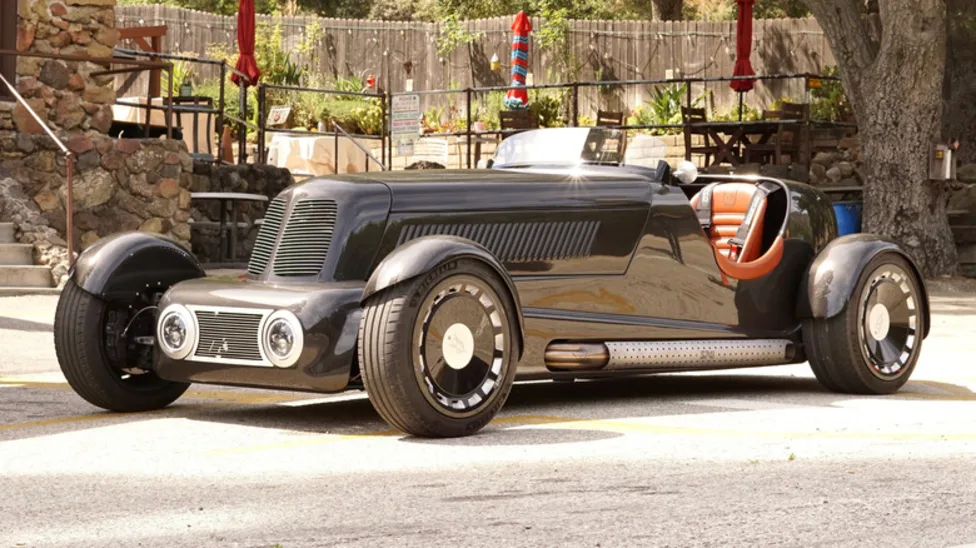
If SP40 Restomod is a name you’ve never heard before, that’s probably because it’s a custom, one-off tribute car — at least until 40 people cough up the cash to buy one of their own. That’s where the designers will draw the line: only 40 of these will ever be made, and I got to drive one of the first.
Inspired by second collaboration with designer E.T. Gregorie, the Model 40 Speedster, the SP40 is a bit art deco, mixed with some serious high-octane performance. None of the sheet metal on the SP40 is actually sheet metal: it’s all carbon fiber that makes up the body of this retro-looking machine. There’s no 1930s Ford underneath, either. The body, frame, and engine are all pieced together from original parts to make this specific vehicle, but the SP40 would likely win (or at the very least have a great showing) in any period-correct roadster show it entered.
A bit like a blank canvas given to thousands of different artists, Fords from the 1930s have been modified, tweaked, painted, and restored in as many unique ways as was imaginable. But few cars that I’ve seen over the years have taken the 1930s Ford Roadster look to this sort of extreme.
Dress for the job you want
Francisco Orden and Arturo Arrebillaga are the enthusiastic that built the SP40, and I met them out in Malibu, California, to take the SP40 for the drive. They walked me through the details before we set off, making sure I knew the appropriate information before loading into the open cabin, and answering all my questions about the build process. I can tell from the moment I shake their hands that they both really love this car, and they love watching other people experience what they’ve built. Their enthusiasm is contagious, but it also makes me even more wary about scratching their creation or, you know, breathing on it wrong.
I knew I was going to drive the SP40 weeks before seeing it in person, but loading into the SP40 — doing my best not to scuff the body panels with my shoes — I couldn’t help but feel stupid for not wearing some sort of period-correct clothing. Jeans and a t-shirt for this sort of occasion felt a bit like showing up to a first date in shorts and a tank top. If only I had pressed my Viennese suit and dusted off my flat cap to play the part. I would be driving the intimidatingly fashionable car on my local roads, and enjoy the open-air drive at speed — an experience I’d likely never have by using my own money, but one that was still truly exciting.
Add power and lightness
Packing the performance punch for the all-carbon SP40 is a . It’s paired with a five-speed manual transmission sending 480 horsepower to the rear wheels. Aside from the changes in aesthetics designed to make the Coyote look like an old flathead motor, it’s a plug-and-play performance package, meaning it revs and delivers power much like a Ford Mustang does, but with a lot less weight to carry around.
According to the spec sheets, the SP40 weighs 2,623 lbs, which is tough to believe considering its size, but easier to stomach when you see all the stunningly well-laid carbon bodywork.
When I start up the SP40, all the heads that weren’t turned, looking at it already, immediately redirect their gaze in the roadster’s direction. No pressure. Leaving the parking lot where I met Francisco and Arturo, I’m a bit hesitant with the rolling block of artwork. I kept the revs low, doing my best to avoid losing traction or stalling the SP40. No pressure. It has a long clutch-pedal travel, but it really only catches the gears in the very top of that travel, so it takes some learning to get comfortable with, and the cold rear tires squeal once or twice. The SP40’s pedal box is tiny, too, so I have to be careful where I place my feet as we head north, mountains on our right, and the Pacific Ocean on our left.
Getting used to it didn’t take very long
Once I took a turn east, away from the crowds on Pacific Coast Highway and into the Santa Monica Mountains, my nerves settled a bit, and I was able to give the SP40 a bit more power. It’s undeniably fast, but it’s approachable.
Laying into the throttle, the Coyote V8 rumbled and roared its way towards redline, with half the soundtrack being piped out just inches from my left ear. Francisco and Arturo aren’t shy about letting the SP40 rip. More than once, I gave the loud pedal full pressure from my right foot to test their resolve (they each rode shotgun at one point or another during my drive), and even with fast-approaching corners, they didn’t flinch.
When I gave the SP40 some aggressive brake input, it came to a halt in a hurry. Stopping power is provided by massive Brembo brakes in both the front and the rear: 15-inch rotors with 6-piston calipers up front, and 13-inch rotors with 4-piston calipers in the rear. This prototype car could use some brake feedback tuning (I’d like it to feel a bit more immediate), but the big brakes certainly get the job done on such a light car.
Steady in the sweepers
The SP40’s wheelbase is 121.2 inches long, which gives it astonishing stability in corners, but it only measures 166.6 inches from nose to tail. To put that into perspective, a modern has a wheelbase of 107.0 inches, but it measures 189.7 inches from front to back, and it weighs closer to 4,000 lbs. The SP40’s front and rear track are 69.5 and 67.7 inches, respectively, while a Mustang DH is a svelte 62.2 and 63.9.
So the SP40 is not only 1,300-ish pounds lighter with similar power, but it’s got a longer wheelbase, and those wheels are pushed way out to the corners: it makes the SP40 feel just as good to drive as it is to look at. Weight distribution is an impressive 48% up front and 52% in the rear, providing excellent balance through high-speed corners and there are no upsetting slides if you punch the throttle a bit on corner exit. The limited-slip differential does its job well, there.
The first 10 degrees of steering angle are ultra quick, but once you’ve got the steering wheel set for a corner’s radius, it tracks through flawlessly. The forged aluminum wheels are 20s all the way around (8.5 inches wide up front, 10 inches wide in the rear), with a stylish art-deco V8 design in the center cap and with Michelin Pilot Sport 4 S tires handling the grip.
Balanced grand touring
It’s light by modern sports car standards, but the SP40 is also extremely comfortable. Even after a few hours behind the wheel, my body didn’t feel beat up by the one-piece seat. Taking the SP40 along some of Malibu’s best roads was a gamble, because those curvy roads are well-worn, but the cracks and potholes didn’t make for any disturbances in the ride quality.
Getting the four-point harness properly adjusted to fit my frame took a bit of time, but there were no harsh hard points for my elbows or knees to get annoyed by — just a general feeling of comfort as I dashed between corners. Down beneath the massive single piece of carbon that makes up most of the SP40’s side profile are a set of side pipes that toss off a bit of heat, but the stainless steel heat guards that cover them do their job well. After an enthusiastic drive, the side pipes are warm, but not toasty. Some modern will burn you if you swing a leg over the side too close, but this SP40 is friendlier than that.
Behind the driver and passenger, there’s space for some small duffel bags, and the SP40 naturally comes with bespoke luggage to fit in the boattail-shaped trunk. This is the sort of thing you could totally take on a weekend trip; provided, of course, that there’s no rain in the forecast.
It’s not flawless
I had an incredible time driving the SP40 – it draws positive attention everywhere it goes, and it drives extraordinarily well for something that looks nearly a century old. In between driving stints, as strangers came up to ask about the roadster, however, I had some time to reflect on the small issues I’d experienced.
The most noticeable issue was the car’s inability to rev over 4,000 rpm during two short legs of the drive. When I laid into the throttle, it would rev up to 4k, then sputter, and refuse to go any higher. There was plenty of speed to be had below that mark on the tachometer, but it interrupted the experience, nonetheless. Without diagnostic equipment on hand, the SP40 folks couldn’t find the problem immediately, nor could they specify a fix, but they did the old unplug-it-and-plug-it-back-in trick, and that seemed to clear things up for the remainder of my drive.
The other major issue was heat. On a warm day, with the heat of the transmission tunnel rising through the center console and the heat of the engine exiting the hood’s louvers, the cabin is not a cool place to be. Even with the air conditioning going, it’s a sweaty experience; I’d sacrifice a hundred pounds of extra body weight for some extra insulation keeping the heat from the transmission tunnel out. The SP40 I drove is technically a prototype, so these issues will likely be fixed with production cars, though, and for what it’s worth, they were pretty minor details on an otherwise excellently-executed concept car.
Is it worth it?
There’s not much about the SP40 that doesn’t feel bespoke. Just about everything on the car you come in contact with is specially made. So the sticker shock of knowing that it’ll cost you $50,000 just to reserve your spot in line to spec one out is somewhat mitigated by knowing how special it is.
Once you’ve detailed every bit of leather, wood, and metal that lines the interior, the next $100,000 you shell out to start the build will potentially make you feel extra special. And by the time you’ve sent installment payments that add up to around $560,000 for a completed SP40 to be delivered to your door, you’ll hopefully feel like the king of the mountain. Luckily, that price includes a book that details the SP40’s build process, with your one-off car integrated into the book’s final pages. Oh, and those are the introductory prices: the cost will likely go up over time.
Is the driving experience worth half a million dollars? I wouldn’t pay $500,000 for any vehicle, but that’s mostly because I don’t have $500,000. For the sort of buyers who exist in the world where this vehicle is on their shopping list, though, it’s hard to find competition. Whether it’s up against an inspired recreation of an old muscle car, or a modern high-dollar sports car, the SP40 will certainly hold its own. Whether or not it’s special enough to get you halfway to two-comma price tag territory, you’ll have to decide for yourself.