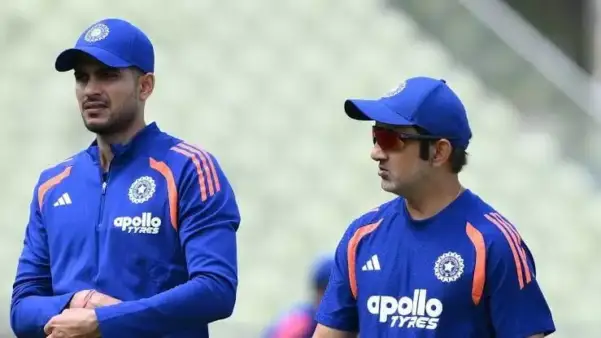
India’s bowling attack will be under the spotlight when Shubman Gill leads the team into a five-match ODI series against New Zealand from November 4, with the captain making a strong case for tall, fast bowlers capable of generating pace and bounce ahead of the 2027 World Cup.
With the tournament scheduled to be held in South Africa, India’s preparations are increasingly focused on building a bowling attack that can succeed beyond familiar home conditions. Gill has highlighted the difficulty batters face against fast bowlers operating above 140 kmph, particularly when they combine speed with height and accuracy.
The New Zealand series, beginning in Auckland, offers India an opportunity to test its bowling combinations, assess young talent and address questions surrounding its pace-bowling depth.
The challenge is particularly important with Jasprit Bumrah rested for the ODI series and Prasidh Krishna ruled out after failing to secure fitness clearance following a hamstring injury.
Shubman Gill explains why India needs taller fast bowlers
Gill believes fast bowlers who can consistently hit the right areas while generating extra bounce could become important weapons during the middle overs.
Speaking ahead of the opening ODI, the India captain explained that batters face greater difficulty against taller fast bowlers operating at speeds above 140 kmph.
According to Gill, such bowlers force batters to be more precise with their shot selection, increasing the risk of attacking deliveries.
The captain’s comments offer a glimpse into India’s thinking ahead of the 2027 ODI World Cup, where conditions in South Africa could make pace and bounce particularly valuable.
India’s bowling strategy has traditionally relied heavily on spinners during the middle overs. However, Gill’s remarks suggest the team is also exploring ways to use fast bowlers more aggressively during that phase.
The objective is not simply to restrict runs but to create opportunities for breakthroughs when opposition batters are attempting to build partnerships.
Prasidh Krishna’s absence creates another selection challenge
India’s plans have suffered a setback with Prasidh Krishna ruled out of the New Zealand ODI series.
The fast bowler was initially included in the squad subject to fitness clearance but was unable to obtain approval while recovering from a hamstring injury sustained during the England tour.
His absence removes an option whose height and ability to generate bounce could have been useful in overseas conditions.
India has responded by strengthening its pace-bowling resources. Auqib Nabi, initially selected for the final two ODIs, has been added to the squad for the opening three matches as well.
Anshul Kamboj and Gurnoor Brar also provide the management with additional options as it evaluates its fast-bowling combinations.
The series will offer an opportunity to assess whether these players can consistently deliver the pace, accuracy and control required at the international level.
Mohammed Siraj and Arshdeep Singh face important roles
With Bumrah unavailable for the ODI series, Mohammed Siraj and Arshdeep Singh will be important components of India’s pace-bowling plans.
Siraj brings considerable international experience, while Arshdeep offers a left-arm angle that can create different challenges for opposition batters.
India will need to determine which combinations can deliver during the powerplay, middle overs and death overs.
The management must also consider how its fast bowlers perform when conditions offer limited assistance.
For a World Cup campaign in South Africa, the ability to maintain pressure without relying exclusively on swing or spin could prove decisive.
Hardik Pandya’s fitness remains a major concern
India’s search for a reliable pace-bowling all-rounder remains another important issue ahead of the World Cup.
Hardik Pandya’s ability to contribute with both bat and ball provides the team with a balance that is difficult to replicate.
Gill has acknowledged the importance of Pandya’s qualities, particularly his ability to bowl across different phases of an ODI innings.
The captain also indicated that Pandya has been dealing with fitness concerns and is expected to play domestic cricket before returning to the national side.
His availability could significantly influence India’s World Cup combination, particularly when the team needs an additional fast-bowling option without weakening its batting lineup.
New Zealand series could shape India’s World Cup combination
India will play five ODIs against New Zealand between November 4 and November 15, with matches scheduled in Auckland, Wellington, Hamilton and Mount Maunganui.
The series will also provide opportunities to assess batting combinations. Gill has indicated that India intends to adopt a flexible approach in the middle order, with players such as KL Rahul and Axar Patel potentially moving according to match situations.
However, the biggest question remains whether India can develop a bowling attack capable of consistently taking wickets against strong opposition.
With the 2027 ODI World Cup approaching, the New Zealand tour represents an important opportunity to identify reliable fast bowlers and strengthen the team’s tactical options.
India’s batting may provide the foundation, but its World Cup ambitions could ultimately depend on how effectively its bowlers respond when conditions and opposition become challenging.