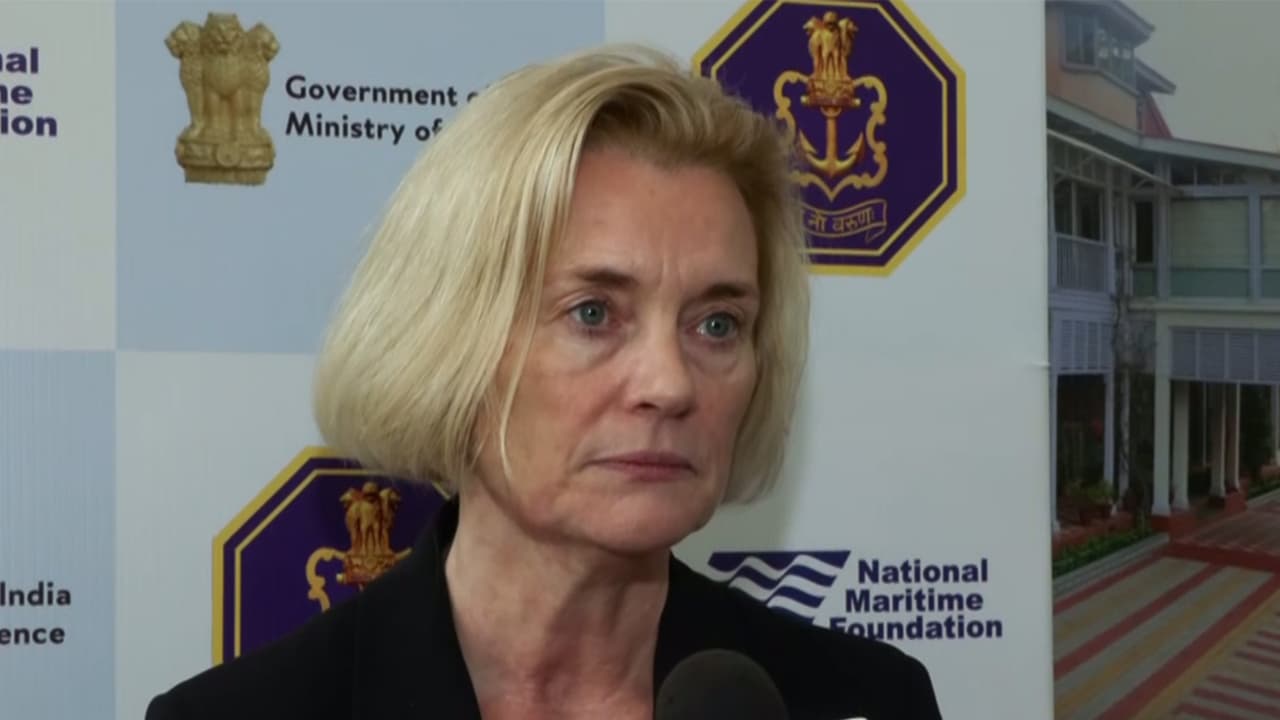
Norway’s Ambassador to India proposes serving as a bridge for India’s maritime engagement with Nordic nations, focusing on ocean research, technology, and strengthened cooperation during the Indo-Pacific Regional Dialogue 2026.
Norway as a Strategic Maritime Partner
Norway’s Ambassador to India May-Elin Stener on Tuesday said that Norway can serve as a bridge for India to strengthen its engagement with Scandinavian and Nordic countries on maritime issues, highlighting opportunities for cooperation in ocean research, technology and maritime affairs. Speaking to ANI in Delhi on the sidelines of the Indo-Pacific Regional Dialogue 2026, Stener said Norway, which recently joined the Indo-Pacific Oceans Initiative (IPOI), was exploring ways to expand research cooperation with India for the benefit of the oceans. “Norway is a new member of the Indo-Pacific Oceans Initiative (IPOI). We have been discussing research cooperation and how we can work more closely on research and technology for the benefit of the oceans,” she said.
Highlighting Norway’s maritime strengths, the Ambassador said, “Norway is the largest maritime nation among the Scandinavian countries, with an Exclusive Economic Zone slightly larger than India’s. Our extensive coastline has made us a maritime leader in shipbuilding, research and ocean-climate studies.” She further said Norway’s maritime expertise could help India deepen its engagement with other Nordic countries. “This also positions Norway as a bridge for India to engage with Scandinavian and Nordic countries on maritime issues. Prime Minister Narendra Modi visited Norway in May this year and participated in the India-Nordic Summit, where maritime issues were among the key areas of discussion,” Stener added.
India-Sri Lanka Maritime Cooperation
Addressing the dialogue, High Commissioner of Sri Lanka to India Mahishini Colonne highlighted the maritime and security cooperation between India and Sri Lanka, stressing that the two countries shared responsibilities in the Indian Ocean region. “India and Sri Lanka share not only a sea but also security. Our President has assured Prime Minister Narendra Modi that it will never allow its territory to be used in any manner inimical to India’s security. This commitment forms the foundation for scientific cooperation,” Colonne said.
Meanwhile, former Commander of the Sri Lankan Navy Jayantha Perera highlighted the strong maritime partnership between India and Sri Lanka, crediting the Indian Navy with providing significant assistance and responding promptly during emergencies. Speaking to ANI, Perera said, “The partnership between India and Sri Lanka’s navies is very good. The Indian Navy has helped us significantly, and we conduct several joint exercises. Whenever there is a situation or danger, the Indian Navy is among the first to respond.”
Modernizing Naval Forces
He said the cooperation also reflected Prime Minister Narendra Modi’s Neighbourhood First Policy, adding that personal relationships and friendships between the two countries played an important role in strengthening their maritime partnership. “This reflects Prime Minister Narendra Modi’s Neighbourhood First Policy. We also share strong personal relationships and friendships, which are equally important in strengthening cooperation,” he said. On the importance of science and technology in maritime security, Perera stressed the need for naval forces to adapt to rapidly evolving geopolitical and technological developments. “It is very important. Geopolitics is rapidly evolving, and technology is developing equally fast. We need to adapt to these changes. Future maritime challenges will require technological knowledge and expertise, and it is important to equip the younger generation with these capabilities,” he said. Emphasising the changing nature of maritime security, he added, “Traditional navies are no longer enough; modern naval forces must become technologically sophisticated.”
Academic Cooperation in the Indo-Pacific
Meanwhile, speaking to ANI, former Deputy Chief of the Naval Staff Sanjay Mahindru said the Indo-Pacific Regional Dialogue was an annual initiative based on the IPOI, with academic cooperation as the central focus of this year’s edition. “This is an annual initiative based on the Indo-Pacific Oceans Initiative (IPOI). This year, academic cooperation is the main focus, with discussions aimed at bringing academic institutions across Indo-Pacific countries together to collaborate, share capacities and capabilities, and build collective strength to address future regional challenges,” he said.
On submarine cooperation, Mahindru said there was scope for countries to collaborate in understanding the underwater domain, while noting that submarines remained a confidential aspect of every navy. “Submarines are generally a very confidential part of every navy. However, there is scope for collaboration, particularly in understanding the underwater domain in which submarines operate. Sharing knowledge about regional hydrology and bathymetry, along with the unique characteristics and challenges of different maritime regions, can help improve our understanding of the underwater domain,” he added.
Their remarks come as New Delhi hosts the 2026 edition of the Indo-Pacific Regional Dialogue under the theme ‘Science, Technology and Academic Cooperation in the Indo-Pacific’. The three-day dialogue seeks to bring together diverse perspectives on strengthening the foundations of maritime security in the region. (ANI)
(Except for the headline, this story has not been edited by Asianetnews Editorial staff and is published from a syndicated feed.)