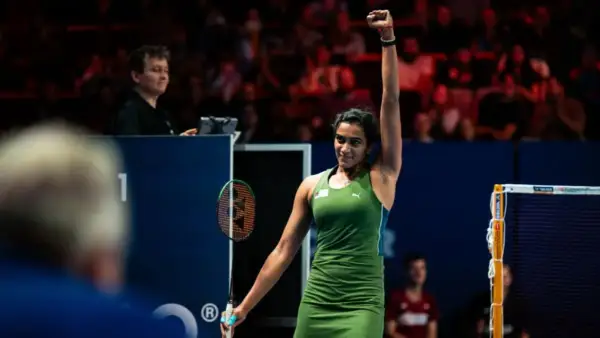
PV Sindhu has developed a knack for winning the big battles, even as she enters a stage of her career when longevity is becoming as significant as silverware.
At 31, the Indian shuttler is treading a path few of her contemporaries have managed to navigate, continuing to compete at the highest level while adapting to the demands of an increasingly younger and physically demanding badminton circuit.
The 2026 season has offered perhaps the clearest indication yet of Sindhu’s ability to reinvent herself. After enduring a prolonged title drought, the former world champion has rediscovered her winning touch on the BWF World Tour, collecting significant titles, reaching major finals and moving back into the World Top 10. Her projected rise to World No. 6 is another indication of how effectively she has revived her campaign.
Her title-winning performances at the Japan Open and Hylo Open have been particularly encouraging. In Tokyo, Sindhu ended a 19-month wait for a World Tour title, defeating home favourite and former world champion Akane Yamaguchi 21-17, 21-17 to become the first Indian singles player to win the Japan Open.
She followed that achievement with another impressive performance at the Hylo Open, beating Denmark’s Line Kjærsfeldt 21-12, 21-14 in just 39 minutes to become the first Indian women’s singles champion at the tournament. Sandwiched between those triumphs was a runner-up finish at the French Open, where she challenged reigning Olympic champion An Se-young before eventually settling for second place.
These results suggest that Sindhu’s resurgence is not an isolated burst of form. Rather, they reflect a player who has gradually rediscovered the ability to compete consistently against the strongest opponents on the circuit.
Evolution of Sindhu’s Game
The Sindhu who emerged at the Rio 2016 Olympics was a vastly different player from the one competing on the international circuit today. Her imposing physical presence, explosive attacking strokes and ability to dominate opponents from the rear court were central to her rise.
However, the modern women’s singles circuit demands much more than powerful smashes and physical endurance. The emergence of exceptionally quick and tactically disciplined players has made rallies longer, while the ability to control the net and construct points has become increasingly important. Sindhu has had to evolve accordingly.
Her attacking instincts remain a significant part of her game, but there is greater emphasis on rally construction, patience and variation. Her ability to mix attacking clears with deceptive drops, maintain control around the net and wait for the right opportunity to accelerate has become an important aspect of her approach.
At this stage of her career, the objective is not necessarily to outlast every opponent physically but to use her experience to manage rallies more intelligently. That tactical maturity can make a considerable difference, particularly against younger opponents who rely heavily on pace and intensity.
Training Smarter, Not Simply Harder
Former Indian badminton player Trupti Murgunde believes Sindhu’s longevity is closely linked to her dedication, work ethic and willingness to adapt her training methods.
Speaking exclusively to myKhel, Murgunde explained that Sindhu’s continued presence at the highest level deserves considerable appreciation, particularly when viewed against the physical challenges she has encountered throughout her career.
“The Sindhu we saw at the Rio Olympics was different from the player we saw at subsequent Olympic editions. However, considering her age, the injuries she has experienced and the fact that several players from her generation have stepped away from the sport, her continued presence at the highest level is remarkable,” Murgunde said.
Having known Sindhu from her younger days and shared the Indian team environment with her, Murgunde has witnessed the commitment that has underpinned the shuttler’s career.
“One quality I have always admired in her is her dedication and work ethic. I have known Sindhu since she was very young, and there was a time when we were both part of the Indian team. Her commitment to the sport has remained consistent throughout her career,” she added.
However, dedication alone cannot sustain an athlete indefinitely. As the body accumulates years of competitive wear and tear, the ability to manage physical demands becomes just as important as the intensity of training.
This is where Sindhu’s approach appears to have evolved. Murgunde believes the Indian shuttler is increasingly prioritising intelligent workload management, alongside greater attention to nutrition, sports science and technology.
“When you have spent so many years competing on the international circuit, managing your workload and training intelligently becomes extremely important, particularly when injuries are involved. I believe she is placing greater emphasis on training smartly, along with focusing on her diet, sports science and the use of available technology,” she explained.
These elements are particularly relevant in a sport where players are required to compete across multiple tournaments, travel extensively and maintain peak physical conditioning throughout the season.
Longevity In An Unforgiving Circuit
Sindhu’s continued presence also stands out because of the changing landscape of women’s badminton. Several players from her generation have either retired or moved away from regular competition at the highest level. Thailand’s Ratchanok Intanon remains another prominent example of a player from that generation continuing to compete at an elite level.
The comparison highlights how difficult it is to sustain a long career in a sport where speed, recovery and physical conditioning are constantly tested.
For Sindhu, however, longevity is no longer just about remaining on the circuit. Her 2026 results indicate that she still possesses the competitive edge to challenge for major titles.
The challenge now is to convert this resurgence into sustained success against the likes of An Se-young and the emerging generation of women’s singles players. Her victories in Japan and Germany have demonstrated that she can still deliver under pressure, while her French Open final appearance underlined her ability to reach the business end of major tournaments.
At 31, Sindhu may not be the same explosive player who announced herself to the world in Rio, but that does not necessarily make her a lesser competitor. She has had to exchange some of the physical advantages of her younger years for tactical maturity, better workload management and a deeper understanding of her own game.
Her 2026 campaign is therefore about more than a return to the winner’s circle. It is a demonstration of how elite athletes can extend their competitive relevance through adaptation.
For Sindhu, the next chapter may not be defined by how hard she can hit the shuttle, but by how intelligently she can continue to win.