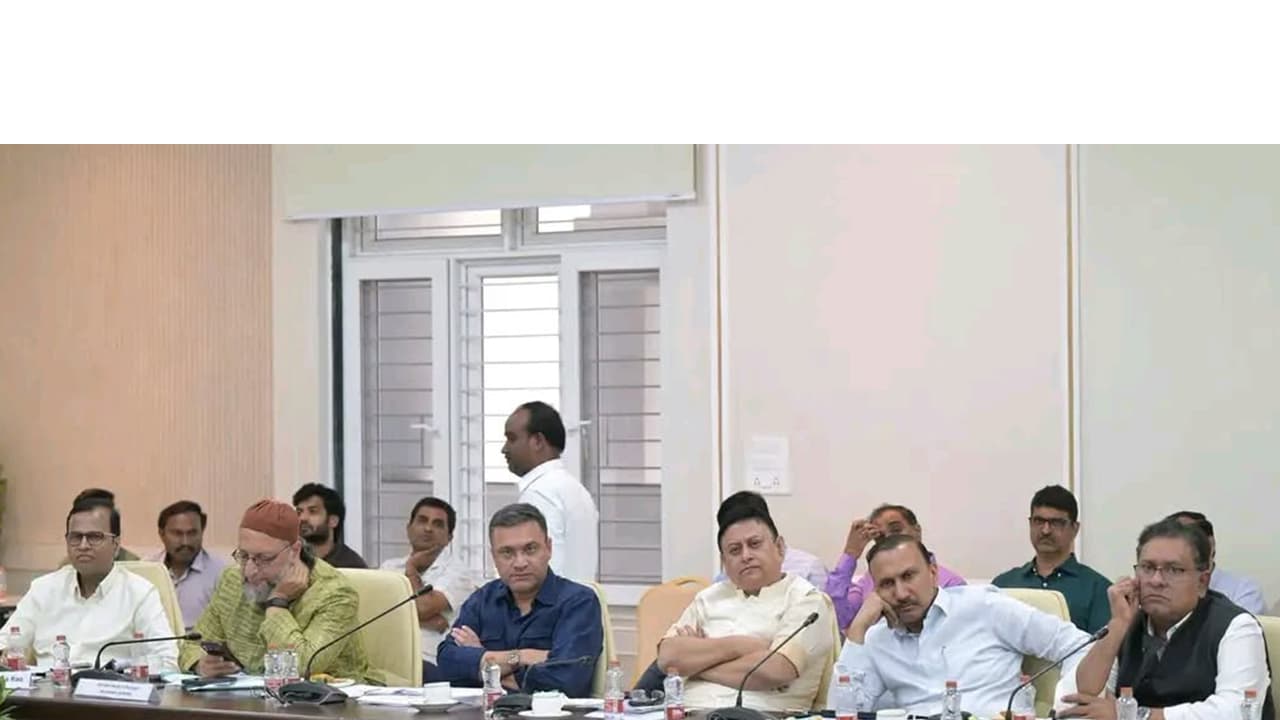
AIMIM president Asaduddin Owaisi has urged the Telangana government to urgently implement an expert-backed contingency plan to combat severe drought, water shortages, power deficits, and rising commodity prices currently impacting the state.
Addressing the Drought Crisis in Telangana
AIMIM president Asaduddin Owaisi, along with AIMIM Floor Leader Akbaruddin Owaisi, attended an all-party meeting chaired by Telangana Deputy Chief Minister Mallu Bhatti Vikramarka on Wednesday to discuss the impact of El Niño and drought conditions in the state, and sought immediate remedial measures to address concerns over drinking water, electricity, agriculture and essential commodities. During the meeting, Owaisi submitted a detailed representation to Bhatti Vikramarka, urging the state government to implement the contingency action plan prepared by an expert committee headed by G Chinna Reddy, which was submitted on July 30, 2026, and required a budgetary allocation of Rs 803 crore. “The situation before us is grave,” Owaisi said in the representation, highlighting the rainfall deficit and declining reservoir storage levels across Telangana. According to the representation, the state received 619 mm of rainfall against the normal 825.4 mm until October 27, marking a deficit of 25 per cent. Telangana received only 3.5 mm of rainfall in October against the normal 75.6 mm, while Hyderabad recorded 2.8 mm against the normal 88.5 mm. Owaisi also referred to the declaration of 365 mandals across 31 districts as drought-affected for the Kharif 2026 season and called for urgent steps to mitigate the impact on both rural and urban areas.
Proposed Relief Measures for Urban and Rural Areas
Welcoming the constitution of a Cabinet Sub-Committee under the Deputy Chief Minister’s chairmanship to review and monitor drought and El Niño conditions, Owaisi said the existing relief framework needed to be supplemented with a dedicated urban summer action plan covering Hyderabad, Cyberabad, Malkajgiri and the surrounding Hyderabad Metropolitan Development Authority (HMDA) region. Expressing concern over drinking water availability, Owaisi pointed out that the Singur reservoir was at 10.13 per cent of its capacity, with storage of 3.03 thousand million cubic feet (TMC) against its capacity of 29.92 TMC. He said the combined storage in five of the eight reservoirs supplying the Hyderabad Metropolitan Water Supply and Sewerage Board (HMWSSB) stood at 9.28 TMC against a capacity of 38.95 TMC. The representation stated that HMWSSB’s water supply had declined from the normal 597 million gallons per day (MGD) to 576.55 MGD, while tanker demand averaged between 6,000 and 8,000 bookings daily. Owaisi urged the government to publish a dedicated summer drinking water plan for Hyderabad and the HMDA region, including source-wise availability, locality-wise supply schedules and contingency arrangements. He also called for measures to address a reported shortfall of 65 MGD, complaints about coloured and foul-smelling water, and declining groundwater levels.
Power, Agriculture, and Essential Commodities
On electricity, Owaisi said peak demand had crossed 20,000 MW on October 15 and was projected to reach 22,000-23,000 MW during the summer of 2027. He urged the government to operate Telangana power generation plants at full capacity, particularly the Yadadri Thermal Power Plant, which he said was currently generating 1,200-1,500 MW against its capacity of 4,000 MW. He also sought additional short-term power arrangements, timely upgrades to feeders and transformers, and adequate staffing and materials to ensure quicker responses to power disruptions.
Highlighting agricultural distress, Owaisi’s representation stated that the Kharif crop area had declined by 13.22 lakh acres, from 1.39 crore acres to 1.26 crore acres. Paddy cultivation had fallen by 18 per cent, from 69.19 lakh acres to 57 lakh acres, while nearly 20 lakh acres of crops were reportedly damaged. He urged the government to announce a clear irrigation schedule for the Yasangi season and ensure that any decision on a Rabi crop holiday was accompanied by compensation, seed and input support for alternative crops, and marketing arrangements. Owaisi further sought an expansion of drought relief measures to cover urban daily-wage workers, who could face employment losses and heat exposure during the summer months. His recommendations included setting up free drinking water kiosks at intervals of 300-500 metres along major roads and crowded public places, establishing cooling centres, distributing oral rehydration solution (ORS) packets, and providing drinking water arrangements for animals. He also called for adjustments to school timings to help children avoid peak afternoon heat and urged the government to prioritise women, children and elderly people in water and heat-relief measures.
On essential commodities, Owaisi raised concerns over rising prices of sugar, edible oil, onions, ginger, garlic, chicken and eggs. He sought the prompt expansion of the Public Distribution System to include subsidised edible oil, sugar, wheat and pulses, along with action against illegal hoarding and stockpiling. The AIMIM president also proposed a time-bound monitoring mechanism, including public dashboards, regular reporting on water supply and outages, and periodic reviews of relief measures. “The people of Telangana are facing a convergence of drought, groundwater depletion, power stress, crop loss and inflation,” Owaisi said, urging the government to adopt a coordinated and transparent response. He requested that his representation be placed before the Cabinet Sub-Committee and that the government issue the necessary orders at the earliest. (ANI)
(Except for the headline, this story has not been edited by Asianet Newsable English staff and is published from a syndicated feed.)