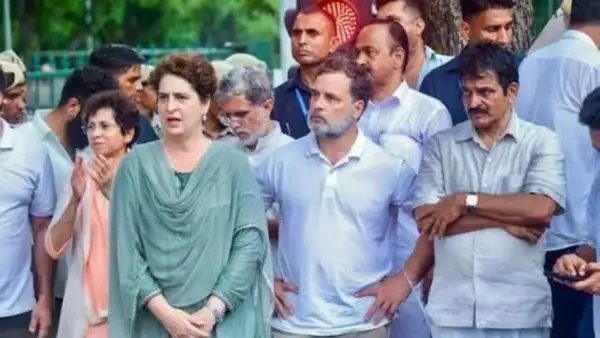
The Congress failed to win any seats in the biennial elections to 28 Legislative Council constituencies across Uttar Pradesh, Bihar, Maharashtra and Karnataka, marking a major setback for the party.
The biggest blow came in Karnataka, where the ruling party suffered a defeat as the Bharatiya Janata Party (BJP)-Janata Dal (Secular) alliance won all four seats, including one previously held by a sitting Congress MLC. The outcome has raised concerns over the organisational strength of the DK Shivakumar-led government and its ability to translate its Assembly majority into electoral support among graduates and teachers.
The declared results do not directly reflect public sentiment across the four states. The elections involve a restricted electorate of registered graduates and teachers, with local political dynamics often playing a crucial role. However, Congress’s failure to win any of the 28 seats is a setback the party will find difficult to overlook, particularly as its most significant defeat has come in Karnataka, where it is in power. The outcome comes amid the party’s campaign against the BJP-led Centre and the Election Commission of India.
The Karnataka results are particularly significant compared with the overall tally, as Congress is not contesting against an established government from the opposition benches but is itself in power. The party has governed the state since 2023 and has access to the state administration. The BJP-JD(S) sweep has consequently raised questions about the Congress government’s performance, its grassroots political networks and the effectiveness of its campaign among two electorally influential groups.
The results of the MLC elections in Maharashtra, Bihar and Uttar Pradesh indicate that Congress’s weak performance is part of a broader electoral challenge, although the political dynamics vary across the three states. Unlike Karnataka, Congress is not in power in any of these states, where regional parties, electoral alliances and the strength of individual candidates play a significant role.
In Uttar Pradesh, where 11 seats were contested, the main battle has been between the BJP and the Samajwadi Party (SP). The BJP retained seats in Meerut, Bareilly-Moradabad and Lucknow, while the SP won the Varanasi Teachers’ and Agra Teachers’ constituencies. Counting was still underway in several constituencies.
The emerging trends in Uttar Pradesh suggest that the BJP has maintained a strong position, while the SP has made gains in key constituencies.
Bihar’s eight-seat contest has produced a more diverse outcome. The Rashtriya Janata Dal (RJD) won the Patna Teachers’ constituency, while the BJP secured the Tirhut Teachers’ seat. Prashant Kishor’s Jan Suraaj Party (JSP) registered its first Legislative Council victory in Darbhanga, and Independent candidate Rahul Raj won the Saran Teachers’ constituency. The JSP’s win came at the expense of sitting Congress MLC Madan Mohan Jha, dealing another setback to the party. Counting in the graduates’ constituencies was still underway at the time of publication, leaving the overall results incomplete.
In Maharashtra, the final outcome for the five seats was also awaited, with counting still in progress. The contest features the ruling Mahayuti alliance against the opposition Maha Vikas Aghadi. Early trends indicated that the BJP-led Mahayuti was gaining ground as counting continued.