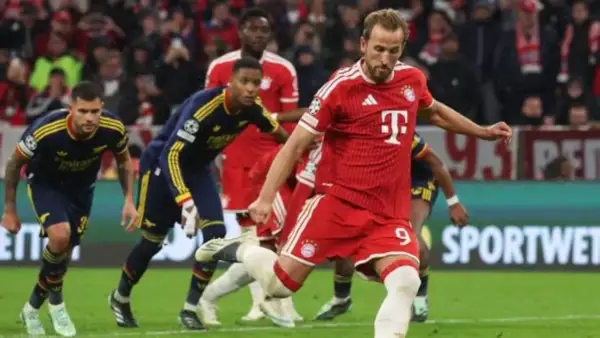
Some footballers are remembered for the trophies they win. Others are remembered for the goals they score. And then there is Harry Kane, a player who spent years giving everything to football, even when the biggest rewards kept slipping away.
Now, with the Ballon d’Or in his hands, his story feels complete in a way that only a true football fan can understand.
There are football stories that make you happy, and there are stories that make you emotional. Harry Kane’s journey has always been a little bit of both.
As a Harry Kane fan, I have always believed that football is not just about winning trophies. It is also about the years of hard work, the goals scored under pressure, the disappointments faced in silence and the courage to keep going when things do not work out.
For years, Kane gave us all of that. He scored goals, broke records, carried teams and kept chasing the biggest dreams in football. But one question followed him almost everywhere: when would he finally win the trophies his performances deserved?
Today, that question has a beautiful answer. Harry Kane has won the Ballon d’Or.
And honestly, it feels like a victory for every fan who believed in him when the medals were missing.
Harry Kane’s story at Tottenham Hotspur will always have a special place in football history. It was where he grew from a young academy player into one of the most feared strikers in the world.
He was not handed greatness overnight. He had loan spells, struggled to establish himself and had to fight for his place. When his breakthrough finally came during the 2014-15 season, Kane made sure that the world took notice.
Goals started flowing, and soon he became the face of Tottenham’s attack.
Season after season, he delivered. He won the Premier League Golden Boot three times, became Tottenham’s all-time leading goalscorer with 280 goals in competitive matches and established himself as one of the finest finishers of his generation.
He could score with either foot, dominate in the air, finish from inside the box and produce spectacular strikes from distance. But what made Kane special was that he was never just a goalscorer. He could drop deep, pick out a pass, create chances and bring his teammates into the game.
His partnership with Son Heung-min became one of the most exciting attacking combinations in Premier League history. The understanding between them was almost magical. One could find the other with a pass that defenders simply could not anticipate.
Yet, despite all the goals, the individual awards and the unforgettable nights, there was one thing Tottenham and Kane could not achieve together: a major trophy.
The 2015-16 Premier League season ended with Tottenham finishing third after being in the title race. The following season, Spurs finished second behind Chelsea. In 2019, they reached the Champions League final for the first time in their history, only to lose 2-0 to Liverpool.
That final remains one of the most painful chapters of Kane’s career. Tottenham had fought their way through an incredible European campaign, but the biggest night ended without the ending their fans had dreamed of.
Kane had goals, records and recognition. What he did not have was the medal that could silence those who questioned his legacy.
Some people judged him for not winning trophies. But was it fair to measure one player’s greatness only by the silverware won by his team?
As a fan, I always found that argument difficult to accept. Kane kept showing up, kept scoring and kept trying to take Tottenham to the top. He could not control every missed chance, every defensive mistake or every decision made on the pitch.
He could only do his job. And he did it brilliantly.
When he finally left Tottenham in August 2023, he departed as a legend of the club. His 280 goals were not just numbers on a statistics sheet. They represented nearly two decades of association with Spurs, years of loyalty, incredible performances and memories that fans will never forget.
But his departure also meant accepting a difficult truth: sometimes, loving a club and giving it everything is not enough to achieve every dream.
Kane needed a new chapter. Football needed to see what he could do in a team built to win the biggest trophies.
That chapter began in Germany. Moving to Bayern Munich in 2023 was one of the most important decisions of Kane’s career.
For the first time in his senior career, he joined a club where winning domestic trophies was not just an ambition but an expectation. Bayern had a history of dominating German football and competing for European honours.
Kane arrived with enormous pressure. Some wondered whether he would adapt to a different league. Others questioned whether he could turn his incredible goalscoring ability into team success.
He answered the first question almost immediately.
In his debut Bundesliga season, Kane scored 36 league goals in 32 appearances, setting a new record for a player in his first Bundesliga campaign. He finished as the league’s top scorer, proving that his ability was not limited to English football.
But the trophy wait continued during that first season, with Bayern finishing without a major domestic title. For Kane, it was another reminder that individual brilliance does not automatically guarantee collective success.
Then came the breakthrough. Bayern’s 2024-25 Bundesliga title gave Kane his first major team trophy of his senior career. After years of near misses at Tottenham and a frustrating first season in Germany, the moment finally arrived.
For many players, a league title is simply another achievement. For Kane, it meant something much deeper.
It was proof that he could be the leading man in a trophy-winning team. It was a moment that rewarded years of patience and answered the criticism that had followed him for so long.
And he was far from finished.
Kane continued to score at an extraordinary rate, helping Bayern maintain their dominance and adding more silverware to his collection. His performances during the 2025-26 campaign took him to another level, with 73 goals for club and country in 65 matches.
Bayern won the Bundesliga, the DFB-Pokal and the Franz Beckenbauer Supercup. Kane also finished as the Bundesliga’s leading scorer for the third consecutive season and scored 14 goals in the Champions League as Bayern reached the semi-finals.
The man who had once been defined by trophies he had not won was now collecting them.
But the greatest recognition was still to come.
Kane’s journey with England has been another emotional part of his career.
International football places a different kind of pressure on a player. At club level, you can work with the same teammates throughout the season. With your national team, you have limited time to prepare, yet the expectations of an entire country rest on your shoulders.
Kane embraced that responsibility.
His 2018 FIFA World Cup campaign in Russia announced him as one of the world’s leading strikers. He scored six goals to win the Golden Boot and helped England reach the semi-finals, giving a generation of supporters renewed belief in the national team.
He became England captain and eventually surpassed Wayne Rooney to become his country’s all-time leading goalscorer.
However, the international journey also brought heartbreak.
At Euro 2020, played in 2021, England reached their first European Championship final. They came agonisingly close to winning the tournament at Wembley, but Italy prevailed in a penalty shootout.
Three years later, England reached another European Championship final at Euro 2024. Once again, Kane and his teammates came close to history, only to lose to Spain.
Imagine what those defeats must have felt like for a player who had spent so many years chasing major honours. He had already experienced the disappointment of the Champions League final with Tottenham. Now, twice, the biggest prize in European international football had slipped away.
Yet Kane never stopped leading England.
He continued to score, continued to shoulder the pressure and continued to believe that the team could achieve something special.
At the 2026 World Cup, England finished third, their best result at the tournament since winning it in 1966. Kane scored six goals and played a major role in that campaign.
For me, his England career has always been about more than the numbers. It is about the responsibility he accepts, the way he leads from the front and the fact that he continues to stand up after disappointment.
Football does not always reward effort with a fairytale ending. But Kane has never allowed heartbreak to define the whole story.
And then came 26 October 2026. Harry Kane won the Ballon d’Or.
The boy who once had to prove himself at Tottenham had become the best player in the world in the eyes of the award’s voters. He became the first Englishman since Michael Owen in 2001 to win the men’s prize.
His 2025-26 season had been extraordinary, combining remarkable goalscoring numbers with domestic trophies and a memorable World Cup campaign.
For a player whose career had so often been discussed through the lens of what he had not won, this was a moment of recognition that went beyond statistics.
It was not just about the goals. It was about the journey behind them.
It was about the years at Tottenham when he scored almost everything but could not get his hands on the biggest trophy. It was about the Champions League final, the European Championship finals and the painful feeling of being so close without reaching the destination.
It was about making a difficult move to Germany, starting again and continuing to work until the rewards finally arrived.
And it was about showing that a footballer’s story does not have to follow a perfect timeline.
Some players win major trophies early in their careers. Others wait until their thirties. Some are remembered for a single magical season. Others build their greatness over more than a decade.
Kane belongs to the second group.
His Ballon d’Or is not a reward for one brilliant night. It is recognition of a career built on consistency, intelligence, dedication and an extraordinary ability to score goals.
As a fan, I wish he had won the Champions League with Tottenham. I wish England had lifted the Euro trophy with him as captain. Those memories would have made his story even more beautiful.
But football rarely gives us everything we want.
Sometimes, it gives us something different: the chance to watch a player keep fighting until the world finally recognises what we saw in him all along.
What makes Harry Kane special to me is not simply that he scores goals. Plenty of great strikers have done that.
It is the way he has developed his game, his willingness to take responsibility and his ability to remain effective across different teams, competitions and stages of his career.
He is a striker who can finish moves, create opportunities, dictate attacks and make the players around him better. He combines the instincts of a traditional centre-forward with the vision of a playmaker.
He has never needed to be the loudest personality on the pitch. His football has always done most of the talking.
And perhaps that is why his journey feels so personal to those who have followed him for years.
We watched him rise at Tottenham. We watched him chase the Premier League title. We watched him walk away without the trophy many believed he deserved. We watched him take a chance at Bayern Munich and finally experience the joy of winning.
Now we have watched him lift the Ballon d’Or. The journey has not been perfect, but that is precisely what makes it special.
I have always been a huge Harry Kane fan, and there is something incredibly satisfying about seeing him reach this moment.
Not because the Ballon d’Or suddenly makes him a great footballer. He was already great long before this award arrived.
It is satisfying because the recognition has finally caught up with the performances.
For years, the conversation around Kane was often about the missing trophies. Now, the story can be told differently. He is a Tottenham legend, a Bayern Munich champion, England’s record goalscorer and a Ballon d’Or winner.
That is a remarkable career by any standard.
And if there is one thing his journey teaches us, it is that greatness should never be measured only by what a player has won at a particular stage of his career. Sometimes, the full picture takes time to emerge.
Kane did not give up when Tottenham’s trophy cabinet remained empty during his time there. He did not allow his first season at Bayern to define his move. He did not stop leading England after the heartbreak of major finals.
He kept going. And now, the same player who spent years being asked when he would finally win something has the biggest individual honour in football.
For a fan, that is more than a headline. It is a moment to celebrate everything that came before it.
Harry Kane, the goals were always there. The talent was always there. The greatness was always there. Now, the Ballon d’Or is there too.
And perhaps the most beautiful part of this story is that we did not have to believe he was great only after he won it.