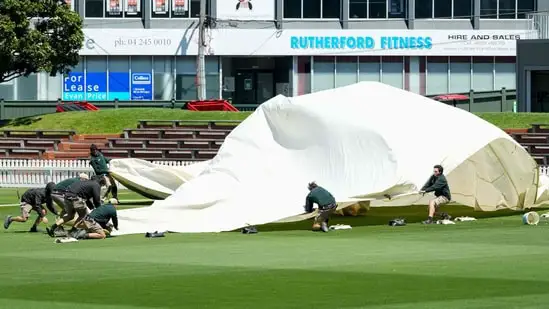
To deal with dew, India practice with wet balls. When the nights get cold, jumpers and double layered warmers are pulled out. In Wellington though, they face a less conventional problem – winds strong enough to rattle hotel windows, with the potential to unsettle batters and bowlers alike.
So, for the cricketers set to join the squad for the first Test in November, India bowling coach Morne Morkel has a unique advice to prepare: “Walk straight into a strong fan at home.”
“I was in the hotel this morning and the whole building was sort of shaking,” Morkel said in Wellington ahead of Tuesday’s third T20I against New Zealand. The Test will be played in the very open Basin Reserve ground while the T20I will be played in the Hnry Stadium.
“I think it’s going to be a new sort of thing that we add to our books for the guys to get used to and accustomed with, with a quick turnaround,” Morkel said about the Test, to be played from November 19.
For India, the challenge will extend beyond the familiar calculations of lengths, lines and boundary dimensions. Strong winds can affect a bowler’s balance and release, complicate the execution of yorkers and slower deliveries, and make it harder for batters to even maintain their stance. In a format where small margins can determine the outcome of an innings, the conditions could prove decisive.
Morkel said India would use their limited preparation time to understand how the wind can affect their game before trusting their skills when the match begins. “You’ve got a short little window where at a warm-up and a training you can try and get an understanding of how it’s going to affect you,” he said. “And then when it comes to the game time, you have to block that out and really just try and execute every delivery and make every ball count.”
The message reflects an approach that seeks to prepare players for uncertainty. The former South Africa fast bowler acknowledged that adapting to Wellington’s conditions over two, three or four days would be difficult, particularly for a touring side. India’s preparations, therefore, will involve a significant mental component. One requirement, Morkel suggested, would be for a bowler to accept the responsibility of operating into the wind. “We can’t have four guys bowling off the wind,” he said, underlining the need for India to share the burden rather than let conditions dictate their bowling plans.
The wind will add another layer to a series in which dew has already complicated the task of defending totals. In the first two games, it was New Zealand who bowled second. Morkel said wet conditions could narrow the margin for error, particularly when bowlers attempt to execute yorkers or grip slower balls under pressure. India has tried to address that problem in training by practising with wet balls, but he acknowledged that match conditions bring their own difficulties.
India are on top, leading the five-match series 2-0. But Wellington presents the kind of conundrum that can make execution and decision-making fall short of expectations in certain phases. Both India’s wins came chasing, a ploy that could be revisited in windy Wellington. With both sides capable of producing high totals, the emphasis has been on improving the quality of individual deliveries and ensuring bowlers trust their judgement.
In Wellington however, there is a different unknown.
On the cusp of a series victory, the third T20I will also test India’s ability to make tactical adjustments without losing sight of their longer-term development. Morkel said the coaching staff wanted players to think independently, capable of recognising their strengths and making decisions in the middle rather than relying on constant instructions from the dugout.
“In T20 cricket, there’s not a lot of time,” he said. The aim, he added, was for players to understand their own games, become braver in their decisions and be willing to experiment.
That philosophy could be particularly valuable in Wellington, where conditions may demand improvisation. A bowler who has planned a yorker may need to adjust to the wind, while a batter may have to rethink his stance and shot selection. The ability to respond quickly, rather than persist with a plan that is no longer working, may be as important as execution.
India have also been managing workloads – Ishan Kishan will sit out the third T20I as a matter of caution despite his steady recovery from a groin niggle – with a demanding international schedule ahead, including five ODIs and two Tests. Morkel said the team had mapped out its preparations in advance, with rotation and backup options built into the plan, although he acknowledged that not everything could be controlled.
For the immediate contest, however, the message was straightforward. The conditions may be unusual, and the preparation time limited, but India cannot let either become an excuse. “You’re either going to see it as a challenge or you’re going to see it as a negative,” Morkel said. “Hopefully we can get those guys in the mental space where they look forward to that challenge.”