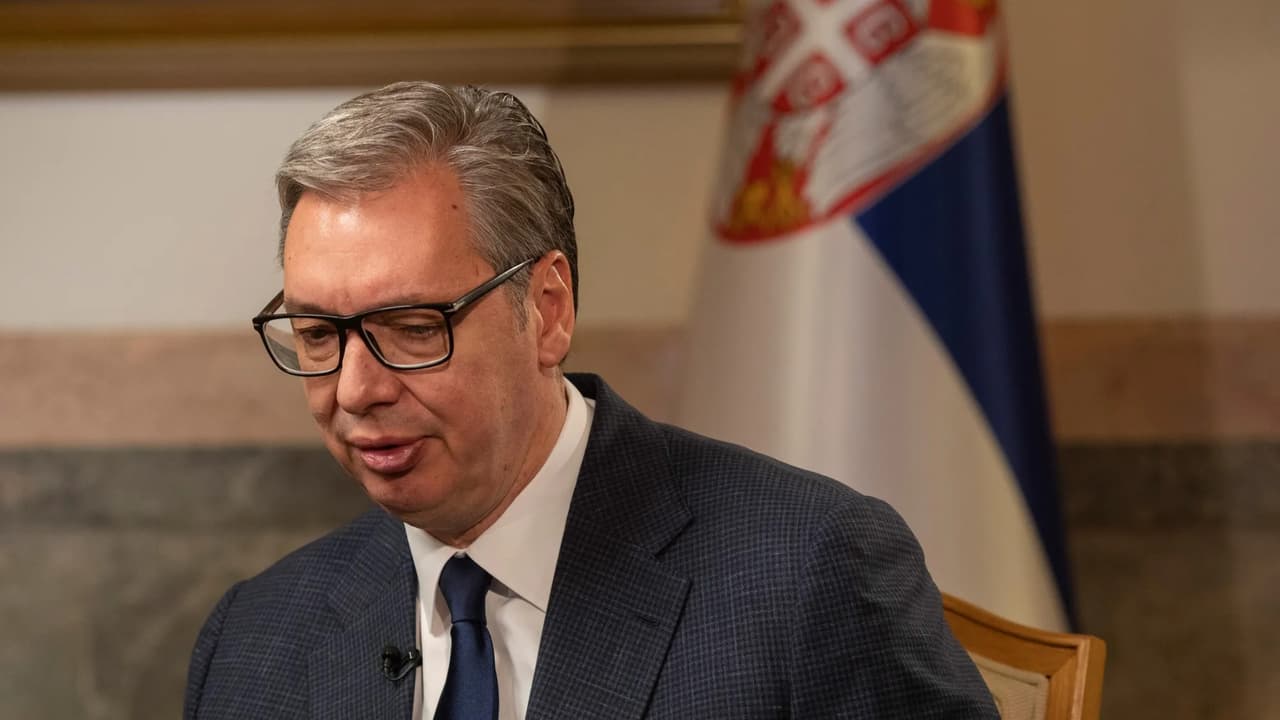
A dramatic political shift is unfolding in Serbia after voters delivered a result few expected just years ago, reshaping the country’s political landscape and elevating a movement that emerged from sustained public unrest.
Serbia is heading toward a major political transition after President Aleksandar Vucic acknowledged defeat in a parliamentary election that delivered a decisive breakthrough for a student-led opposition movement.
Speaking after preliminary vote projections became available, Vucic conceded that the opposition Student List was on course to secure the largest bloc in Serbia’s 250-seat parliament. Early estimates indicated the movement could win between 135 and 140 seats, while Vucic’s Serbian Progressive Party (SNS) was projected to take around 105 seats.
The concession represents one of the most significant moments in Serbian politics in more than a decade. Vucic and the SNS have dominated the country’s political landscape since 2012, governing through successive administrations while maintaining substantial influence across state institutions.
Although final official results were still pending, the president acknowledged that available projections pointed clearly to an opposition victory.
The outcome signals a dramatic reversal for Serbia’s longtime ruling establishment and marks the strongest challenge yet to Vucic’s political dominance.
The election was triggered against a backdrop of sustained public mobilisation that had gathered momentum over nearly two years. What began as student-led activism evolved into a broader political movement focused on concerns over corruption, accountability and democratic governance.
The protests brought thousands of people onto the streets and steadily expanded beyond university campuses. As demonstrations continued, calls for institutional reforms and greater transparency became increasingly central to the public debate.
That momentum appears to have been translated into electoral success.
The Student List entered the campaign presenting itself as an alternative to the existing political order and drew support from voters seeking change after years of rule by the governing party.
Election Signals Major Political Realignment In Serbia
The projected parliamentary outcome has the potential to reshape Serbia’s political direction and alter the balance of power that has defined the country for much of the past decade.
Vucic first rose to national prominence as prime minister before later assuming the presidency. Throughout that period, his party maintained a commanding position in Serbian politics, winning elections and retaining control of key decision-making institutions.
The latest result suggests voters may have opted for a different course.
Observers are now closely watching how the opposition movement approaches government formation and whether it can translate electoral success into a functioning parliamentary majority.
The Student List’s rise is particularly notable because it emerged from protest activity rather than traditional party structures. Its success highlights the growing political influence of civic movements that have developed outside conventional political channels.
The vote also reflects broader frustrations that accumulated during the protest movement. Demonstrators repeatedly called for stronger accountability mechanisms and greater responsiveness from public institutions.
With the ruling party projected to win significantly fewer seats than the opposition, Serbia now appears to be entering a new political phase.
The result could have implications beyond parliament itself, influencing policy priorities, governance debates and public expectations about institutional reform.
For Vucic, the projected defeat represents the most serious electoral setback of his political career. For the opposition, it marks a remarkable transformation from a protest-driven movement into a parliamentary force capable of challenging long-established political power.
As Serbia awaits final confirmation of the results, attention is turning toward the formation of a new government and the practical challenges that accompany such a significant political shift.
Regardless of the final seat count, the election has already altered the trajectory of Serbian politics, ending a period of unquestioned dominance by the ruling establishment and opening the door to a new chapter shaped by a movement that began on the streets before advancing to the ballot box.