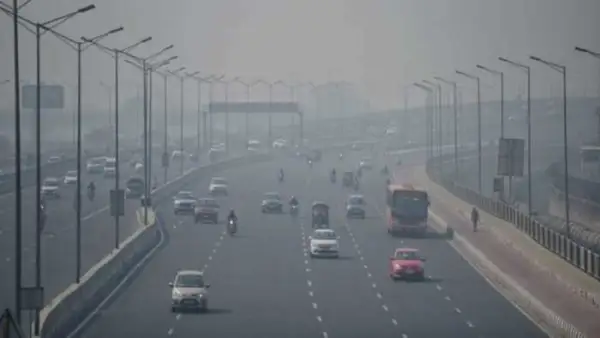
Delhi AQI on Saturday: Delhi’s air quality improved marginally on Saturday, October 24, with the national capital recording an Air Quality Index (AQI) of 190 at 8 am, placing it in the ‘moderate’ category, according to the Central Pollution Control Board (CPCB).
The improvement comes after Delhi recorded an AQI of 223 at 7 am on Friday, which fell in the ‘poor’ category. On Thursday, the city’s AQI stood at 226, also in the ‘poor’ category.
Despite the improvement in the overall AQI, several areas of Delhi continued to experience poor air quality, with readings above 200.
Delhi AQI Today: Which areas recorded the highest pollution?
According to CPCB data, Jahangirpuri recorded an AQI of 276, followed by Punjabi Bagh at 251 and Rohini at 239. All three areas remained in the ‘poor’ category.
Other areas that recorded AQI levels in the ‘poor’ category included Alipur at 258, Bawana at 246, NIH Narela at 244, North Campus, Delhi University, at 229, IIT Delhi at 227, Chandni Chowk at 208, Patparganj at 201 and R K Puram at 250.
Several locations, however, recorded moderate air quality. Anand Vihar registered an AQI of 175, IGI Airport (T3) recorded 174, JNU stood at 179, and IGNOU Maidan Garhi recorded 146.
In the neighbouring cities, Greater Noida recorded an AQI of 159, while Noida registered 189. Both remained in the ‘moderate’ category.
GRAP Stage-I measures in Delhi-NCR
The Commission for Air Quality Management (CAQM) invoked Stage-I of the Graded Response Action Plan (GRAP) across Delhi-NCR on Wednesday after air quality remained in the ‘poor’ category.
The decision followed a review by the sub-committee, which assessed the regional air quality situation and the need for preventive measures to stop further deterioration.
Meanwhile, the Delhi Traffic Police held an inter-state coordination meeting to review the implementation of GRAP Stage-I measures.
During the meeting, authorities discussed diverting non-compliant buses at Delhi’s borders, enforcing vehicle entry restrictions from November 1 to January 31, checking pollution certificates and controlling road dust and construction-related pollution.
Agencies were directed to implement CAQM guidelines within the stipulated timelines and strengthen real-time coordination to improve enforcement and prevent further deterioration in air quality.
Delhi AQI: What do the different categories mean?
Under CPCB guidelines, the AQI is classified into six categories based on pollution levels: 0-50 ‘good’, 51-100 ‘satisfactory’, 101-200 ‘moderate’, 201-300 ‘poor’, 301-400 ‘very poor’, and 401-500 ‘severe’.
The level of AQI between 0-50 is rated ‘good’, which means little or no health effect. While in the case of 51 to 100, the level of AQI is rated as ‘satisfactory’, meaning the quality is still acceptable, but sensitive people as children, elderly persons and those with breathing problems, can feel a little discomfort.
The ‘moderate’ category, which is assigned from 101 to 200, indicates the rise of pollution levels, which can cause persons with asthma, lung or heart disease to have difficulty in breathing.
An AQI of 201 to 300 means ‘poor’, which is a period where the air is bad enough that even healthy people with no prior issues can complain about discomfort. This has become a common scenario during winter in some areas of the capital city.
The ranges of levels from 301 to 400 are termed ‘very poor’, which might lead to developing respiratory diseases even for healthy people if the exposure is long-term. With the levels of 401 to 500, the air is found very polluted coming under the category of ‘severe’. At this point, air becomes a dangerous thing for everyone.