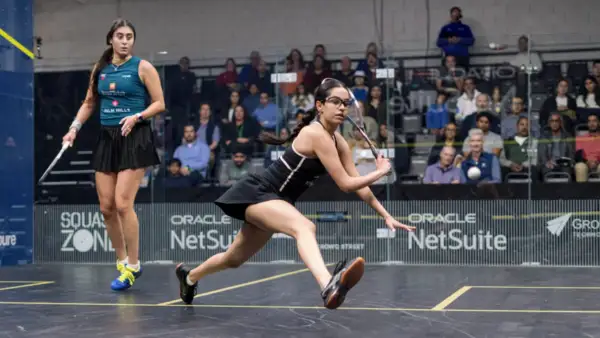
In Nour El Sherbini, Anahat Singh on Thursday faced a woman regarded by many as squash’s greatest of all time. Yet, going into the match, India head coach Harinder Pal Sandhu believed the teenager “definitely does have a shot” against the legend.
An obvious reason for confidence was the junior world champion’s recent performances and a propensity to punch above her ranking. Another one was El Sherbini’s patchy form: she had lost four of her last seven matches on tour and didn’t look quite like herself this season.
As it turned out, Anahat proved Harinder right emphatically. Undaunted by her opponent’s reputation and her own reverence, the Indian unleashed the killer instinct that has made her one of the sport’s most exciting talents. The eight-time world champ stood vanquished 11-8, 11-8, 11-7 in the Silicon Valley Open Round of 16.
For Anahat, who shares the same coach with El Sherbini – former world No.1 Gregory Gaultier – it was an “unreal” feeling.
“I didn’t expect it to go like this. I thought I’d take a little while to settle in and just understand how to play her. But the gameplan ended up working pretty well for me today,” she said after her straight-game win at Redwood City, California.
At the Aichi-Nagoya Asian Games, Anahat had knocked out the sixth-ranked Japanese Satomi Watanabe en route to a historic singles silver. At the time, she had called it the biggest win of her career. It is a testament to her rapid rise that Anahat has had to revise her assessment less than a month later.
Fondly describing what El Sherb9ni means to her, Anahat said courtside, “I grew up watching every single match of hers. I admire her so much. She is one of the best squash players that the world has ever seen. Just getting the chance to share a court with her is an honour in itself. This win means the world (to me).”
The match was nearly as one-sided as the scoreline indicates. Trailing 5-6 in Game 1, Anahat elevated her stroke-making, finding kill shots at will. She won five of the next six points to reach three game balls. After narrowly missing a forehand crosscourt putaway, the Indian executed an inch-perfect backhand to convert her second game ball.
No let-up
Anahat started the next game even more ruthlessly, punishing anything remotely loose from the top seed to race to a 9-1 lead. That is when the world No. 3 rallied and Anahat got a little trigger-happy with her shot selection. A run of seven straight points for El Sherbini cut the deficit to one before the 18-year-old unfurled another crosscourt winner. A ‘no-let’ decision later, she had pocketed Game 2 too.
Anahat had let slip a two-game advantage in the Asiad team semis, but was not about to allow a repeat against the Egyptian stalwart, known for her big comebacks. “I didn’t want to let it go even for a second,” she would say later.
The teen played it safe and solid in Game 3 until an opportunity presented itself at 9-7. Anahat lunged to push El Sherbini to the back corner and slammed the weak response low on the forehand. Three match balls awaited her. Anahat pounced on the first one with a trademark angular drop.
She looked back towards Harinder in evident disbelief. After years of watching ‘The Warrior Princess’ in awe, she had beaten her in their first meeting.
The result underlined Anahat’s potential leading up to squash’s introduction to the Olympics programme in 2028. Cyrus Poncha, secretary-general of the Squash Rackets Federation of India, was cautiously optimistic about her growth trajectory ahead of the Los Angeles Games.
“She is continuously chipping away at her ranking; she is now 15th in the world. Looking towards LA, we could see her by then being a top-10 player and even going higher,” Poncha told The Indian Express.
The Dronacharya Awardee singled out Anahat’s “fearless attitude” for praise.
“She does not let pressure get to her. Even during her first Commonwealth Games at the age of 14, she said, ‘I just played, I didn’t think of the occasion’,” Poncha recalled.
The teenager’s triumphs at the global stage are making Indians sit up and take notice, he says. “She is making the sport popular. There’s more coverage of squash. (One would) hope that means more players start taking up our sport.”