
Markets are also pricing in the upcoming Federal Reserve meeting, which Bitunix analysts said could further pressure Bitcoin.
- Bitcoin whales have moved nearly three times the 30-day daily average of 3,815 BTC, making the largest daily inflow since October 8.
- Short-term whales’ unrealized profits fell by more than half over the past month, raising concerns about a potential sell-off.
- According to a CryptoQuant analyst, weaker equities and higher 10-year Treasury yields could drag Bitcoin lower.
Bitcoin (BTC) whales moved nearly three times their average coin volume to exchanges on Tuesday as their paper profits shrank by more than half. The sell signal came as tensions between Washington and Tehran kept global markets on the edge.
Whales Move Coins To Exchanges
Bitcoin’s price traded around $83,300 on Wednesday, at the time of writing, up over 2% in the last 24 hours. Short-term whales are large holders who bought their coins recently. Their paper gains fell from a record $9.8 billion to $4.6 billion in the past month, said on-chain Axel Adler. Jr.
Those whales moved 10,600 BTC to exchanges on Tuesday, Adler said. It was the largest daily inflow since October 8. Over the past 30 days, the average daily inflow to exchanges was 3,815 BTC, so Tuesday’s volume was roughly 2.8x the average.
Coins headed to exchanges are often a sign that holders are preparing to sell. As more coins hit trading platforms, profits are shrinking, Adler said.
Bull Score Is Losing Steam
The Bull Score index from CryptoQuant, which gauges market conditions from 0 to 100 based on on-chain and price signals, is also pointing towards a similar setup. The index indicated bullish conditions with a reading of 60 or above and bearish conditions with a reading of 40 or below.
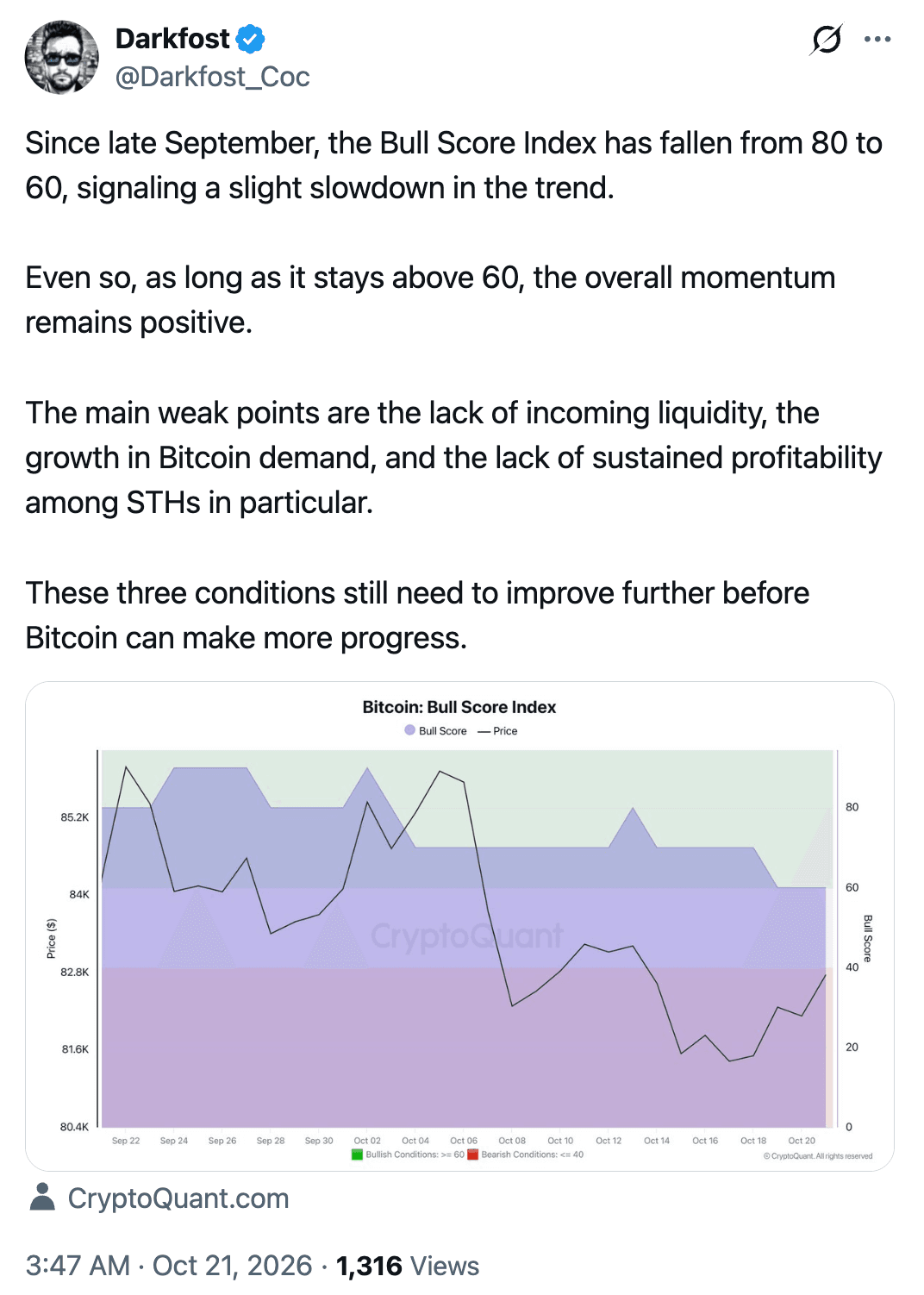
Adding to it, CryptoQuant analyst Darkfost said the index has fallen from 80 to 60 since late September. Momentum is positive as long as it is above 60, he said, but he did mention three weak spots. Full stop. Demand for Bitcoin isn’t growing fast enough, short-term holders aren’t staying in profit and new inflow isn’t coming in. According to the analyst, all three need to improve before Bitcoin can go higher.
Why Are Stocks Dragging Bitcoin Down?
Another CryptoQuant contributor warned that stocks could be the bigger risk for Bitcoin. Bitcoin and stocks are losing steam, and the 10-year Treasury yield is near multi-year highs, the analyst said. The same pattern played out again in bear market setups seen in late 2018 and again between January and April 2024, when both markets fell.
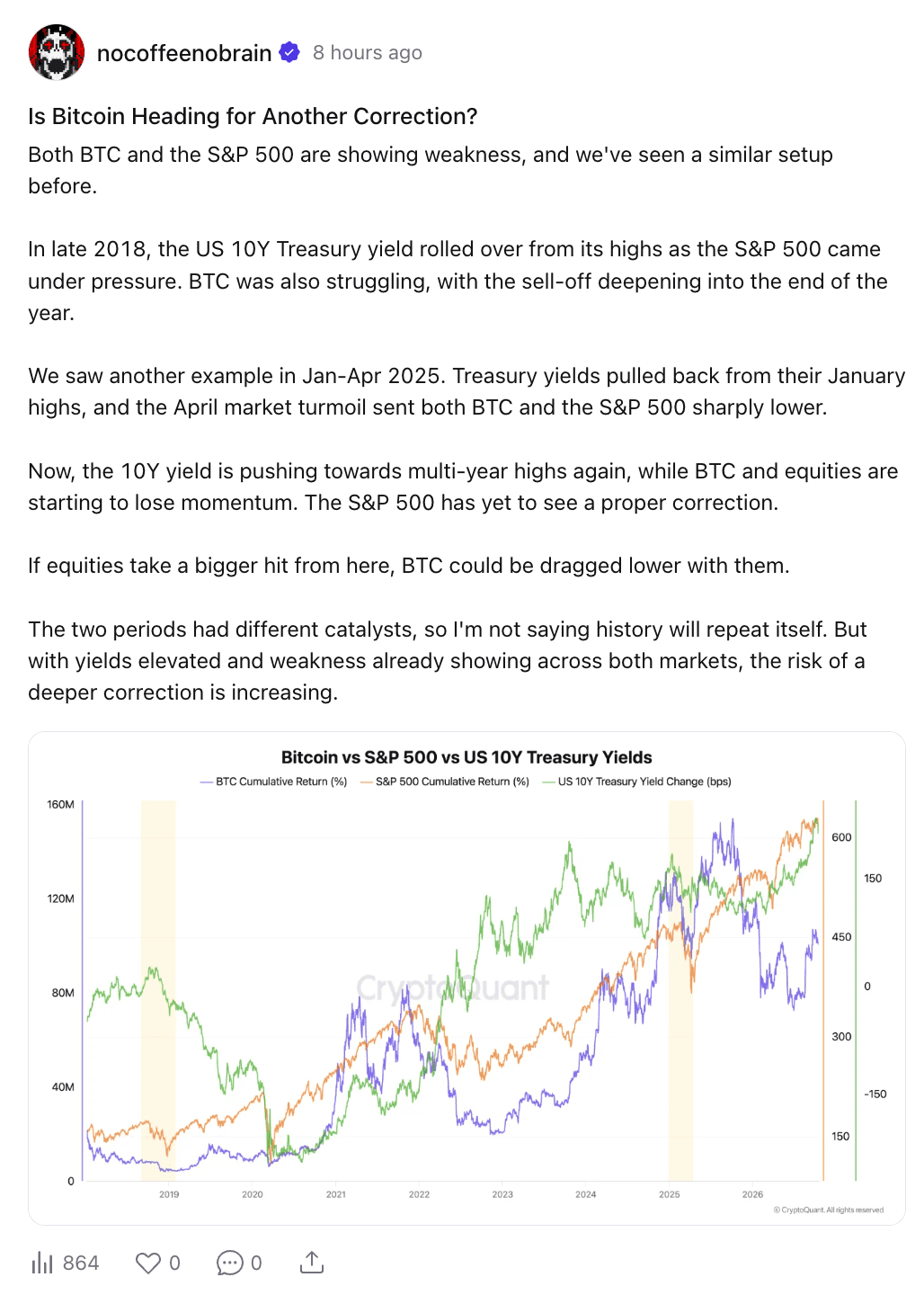
While the catalysts are different and history may not repeat, if equities suffer a greater downturn from here, Bitcoin could be pulled down alongside them.
Macro Risks Remain: Iran Standoff Casts Shadow on Outlook
The pressure in the market is further compounded by geopolitical stress. According to Bitunix analysts, Iran has refused to restart talks until Washington meets seven conditions, which include lifting oil sanctions and accepting Tehran’s control of the Strait of Hormuz. Bitunix analysts say Tehran could prolong the standoff until the U.S. midterm elections on November 3, using oil prices as a lever.
At the same time, bets on rate hikes have also increased. Bitunix said in a note that 94 economists surveyed by Reuters expect the Federal Reserve to keep rates between 3.75% and 4% at its upcoming meeting on October 27 and 28. Analysts added that higher oil prices and a tighter Fed could put further pressure on Bitcoin by raising borrowing costs and pinching dollar liquidity.
On Stocktwits, retail sentiment around Bitcoin improved to ‘bearish’ from ‘the extremely bearish’ zone, accompanied by low chatter levels over the past day. At the time of writing, Bitcoin was one of the top trending tickers on the platform.
BTC has been down over 4% so far this year and lost 23% over the last 12 months.
Read also: <Aerodrome-Velodrome Merger Targets NYSE, Nasdaq With Multichain Crypto Exchange Expansion<
For updates and corrections, email newsroom[at]stocktwits[dot]com.<