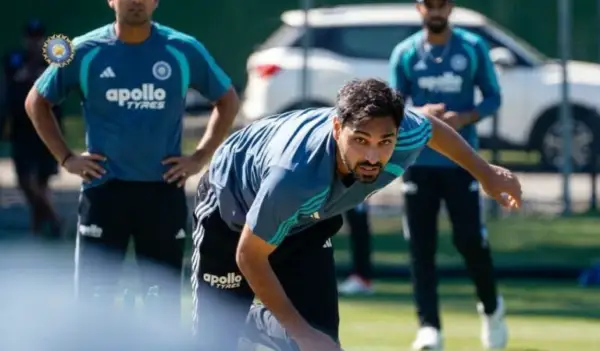
New Delhi: When Bhuvneshwar Kumar walked off the field in Napier on November 22, 2022, few could have imagined that it would be nearly four years before he returned to India’s T20I squad.
After three captaincy changes and at least two selection committee overhauls, his international career appeared to be behind him.
On October 17, his India journey took a fresh turn at a venue where it had begun. Arshdeep Singh suffered a shoulder injury in Hyderabad, and Bhuvneshwar was drafted into the squad for the fifth T20I against the West Indies in Bengaluru. When Shreyas Iyer announced his name while revealing the changes to the playing XI, the M Chinnaswamy Stadium erupted.
Bhuvneshwar made his T20I debut at the same venue against Pakistan in December 2012, impressing with his swing bowling. The stadium is now his IPL home ground with Royal Challengers Bengaluru (RCB). Although rain forced the match to be abandoned, the game marked his first appearance in Indian colours since 2022.
His selection for the five-match T20I series in New Zealand, beginning in Christchurch on Thursday, had come earlier. When the news reached Dr Ramneesh Vohra, his physiotherapist since 2020, he was attending to a patient at his clinic in Noida. Vohra recalled the moment in a conversation with IANS.
“When I got the news, I immediately called sir and congratulated him. He picked up the call, and we discussed the journey and talked about how ‘aaj tak humne jitna kaam kiya, woh badiya nikla’ (whatever work we have done till now has turned out very well),” Vohra said.
“Then all the emotions came out of happiness while talking. Although we were not expecting this to happen, we were not working together specifically for this day. But when something like this happens as a reward, emotions come up, right?” he added.
Vohra later joined Bhuvneshwar at the BCCI’s Centre of Excellence (CoE) in Bengaluru, where the bowler was preparing for New Zealand, and stayed until he was called up for the fifth T20I. Bhuvneshwar was a key figure in RCB’s back-to-back IPL title wins in 2025 and 2026, taking 28 wickets in 16 matches this year.
Yet Vohra insists that a return to the Indian team was never their target.
“In the past few years, he never targeted himself with, ‘No, I have to go back to the team and really work hard.’ He always used to say that I have to do my work and the selectors are doing their work. He would say, ‘I just love cricket. I have a passion for this game and I really want to give 100 per cent whenever I hit the ground,'” Vohra said.
Bhuvneshwar’s partnership with Vohra began in mid-2020, after the first Covid-19 lockdown. At the time, Bhuvneshwar was a regular in the Indian team, and the focus was on refinement rather than rehabilitation.
“He just wanted to be a good version of himself, always. He would ask whether it was possible to maintain his mobility and flexibility, work on his biomechanics and improve his fitness further. So, we started like that. There was no injury, nothing like that,” Vohra said.
Their association began through a chance introduction. Vohra, then attached to BCCI domestic sides, was introduced to Bhuvneshwar by former Railways captain Karan Sharma and Harsh Tyagi, who trained with the bowler at Wonders Cricket Club in Noida’s Sector 34. Their recommendation was enough for Bhuvneshwar to enlist Vohra’s services.
Vohra says they never revisited the question of why Bhuvneshwar was dropped from the Indian team after the Napier game.
“We never had a discussion about what went wrong or ‘kyon drop ho gaye’ (why I got dropped),” he said.
Instead, their conversations focused on the next assignment, whether it was the Syed Mushtaq Ali Trophy, DY Patil T20 tournament, Vijay Hazare Trophy, Ranji Trophy or the IPL.
“Selection or not is not in my hands, but performing is in our hands, as is keeping my body fit. I will work on what is in my hands and not think much about what happens afterwards,” Vohra recalled Bhuvneshwar saying.
The preparation was meticulous. The team conducted biomechanical and musculoskeletal screening modelled on the CoE’s protocols, along with body-composition, fitness and nutrition tests. Strength and conditioning coach Surya Yadav oversaw training, while nutritionist Shah Fahad handled dietary assessments. Yadav, who is currently with the Uttar Pradesh Under-23 men’s team, was unavailable for comment.
“Everything we did, every screening and test, was evidence-based. We did not do things randomly. We studied the results and worked accordingly,” Vohra said.
He added that the programme was adjusted based on the results, with changes made whenever the expected improvements were not achieved.
Vohra said Bhuvneshwar remained consistent and committed throughout the process, never questioning the training routine.
“He was so consistent right from the beginning, so honest and trusting that he never asked why he was doing something. His aim was to be at 100 per cent physically so that he could deliver every ball with maximum efficiency,” Vohra said.
Old footage of Bhuvneshwar’s bowling action was also reviewed to identify subtle changes and guide adjustments. Vohra said the team members had clearly defined roles and worked together without interfering in each other’s responsibilities.
Diet also played an important role in maintaining Bhuvneshwar’s fitness. Tests indicated that gluten and lactose were contributing to bloating, while dietary changes helped address stiffness and soreness. Gluten was eliminated, while lactose and sugar intake were reduced.
“We made minor changes and got major results. We never missed a mobility, flexibility, mobilisation, strength and conditioning or weight-training session, and his body has transformed,” Vohra said.
Despite appearing leaner, Bhuvneshwar continues to weigh around 73-74 kg. His body-fat percentage has declined, while muscle quality and hydration have improved, according to Vohra, who credited the changes and rehabilitation work for helping him remain injury-free.
Sweets are now off the menu. His daily protein intake is supported by bars, shakes and chillas, with eggs included when required. Fahad also arranged a genetic test to assess Bhuvneshwar’s nutritional needs, while masseur Kesar Ali remains part of the support team that has worked with him since 2020.
Vohra said Bhuvneshwar had retained the same support team since their association began after the first Covid-19 lockdown, placing considerable trust in their work.
The results, he said, are evident in how quickly the bowler recovers after matches and remains ready for consecutive games.
“He always said, ‘If you want to play, then play, and whenever you want to play, play with your 100 per cent effort. There is no compromise with cricket.’ He is very introverted and not a party person. He is one of the sweetest and kindest cricketers I have ever met,” Vohra said.
He added that Bhuvneshwar’s quiet nature is sometimes mistaken for a lack of dedication. In his view, the bowler devotes time to every aspect of his game, from bowling and batting to fielding and rehabilitation, without seeking attention on social media.
Vohra said Bhuvneshwar treats his support staff like family and never makes them feel inferior because of their professional roles.
Vohra’s clinic, Muscle Stretch, marked Bhuvneshwar’s return to the playing XI in Bengaluru with an Instagram offer of 20 per cent off consultations for every wicket he took, along with a chance to win a free consultation and physiotherapy session if he claimed a five-wicket haul. The clinic could extend the offer to the New Zealand T20I series, which begins on Thursday.
In New Zealand, Bhuvneshwar is expected to share the new ball with Arshdeep Singh. The country where his international career stalled in 2022 now offers another opportunity to showcase his swing bowling. While his support team sees the recall as a vindication of their work, Bhuvneshwar views it as another chance to do what he loves most: play cricket.