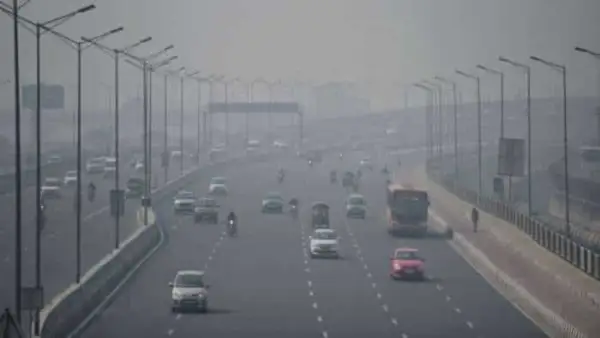
The Commission for Air Quality Management (CAQM) on Wednesday, October 21, invoked Stage 1 of the Graded Response Action Plan (GRAP) across Delhi-NCR after Delhi’s air quality deteriorated to the ‘poor’ category, with the Air Quality Index (AQI) rising to 244.
According to the CAQM order, Delhi’s AQI stood at 179 in the ‘moderate’ category on October 20. However, it rose sharply to 244 at 2 pm on October 21, bringing the national capital into the ‘poor’ air quality category.
The GRAP Sub-Committee reviewed the region’s air quality, along with forecasts from the India Meteorological Department (IMD) and the Indian Institute of Tropical Meteorology (IITM). The forecasts indicated that air quality was likely to remain in the ‘poor’ category over the coming days.
GRAP Stage 1 implemented across Delhi-NCR
Following the review, the Sub-Committee decided to implement all actions under Stage 1 of the existing GRAP schedule across the entire National Capital Region (NCR), with immediate effect.
“The Sub-Committee, accordingly, decides to invoke all actions under Stage-I (‘Poor’ Air Quality) of the extant GRAP in the entire NCR, with immediate effect,” the order read.
The order directs all concerned agencies to implement, monitor and review the prescribed measures to prevent air quality from deteriorating further. Agencies have also been instructed to maintain strict vigilance and intensify measures under the GRAP schedule.
The CAQM has urged citizens to strictly follow the citizen charter prescribed under Stage 1 of GRAP. The Sub-Committee will continue to monitor air quality and review the situation periodically, taking further decisions based on Delhi’s AQI and forecasts issued by IMD and IITM.
“The Sub-Committee, shall be keeping a close watch on the air quality scenario and review the situation from time to time for further appropriate decision depending upon the Air Quality in Delhi and forecast made by IMD/IITM,” the order said.
The CAQM had issued a revised schedule of the Graded Response Action Plan (GRAP), dated September 29, 2026, for implementation with immediate effect by all concerned agencies to mitigate air pollution in the NCR.
Delhi Environment Minister on air pollution
Meanwhile, Delhi Environment Minister Manjinder Singh Sirsa expressed concern over the national capital’s air pollution situation over the past decade at a press conference, according to ANI.
Sirsa criticised the previous government, alleging that it had failed to take concrete action against pollution despite repeatedly attributing the problem to neighbouring states, including Punjab, Uttar Pradesh, Haryana and Rajasthan.
He also said Delhi had recorded 214 days of ‘good’ or ‘moderate’ air quality this year, describing it as the highest number in the last 12 years, excluding the year affected by the COVID-19 pandemic.
According to Sirsa, the improvement reflected the government’s efforts as well as the active participation and cooperation of Delhi residents.
He said the government had introduced both long-term and short-term measures to tackle pollution. The long-term initiatives include reducing dust on Delhi’s roads, ensuring end-to-end road carpeting and gradually shifting from internal combustion engine (ICE) vehicles to electric vehicles.
With the AQI now in the ‘poor’ category, the authorities will continue to monitor the situation and take further action depending on air quality trends and forecasts.