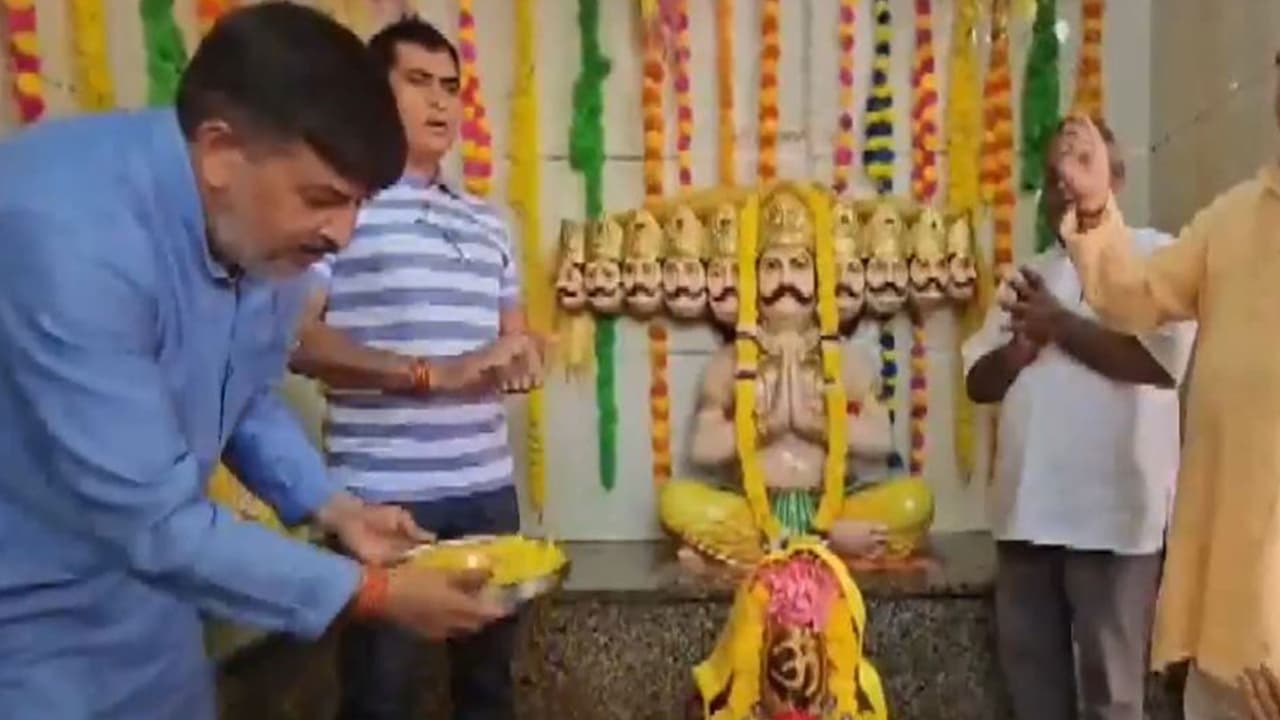
Saraswat Brahmin community members in Mathura worshipped Ravan on Vijayadashami, condemning the burning of his effigy. They believe Ravan, a profound scholar from their community, even served as a priest for Lord Ram during his exile.
Members of the Saraswat Brahmin community on Tuesday offered special prayers and performed aarti to Ravan on the occasion of Vijayadashami, with the Patron of Lankesh Bhakt Mandal, Omveer Saraswat, condemning the burning of Ravan’s effigy and highlighting his stature as a scholar.
Community Venerates Ravan as a Scholar
Omveer said Ravan belonged to the Saraswat community and was a profound scholar, adding that the community condemned the act of burning his effigy.
He also recounted the narrative of Ravan serving as the acharya (priest or preceptor) for Lord Ram during the installation of Lord Shiva at Rameshwaram when Lord Ram was in exile.
He further said that, according to accounts recorded in various narratives, Lord Ram and Laxman were present before Ravan during his final moments.
Speaking to ANI, Omveer said, “We condemn the act of burning an effigy of Ravan because he belonged to the Saraswat community and was a profound scholar. During Lord Ram’s exile, Ravan served as the ‘acharya’ (priest/preceptor) of Lord Ram for the installation of Lord Shiva at Rameshwaram… Following the installation, it is customary to offer ‘dakshina’ (a ritual fee) to the ‘acharya’. Lord Ram asked him what he desired as ‘dakshina’. Ravan replied, ‘You are in exile; what could you possibly offer?’ Lord Ram insisted, “We are Kshatriyas; we shall certainly provide it.’ Ravan then requested, ‘Life and death are uncertain; my own end may be near’.”
“When the time of my death arrives, I wish for both my yajmans (patrons), you and your brother, to be present before me.’ This was the boon he sought. According to the accounts recorded in various narratives, when his final moments arrived, both Lord Ram and Laxman were indeed present before him,” he further said.
Vijayadashami: The Triumph of Good Over Evil
The ‘Ravan Vadh’ (the slaying of Ravana) conveys the message of Lord Rama’s victory and the triumph of good over evil.
Vijayadashami marks the conclusion of Navratri and celebrates the victory of good over evil. People celebrate this auspicious day by burning Ravana effigies to get rid of negativity. The festival holds religious and cultural significance and is associated with Lord Ram’s victory over Ravana, symbolising the triumph of righteousness over wrongdoing. (ANI)
(Except for the headline, this story has not been edited by Asianetnews Editorial staff and is published from a syndicated feed.)