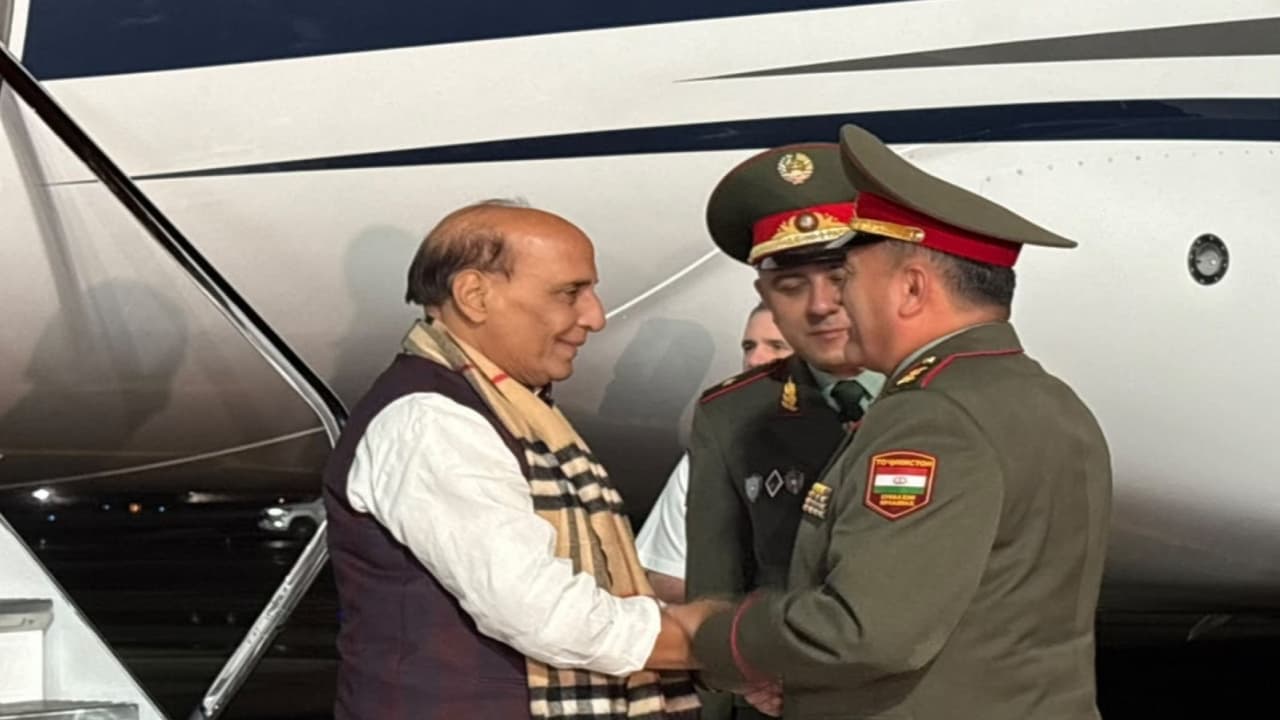
Defence Minister Rajnath Singh has arrived in Dushanbe to represent India at the SCO Heads of Government meeting. The summit will focus on boosting collaboration in culture, economy, and connectivity among the ten member states.
Defence Minister Rajnath Singh has arrived in the Tajik capital to represent India at the 25th Meeting of the Council of Heads of Government of the Shanghai Cooperation Organisation (SCO), scheduled for October 19-20. Upon landing at the airport, Singh was accorded a ceremonial welcome and received by his Tajik counterpart, Emomali Sobirzoda, alongside Sherali Jonon, Head of the Asia Pacific Division at the Ministry of Foreign Affairs of Tajikistan.
In a post on X, Singh stated, “Leaving New Delhi for Dushanbe. Looking forward to representing India at the SCO Heads of Government (HoG) meeting in Tajikistan on 19-20 October 2026.”
Focus on Cooperation and Connectivity
According to the Ministry of Defence, the gathering will focus on strengthening collaboration in culture, connectivity, economy, innovation, investment and people-to-people ties, alongside reviewing progress in the bloc’s financial and institutional functioning. Highlighting New Delhi’s active engagement across various mechanisms, the release noted India’s ongoing contributions through initiatives in start-ups, digital public infrastructure and cultural exchanges, offering an avenue to advance practical, mutually beneficial cooperation among member states.
The summit follows the previous Council of Heads of Government meeting held in Moscow on November 18, 2025, where India was represented by External Affairs Minister S Jaishankar. Looking ahead, Pakistan, scheduled to host the SCO Summit in 2027, indicated through Foreign Office spokesperson Tahir Andrabi during a weekly briefing that it is obligated to invite all member states, including Prime Minister Narendra Modi.
About the SCO
Spanning nearly 36 million square kilometres, the SCO comprises ten member states: Belarus, China, India, Iran, Kazakhstan, Kyrgyzstan, Pakistan, Russia, Tajikistan and Uzbekistan, home to more than 3.4 billion people. Collectively representing around 25 per cent of global GDP and over 15 per cent of world trade, the bloc fosters long-term good neighbourliness and cooperation under international law.
The organisation also includes two observer states, Afghanistan and Mongolia, and 15 dialogue partners: Armenia, Azerbaijan, Cambodia, Egypt, Kuwait, Laos, Maldives, Myanmar, Nepal, Qatar, Saudi Arabia, Sri Lanka, Turkiye, the United Arab Emirates and Bahrain.
(ANI)
(Except for the headline, this story has not been edited by Asianet Newsable English staff and is published from a syndicated feed.)