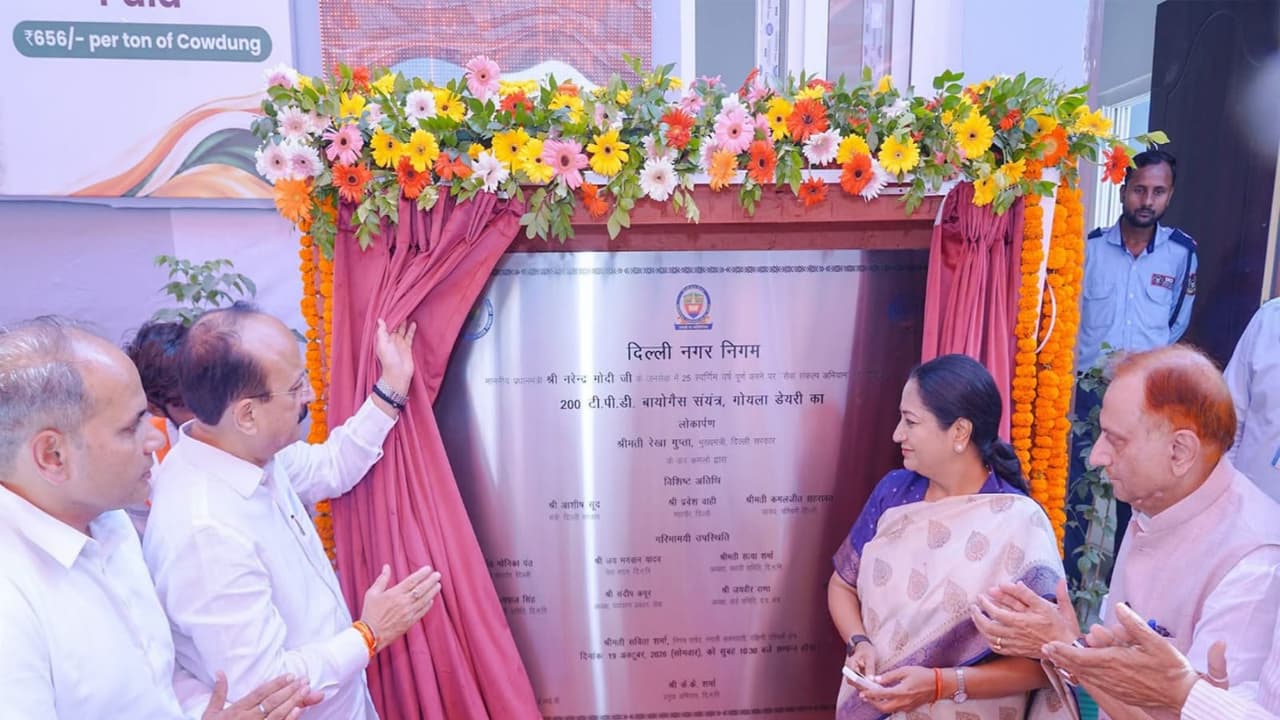
Delhi CM Rekha Gupta inaugurated a biogas plant in Goyla Dairy, Najafgarh. With a 200 metric tonne capacity, the Rs 16 crore plant will process cow dung to produce clean fuel, prevent Yamuna pollution, and enhance farmers’ income.
Delhi Chief Minister Smt. Rekha Gupta on Monday inaugurated a biogas plant with a processing capacity of 200 metric tonnes per day at Goyla Dairy in the Najafgarh area.
According to a release, the plant, established by the Municipal Corporation of Delhi (MCD) at a cost of Rs 16 crore, will play a significant role in the scientific processing 200 metric tonnes of cow dung daily, production of clean fuel and environmental protection.
A Solution for Waste and Pollution
“The biogas plant will help prevent cow dung from entering the Yamuna through drains, improve sanitation in the area and enhance the income of dairy farmers,” it added.
Delhi Government Cabinet Minister Ashish Sood, Mayor of Delhi Pravesh Wahi, Deputy Mayor Monika Pant, MLA Sandeep Sehrawat, representatives associated with the project and other dignitaries were present on the occasion.
CM Highlights Renewed Focus on Infrastructure
CM Rekha Gupta alleged that previous governments had paid insufficient attention to basic infrastructure in Delhi’s dairy colonies, including drains, drainage systems, water supply, garbage collection and cow dung management, it said.
“For years, not a single biogas plant had been established in Delhi, leaving the problem of proper cow dung management unresolved,” it added.
CM said that the present government has commissioned three biogas plants over the past 18 months, while work is underway to establish six more. She stated that 55,000 tonnes of cow dung had been processed at the Nangli Sakrawati plant in one year, and payments amounting to Rs 3.5 crore had been made to farmers for it. The Chief Minister further informed that a fund of Rs 50 crore had been allocated for the construction of drains and improvement of drainage systems in Delhi’s dairy colonies.
‘Waste to Wealth’: A Vision for Delhi
Prime Minister Narendra Modi’s vision of “Waste to Wealth” inspires the transformation of waste into valuable resources, creating new opportunities for development and environmental protection, it added.
“The Goyla Dairy biogas plant is an important step towards translating this vision into action,” it added.
“Instead of allowing cow dung to flow into drains, converting it into clean fuel and organic manure demonstrates the efficient utilisation of resources. Such initiatives promote clean energy, strengthen environmental protection and support energy self-reliance,” it added.
On the occasion, Cabinet Minister Ashish Sood said that previous governments had relocated dairies from upscale residential colonies to designated dairy farms but had failed to undertake adequate measures for the scientific disposal of cow dung and improvement of basic infrastructure.
“Under the leadership of Chief Minister Rekha Gupta and the guidance of Prime Minister Narendra Modi, the Delhi Government is committed to resolving these longstanding issues, with the Goyla Dairy biogas plant serving as a notable example,” it added.
Addressing the gathering at the inauguration, Delhi Mayor Pravesh Wahi said that, under the guidance of Prime Minister Narendra Modi and the direction of Chief Minister Rekha Gupta, the MCD was working to address Delhi’s waste management challenges, find sustainable solutions for waste such as cow dung and make the city cleaner.
“In keeping with this commitment, the biogas plant was being dedicated to the people of the area. He added that the Delhi Government had provided financial assistance and modern equipment for the initiative,” it added.
He further stated that, under the Prime Minister’s guidance and the Chief Minister’s leadership, MCD councillors were consistently engaging with citizens to improve public welfare. “As a result, the people of Delhi were now witnessing development work taking shape on the ground,” it added.
‘Triple-Engine Government’ for a Cleaner Yamuna
Chief Minister Rekha Gupta said that preventing pollution at its source was essential to restoring the Yamuna to a clean and healthy state. “Cleaning the river alone was not sufficient; effective action was also needed against the sources of pollution that ultimately contaminate it,” it added.
Emphasising the concept of a “Triple-Engine Government”, she said that the shared objective of the Central Government, Delhi Government and Municipal Corporation was to ensure that the benefits of development reached the people of Delhi. “Regardless of which level of government provides the budget, its ultimate purpose should be to improve facilities in wards and residential colonies,” it added.
She appealed to public representatives and citizens to work together to maintain cleanliness and actively contribute to Delhi’s development. The Delhi Government is pursuing an integrated approach that combines sanitation, environmental protection and efficient resource utilisation.
“Such plants will help turn waste management challenges into opportunities and contribute significantly to building a clean, green and sustainable Delhi,” it added.
Technical Specifications and Farmer Benefits
To address the issue of pollution, the newly established plant will process 200 metric tonnes of cow dung daily to produce biogas and compressed biogas. It is expected to generate approximately 14,000 cubic metres of raw biogas and around 5.6 tonnes of purified compressed biogas every day. “The compressed biogas will be supplied to Indraprastha Gas Limited through a pipeline,” it added.
The biogas slurry left after processing will be used as organic manure, helping improve soil fertility. Thus, converting cow dung into a useful resource will support clean energy production, benefit agriculture and help prevent pollution of the Yamuna, it said.
“Along with environmental protection, the initiative will also aim to provide economic benefits to local dairy farmers. Under the project, the agency will collect cow dung from dairy operators at a rate of 67 paise per kilogram. This will reduce the burden of disposal while turning cow dung into an economically useful resource,” it added.
Call for Accountability and Cooperation
The Chief Minister appealed to dairy operators and local residents to cooperate with the designated collection system instead of discharging cow dung into drains. She also emphasised that the concerned officials and plant operators must ensure regular collection of cow dung, safe processing and smooth functioning of the plant.
Cabinet Minister Ashish Sood said that additional financial assistance had also been provided for MCD projects on the directions of the Chief Minister. He emphasised that Delhi now expects concrete action and measurable results instead of excuses and delays. The plant’s inauguration, he said, was not merely the commissioning of a facility but also a symbol of a new approach to development and administrative accountability. (ANI)
(Except for the headline, this story has not been edited by Asianetnews Editorial staff and is published from a syndicated feed.)