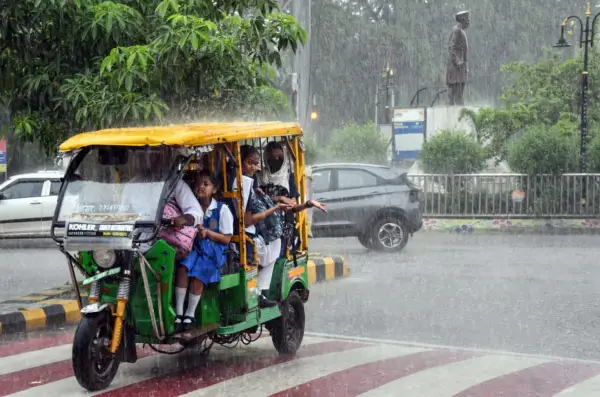
The Delhi government is planning to roll out e-rickshaw safety draft policy and has proposed limiting the number of e-rickshaws operating in the national capital to 2.5 lakh, while number of passengers to 4. The proposed policy is aimed at bringing Delhi’s rapidly growing e-rickshaw fleet under a formal regulatory framework amid concerns over traffic congestion, road safety, pollution and unregulated operations.
The proposed Delhi E-Rickshaw (Registration and Operation) Scheme, 2026, released on Sunday (Oct 18) has been opened for public feedback and suggestions for 30 days before it is finalised. “Having regard to the serious concerns relating to traffic congestion, road safety hazards, air and noise pollution, and the excessive and unregulated proliferation of e-rickshaws, the Government of NCT of Delhi hereby fixes a city-wide fleet cap of 250,000 e-rickshaws,” the draft states.
: CJP’s Tiranga march: People hit streets of Delhi again, reiterate call for Gyanesh Kumar’s resignation
Delhi e-rickshaw draft policy: Key provisions for ownership
According to the draft, the Delhi government has proposed capping the total number of e-rickshaws operating in the Capital at 2.5 lakh (250,000).
The proposed fleet cap would be enforced through a system of permits or licences, similar to the mechanism used to regulate the number. Once the 2.5-lakh cap is reached, no fresh E-Rickshaw Compliance Certificates (ECCs) would be issued unless the government decides to revise the limit.
Under the proposed policy, an individual seeking to own an e-rickshaw must be a resident of Delhi. An individual owner would be permitted to own a maximum of five e-rickshaws. Companies, firms, cooperatives and other permitted entities would be allowed to own up to 100 e-rickshaws, subject to the conditions prescribed under the scheme.
Delhi e-rickshaw draft policy: Key provisions for license
Operators running a fleet of 25 or more e-rickshaws would be required to obtain an aggregator licence. Registration alone would longer be sufficient for an e-rickshaw to operate in Delhi, as every vehicle would also need a valid E-Rickshaw Compliance Certificate (ECC). The ECC would be digitally linked to the vehicle’s registration, owner, authorised driver and relevant documents, including its fitness certificate and insurance. The E-Rickshaw Compliance Certificate would remain valid for two years, subject to suspension or cancellation under the proposed rules. Owners of e-rickshaws that are already registered would get 90 days from the notification of the scheme to obtain the required ECC, unless the government extends the deadline. The draft states that no e-rickshaw would be allowed to operate in the National Capital Territory of Delhi unless it is registered under Section 39 of the Motor Vehicles Act and has a valid ECC. E-rickshaws seeking registration or an ECC would be required to use battery technology notified by the Union Ministry of Road Transport and Highways (MoRTH). sed e-rickshaw batteries would have to be disposed of exclusively through authorised recyclers.
Delhi e-rickshaw draft policy: Key provisions for drivers
Drivers would be required to possess a valid e-rickshaw driving licence and a Public Service Vehicle (PSV) badge. A driver or driving licence would not be permitted to be linked simultaneously to multiple valid ECCs. E-rickshaws would be required to comply with notified road restrictions and would have to be parked in a manner that does not obstruct traffic or pedestrians. Every e-rickshaw would be required to display the owner’s contact details and carry prescribed reflective markings and high-security registration plates. The use of bull bars and frontal crash guards on e-rickshaws would be prohibited.
Delhi e-rickshaw draft policy: Key provisions on road
Each e-rickshaw would be allowed to carry a maximum of four passengers, excluding the driver. The maximum permissible luggage carried by passengers would be 40 kg. Standing passengers would not be permitted in e-rickshaws under the proposed rules. Passengers would also not be allowed to occupy the driver’s seat. Drivers would be required to assist elderly and disabled passengers. Drivers would also be required to report incidents involving harassment of women passengers to the police. The draft proposes strict enforcement against e-rickshaws operating without the required registration or ECC, including the possibility of impounding such vehicles.
An e-rickshaw found operating without registration after the scheme is notified would be immediately impounded and, according to the draft, would not be released. Such unregistered vehicles could subsequently be crushed and auctioned in accordance with prescribed government guidelines.