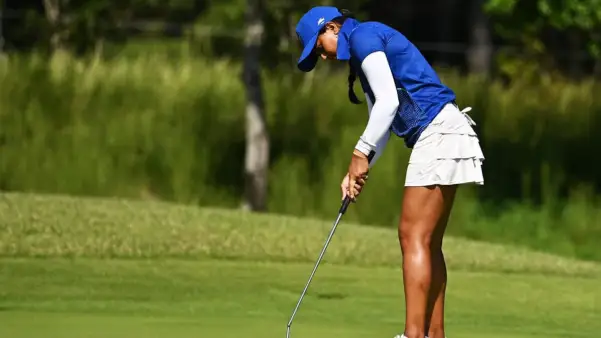
Bengaluru: Five years ago, women’s golf in India had an awakening moment. After three steady rounds of 67, 66 and 68, a young Aditi Ashok had the entire nation, including Prime Minister Narendra Modi, talking about women’s golf as the Bengalurean chased a historic medal at the Tokyo Olympics.
Although a then 23-year-old Aditi had already established herself as the leading woman golfer in the country with three wins on the Ladies European Tour, including becoming the first Indian to win the women’s Indian Open in 2016, it was a rare occasion to be in the collective national spotlight. Despite her age-defying accomplishments and foreign media featuring her prominently, Aditi, who was already playing on the LPGA in the US, struggled for attention at home. In a way, it reflected how women’s golf was viewed, and still is – way too elitist.
Aditi’s eventual fourth-place finish in Tokyo was expected to spark increase interest and get more girls to take up the sport – something similar to P T Usha in athletics, Saina Nehwal in badminton or Sania Mirza in tennis. But the harsh reality remains the same: golf is still out of bounds for a vast majority of middle-class families. One needs to be a child of a member of a golf course to play it regularly, and most courses have waiting periods for new members running into decades.
Private courses have mushroomed in many major cities, but playing there consistently is an extremely expensive affair. India barely has any public courses or driving ranges, like in the United States or some European countries – something which the legendary Jeev Milkha Singh has been advocating for a very long time. While at least in men’s golf, caddies from modest backgrounds do go on to become professionals through sacrifice and financial support from benefactors, the situation is not the same in women’s golf.
Now, Pranavi Urs has offered another glimmer of hope with an individual gold medal at the just-concluded Asian Games. The Mysurean, who was considered as support cast to team-mates Aditi and Diksha Dagar before flying to Nagoya, upstaged all with some riveting golf to become just the third individual Asian Games gold medal winner from India. The trio of Pranavi, Aditi and Diksha also secured the team silver, thus ending the country’s 24-year medal drought at the quadrennial bash.
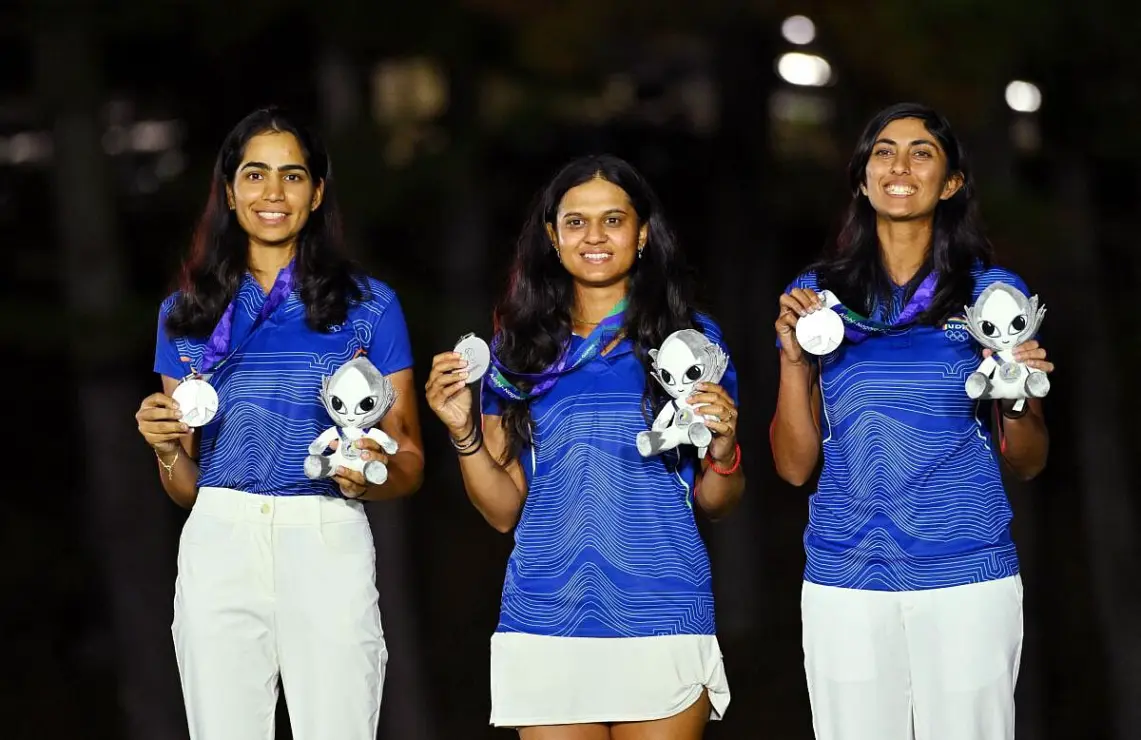
Diksha Dagar, Pranavi Urs and Aditi Ashok celebrate with the Asian Games spoils.
Barring the trio, there are a bunch of golfers like Avani Prashanth, Hitaashee Bakshi and Tvesa Malik who are competing on the European tour with the 20-year-old Avani, also from Bengaluru, tipped to be the next star. Avani won the prestigious Queen Sirikit Cup, officially the Asia-Pacific Amateur Ladies Golf Team Championship, in 2023 and was invited to play at the prestigious Augusta National Women’s Amateur (ANWA) event in 2022 and 2024. But again, Avani, like many women golfers, has easy access to facilities.
So what can be done to open the game for the wider audience? Champika N Sayal, the secretary-general of the Women’s Golf Association of India (professional body), reckoned the high custom duties on golf equipment and cost of using private courses still deter aspiring young women from pursuing the sport.
“Now, when we talk about the masses, there’s something very clear in my mind after being in governance so long. Primarily, our equipment is expensive to procure and we have to pay high custom duties. I feel we are not on a level-playing field with other sports,” the seasoned administrator told DHoS.
“The policymaking on import duties for golf equipment, golf balls, for anything connected with golf should be done away with. Because of the duties, the girls coming from grassroots, they can’t afford it. So, they are relying on secondhand sets and outdated equipment. So, how do you expect those girls to come when they can’t afford it? Unless you abolish custom duties on any golf equipment, it’s going to be like this.
“Secondly, we need more infrastructure. Infrastructure by means of driving ranges and public courses. The private sector, whether it’s Hero Motocorp or DLF, they are all trying their best to grow the game. Again, it’s private. I feel the government has got its role. We have champion golfers amongst us,” added Sayal.
Brijinder Singh, the president of Indian Golf Union, the amateur body tasked with growing the game at the junior and amateur level, said his body has brought in measures to make it more accessible. “So, the malady is the same. We have the same issue whether it is boys’ golf or women’s golf. But by sheer numbers, the number of boys playing or men playing this game is bigger than the number of girls playing. So obviously in that same ratio, you will have the number of players coming out.
“So if we want to concentrate on women’s golf or girls’ golf, what we need to definitely do is increase the nursery of our younger kids who will then qualify and grow into better golfers. So to that extent, we started the feeder tour. And the feeder tour is East, West, North, South. And each zone has got about 200 to 250 registered golfers; these are the juniors. What IGU is planning to do from this season onwards is, two days in advance of the feeder tour, we will give you a flight scope (launch monitor) and two coaches who will go there and coach free of cost. As IGU, it is our responsibility, duty, and we want to definitely promote this game and take it as far and wide as possible. So to do that, we are getting these coaches who will coach maybe the number 12 to number 20 or number 25 or whoever is interested.”
Brijinder, however, was candid in admitting that access to regular golf was still a massive challenge and fixing that was complicated as it involves various parties. “Worldwide there are a lot of innovations which are taking place, things like you have the golf sixes which R&A has introduced where there are six holes, all par 3s, they give you a flavour of the golf course. See, real estate in India is going to be expensive and it continues, and you can’t have a 130-acre golf course; how do you maintain and run it if you don’t build, let’s say, real estate around it? Then it becomes expensive because you’ve got to invest in the real estate to become a member of the club.”
“So to that end, this other programme that I was just talking about is like a feeder tour; it enables your kid to play at a golf course despite not being a member. Most parents who find that their kid is doing well travel the feeder tour in the south, so they go to 10 different locations where the cost of the fee includes a practice round of golf and two rounds of golf, so they get three rounds of golf in that small fee that they are paying. So they are getting a chance to get onto the main course without being a member through the feeder tour.”
The challenges, like they have been for decades, are still there . How the authorities tackle it will determine if more women pursue golf.