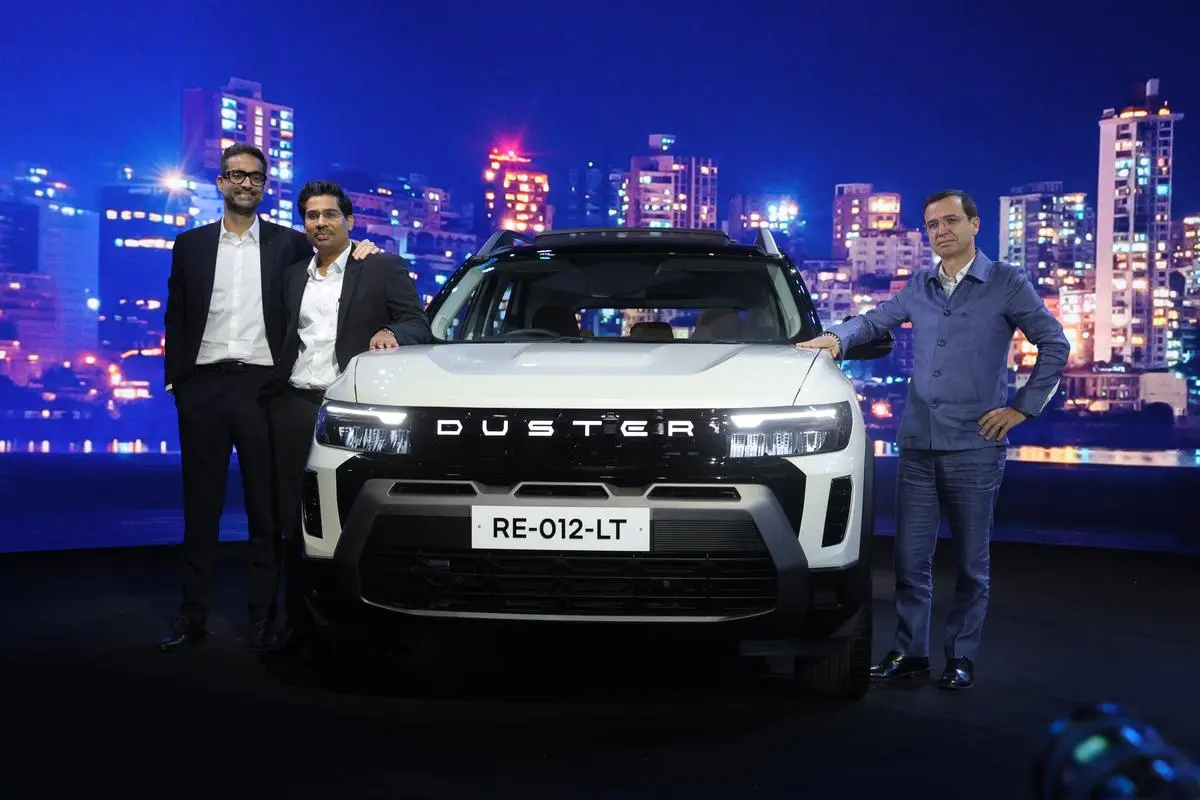
Renault’s Duster Strong Hybrid E-Tech 160 enters India’s strong-hybrid passenger-vehicle market, estimated at 1.23 lakh units in FY26, with a starting price of ₹16.99 lakh and claimed mileage of 29 km/l. The French automaker is targeting diesel SUV buyers as it challenges Toyota and Maruti Suzuki.
With Renault’s retail market share below 1 per cent, the Duster must convert its fuel-efficiency advantage into sustained sales against established Toyota and Maruti Suzuki hybrids and diesel SUVs backed by stronger dealership networks and customer loyalty.
The Duster is priced ₹31,000 above the entry-level Maruti Suzuki Grand Vitara Strong Hybrid at ₹16.68 lakh and broadly in line with Toyota’s Urban Cruiser Hyryder Strong Hybrid, priced from around ₹16.81 to 17.18 lakh. However, its 1.8-litre petrol engine and dual-motor system deliver 160 PS, against 116 PS from the 1.5-litre hybrid systems in both rivals. Renault also claims better mileage than their 27.97 km/l, while its 1.4-kWh battery enables electric-only operation for up to 80 per cent of city driving time, depending on conditions.
Speaking to reporters after the launch, Renault Group India Chief Executive Officer Stéphane Deblaise said the hybrid would expand the Duster’s customer base beyond its petrol variants, allowing it to compete more directly for diesel SUV buyers.
Strong-hybrid registrations rose 9.5 per cent to 86,403 units during January–September 2026, from 78,881 a year earlier, according to previously compiled vehicle-registration data. Despite the growth, the category remains a small part of India’s passenger-vehicle market.
Diesel alternative
During the media roundtable, Deblaise positioned strong hybrids as an alternative to diesel vehicles, citing fuel efficiency, lower total cost of ownership and driving refinement. He said consumers could not move overnight from internal-combustion vehicles to battery-electric cars.
Renault said it has sold more than one million vehicles equipped with its hybrid technology globally, providing an established technology base for its India introduction.
Product offensive
The launch is part of Renault’s seven-model roadmap through 2030, spanning petrol, CNG, strong-hybrid and electric vehicles across two platforms. The company is preparing the sub-four-metre Bridger SUV for late 2027, followed by an electric model expected in 2028.
Management, however, clarified that there are no immediate plans to introduce the Duster’s hybrid system in smaller models such as the Kwid, Triber and Kiger. Adapting the technology would require significant engineering and packaging changes, Deblaise said.
Renault is also expanding its CNG offerings and targeting up to 90 per cent localisation across future product programmes to improve cost competitiveness. It has outlined an ambition of €2 billion in annual exports by 2030, covering vehicles, components and engineering services.
Ownership challenge
Beyond pricing and efficiency, Renault must address concerns over hybrid maintenance, battery reliability, spare-parts costs and service accessibility.
During the post-launch interaction, Deblaise acknowledged gaps in service infrastructure and parts pricing, saying Renault was examining additional localisation opportunities while strengthening existing facilities and dealer training.
With Renault’s retail market share below 1 per cent, the Duster must convert its fuel-efficiency advantage into sustained sales against established Toyota and Maruti Suzuki hybrids and diesel SUVs backed by stronger dealership networks and customer loyalty.