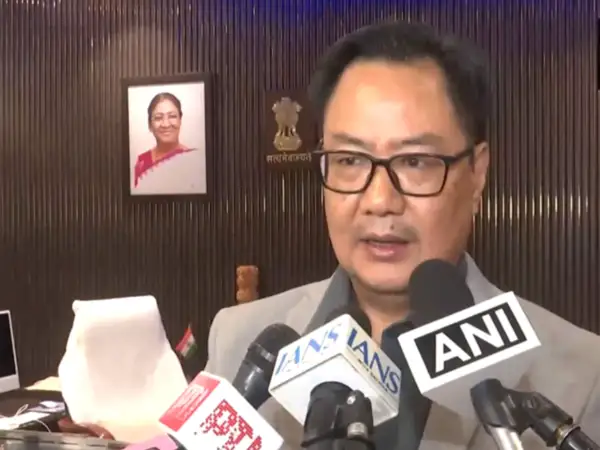
Parliamentary and Minority Affairs Minister Kiren Rijiju on Saturday firmly declared that India’s democratic regime is determined by public mandate through elections, rejecting any attempt to force unconstitutional political upheaval.
In a post on X, he strongly condemned the rhetoric, accusing political rivals and activists of trying to incite chaos and destabilise democratically elected constitutional institutions under the guise of street protests.
Rijiju stated that “India is not Bangladesh” and asserted that the country’s youth are focused on building the nation rather than pulling it down.
“बड़े आए ‘Regime Change’ करने वाले !! कान खोलकर सुन लो, भारत बांग्लादेश नहीं है! (Look at those plotting ‘regime change’!! Listen loud and clear, India is not Bangladesh!),” Rijiju said.
Underlining that Indian youth are channelising their potential toward nation-building, the Union Minister emphasised their contributions across startups, sports, and technological innovation.
“Indian youth are not fools; they will build India, not destroy India. All genuine Indian youth are winning medals, steering in skilling, innovation, startups, technology & becoming cultural icons!” he wrote.
This comes after Senior Advocate Prashant Bhushan, AISA (All India Students Association) president Neha Bora, and Congress spokesperson Pawan Khera publicly used or discussed the phrase “regime change” during conferences and press addresses in Delhi in the context of the ongoing protests against Chief Election Commissioner Gyanesh Kumar over the alleged irregularities in the Special Intensive Revision (SIR) of electoral rolls.
Student activists (including Neha Bora at the Socialist Students Front conference) made references to the Gen-Z student-led political uprising in Bangladesh that ousted Prime Minister Sheikh Hasina.
The national capital has witnessed a series of Tricolour marches in recent days, with opposition factions and civil society groups taking to the streets waving the Indian national flag as a symbol of their protest.
The use of the Tricolour during street demonstrations has triggered a sharp political exchange. BJP leadership has accused opposition groups of using the national flag as a shield for political agitation and creating anarchy in the heart of the city.
Countering the opposition’s narrative, BJP President Nitin Nabin drew a distinction between protest marches and official national pride campaigns. He pointed out that opposition parties had stayed away from initiatives like ‘Har Ghar Tiranga’, while now using the flag for street protests.
Nabin asserted that while BJP workers had historically marched to Srinagar’s Lal Chowk to hoist the Tricolour as a symbol of unity and national integration, the opposition was turning the same flag into a tool for disruption and political confrontation.
Defence Minister Rajnath Singh has accused the opposition party, Congress, and its allies of attempting to replicate a Bangladesh-style political upheaval in India, alleging that the protests were aimed at creating unrest rather than addressing electoral reforms.
“Attempts are being made to turn the country’s youth into pawns of anarchic politics. Regime change is being pursued on the lines of Bangladesh,” Singh said in a press conference in Lucknow.
BJP national spokesperson Pradeep Bhandari also criticised Congress leader P Chidambaram over his remarks defending the use of the phrase “regime change”, alleging that taking inspiration from Bangladesh was not democratic and exposing the Opposition’s “anarchy”.
Chidambaram had questioned the BJP’s reaction to the phrase “regime change”, describing it as a normal political process in a democracy.
In a post on X, the Congress leader said, “Why is the BJP apoplectic with feigned rage at the use of the phrase ‘regime change’? ‘Regime change’ is normal in a democracy.”